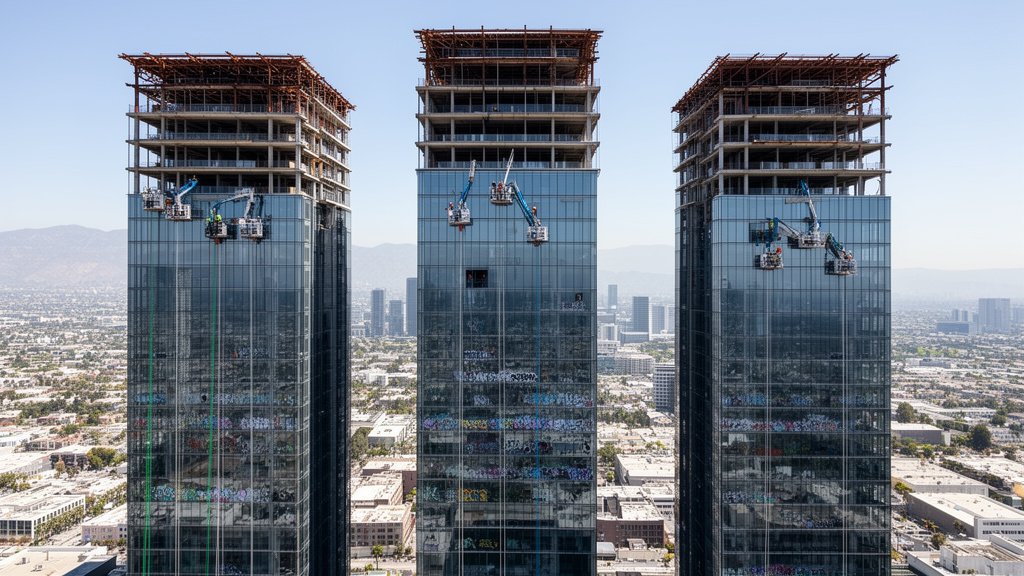
The skeleton of the unfinished Oceanwide Plaza in downtown Los Angeles, which spent much of 2024 as a towering canvas for vandals, is finally undergoing a scrub-down. Cleanup crews have descended upon the three massive skyscrapers, marking a pivotal moment in the saga of a project that spiraled from a $1 billion luxury ambition into the city’s most recognizable symbol of urban decay.
Key Highlights
- Site Status: The three towers at 1101 S. Flower St. are currently being cleaned after months of intense pressure from local officials and residents.
- The Catalyst: The cleanup is a court-mandated action following the bankruptcy of developer Oceanwide Holdings, aimed at securing the site and reducing liability.
- History: Construction on the $1 billion project halted in 2019, leaving the site abandoned for half a decade before it became a magnet for graffiti artists in early 2024.
- Objective: The current operation focuses on mitigating safety hazards and restoring the building’s exterior, though its long-term future remains uncertain.
Reclaiming the Skyline: The Restoration of Oceanwide Plaza
The silence that once defined the dead zone at 11th Street and Flower Street in downtown Los Angeles is being broken. For months, the three hulking, glass-clad towers—known colloquially as the ‘Graffiti Towers’—loomed over the city center, completely covered in layers of spray paint, tags, and street art that gained international notoriety. Today, that narrative is shifting. Industrial cleanup crews have initiated a systematic removal process, scaling the structures to tackle the vast accumulation of graffiti that plastered the glass curtain walls from the ground floor to the upper reaches of the steel-framed giants.
This is not a cosmetic choice, but a legal and financial necessity. The site has been under the jurisdiction of a court-appointed receiver as the fallout from the developer’s bankruptcy continues to wind through the legal system. The move to clean the towers addresses persistent safety concerns raised by the LAPD and the L.A. City Council, who had long argued that the open-access nature of the site, compounded by the visual blight of the graffiti, posed a significant public nuisance.
A Decade of Failure: From Luxury to Liability
To understand the significance of the current cleanup, one must look back at the original vision for Oceanwide Plaza. Billed as a massive, $1 billion mixed-use development, it was meant to feature high-end luxury condominiums, a Park Hyatt hotel, and expansive retail space. However, construction ceased abruptly in 2019 when Oceanwide Holdings, a Chinese development conglomerate, ran out of funding. For five years, the structures sat as concrete shells—a stark reminder of the volatility of international real estate speculation.
By early 2024, the site had transitioned from a ghost of the construction boom into a full-scale urban phenomenon. Base jumpers, urban explorers, and graffiti artists treated the towers as an unauthorized playground. Videos of the tags went viral on social media, turning the towers into a tourist attraction of sorts, but for local officials, the situation became untenable. The cost of securing the site became a contentious point in the bankruptcy proceedings, with the city pushing for the owners to foot the bill for security and cleaning.
The Logistics of the Scrub-Down
Removing tags from a skyscraper of this magnitude is a Herculean task. The current cleanup efforts are focused on the most visible aspects of the vandalism. Using high-access equipment and specialized cleaning solutions, crews are painstakingly working to clear the glass exterior. This process is complicated by the nature of the graffiti itself, which in many areas was applied directly to the glass panels, requiring chemical solvents that won’t damage the structural integrity of the window seals or the remaining exterior cladding.
However, officials emphasize that this is a stabilization effort, not a construction restart. The goal is to return the site to a state where it is no longer an active hazard or an aesthetic blight, effectively ‘resetting’ the building’s exterior while legal and financial entities determine the site’s ultimate fate. Whether this leads to a potential sale of the project to a new developer remains the billion-dollar question.
The Future of the Flower Street Site
While the graffiti is being removed, the fundamental issue remains: what to do with three, partially finished skyscrapers that have been exposed to the elements for years? The site is currently a ‘distressed asset’ in the eyes of the real estate market. The cost to complete construction, based on current interest rates and construction labor costs, is estimated to be hundreds of millions of dollars.
Experts suggest that the current cleanup is a prerequisite for any future sale. No investor or developer would touch a site that is a public spectacle and a magnet for criminal activity. By clearing the exterior, the court-appointed receiver is effectively cleaning the balance sheet—at least in appearance—to make the asset more attractive to potential buyers. It is a necessary, albeit late, step in closing the book on this chapter of Downtown L.A.’s architectural history.
FAQ: People Also Ask
Q: Who is paying for the cleanup of the Oceanwide Plaza graffiti?
A: The cleanup costs are being managed through the court-appointed receivership overseeing the bankruptcy of the property. The funds are being drawn from the bankruptcy estate assets, a move that was heavily pressured by the Los Angeles City Council to avoid the city taxpayers covering the expense.
Q: What happens to the Oceanwide Plaza towers after they are cleaned?
A: After cleaning, the site remains in limbo. The ultimate goal of the receivership is to secure the property for a potential sale to a new developer, though a buyer has not yet been named or finalized.
Q: Why was the graffiti removal delayed for so long?
A: The delay was primarily a result of complex bankruptcy litigation. Because the ownership of the site was tied up in legal proceedings involving international developers, there was no clear entity responsible for the immediate upkeep or security costs, leading to a bureaucratic stalemate that lasted for months.
Q: Can the public enter the site now that it is being cleaned?
A: No. The site remains strictly off-limits and is considered private property. Unauthorized entry is classified as trespassing, and the site is under active security monitoring to prevent new vandalism.