
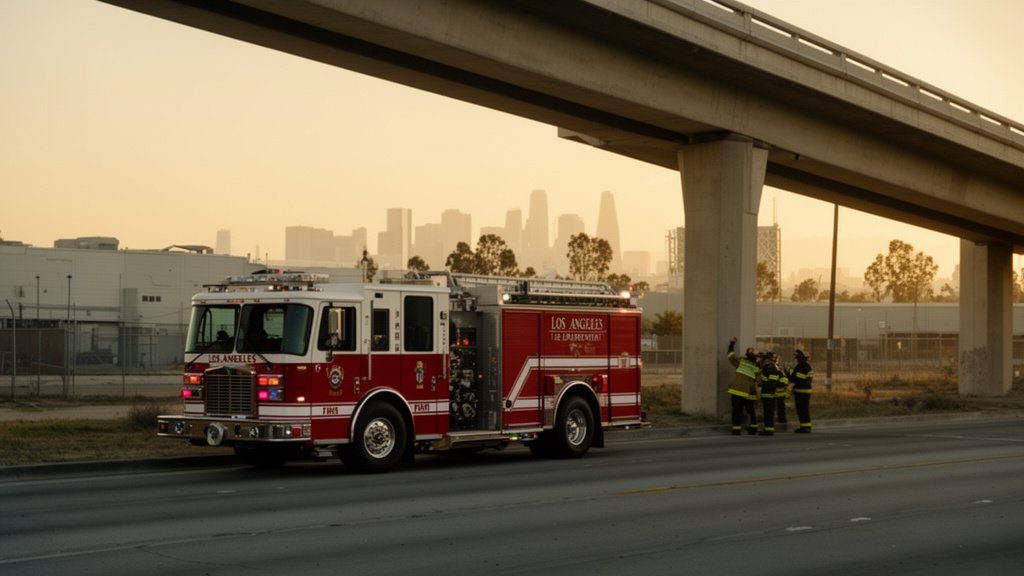
A sharp, sudden jolt interrupted the early morning silence for residents across the Los Angeles area on Friday, as a 4.2-magnitude earthquake centered near the industrial hub of Commerce provided a jarring wake-up call for millions. The tremor, which struck at an early hour, sent shockwaves through the basin, prompting immediate action from emergency services and triggering the standardized protocols essential for a city built upon a complex network of fault lines. While the seismic event resulted in no significant structural damage or injuries, it underscored the persistent vulnerability of the region and the efficacy of modern emergency response systems.
Key Highlights
- Magnitude & Location: A 4.2-magnitude earthquake was recorded with its epicenter located in the vicinity of Commerce, California.
- Emergency Protocol: The Los Angeles Fire Department (LAFD) immediately initiated its standardized “earthquake mode,” deploying resources to survey critical infrastructure and high-rise structures.
- Impact Assessment: Despite the intensity felt by residents, official reports confirm no major property damage, utility failures, or physical injuries.
- Seismic Context: The event occurred in a region known for complex fault systems, renewing discussions about earthquake preparedness in Southern California.
Understanding the Friday Morning Jolt
The earthquake, occurring in the early hours of Friday, was felt by residents from the heart of downtown Los Angeles to the outer suburbs. For many, the experience was characterized by the distinctive “rolling” or “jerking” motion associated with shallow seismic events in the LA Basin. While a 4.2 magnitude is classified as a light-to-moderate earthquake, its proximity to densely populated industrial and residential areas made it significant enough to command the attention of both local authorities and the public.
The LAFD Response: Anatomy of a Protocol
In the minutes following the tremors, the Los Angeles Fire Department executed its “earthquake mode” protocol. This is a crucial procedural standard that separates modern disaster management from reactive, chaotic responses. In this phase, the department does not wait for 911 calls to accumulate. Instead, designated personnel are dispatched to perform a tactical survey of high-risk infrastructure. This includes checking the structural integrity of freeway overpasses, inspecting utility lines for potential ruptures, and conducting aerial assessments via helicopter when necessary. The fact that the LAFD cleared the area without incident shortly after the event speaks to the robustness of these standing procedures.
The Fault Lines Under Our Feet
Geologically, the area near Commerce is situated in a region influenced by the Puente Hills Thrust fault system. This system is a blind thrust fault—meaning it does not break the surface and cannot be easily mapped by visual inspection alone. Unlike the more famous San Andreas Fault, which is a strike-slip fault that slides horizontally, the Puente Hills system is compressional, meaning it pushes the crust upward. Even smaller quakes like this 4.2 event are critical indicators of the ongoing tectonic stress being accumulated in the basin. Geologists monitor these events not just for their immediate impact, but for what they reveal about the rate of crustal shortening and the accumulation of stress that could eventually be released in larger, more destructive events.
The Psychology of a City on Edge
Living in Los Angeles means living with a unique brand of low-level anxiety. Every earthquake, regardless of magnitude, reignites the collective consciousness regarding “The Big One.” When an event occurs early in the morning, it interrupts the rhythm of the city, often leading to a spike in social media activity and digital engagement. This “social seismology”—where citizens report their experiences in real-time on platforms like X (formerly Twitter) and the USGS “Did You Feel It?” portal—acts as a crowdsourced data layer that complements the hard scientific data provided by seismometers. This engagement is a vital component of public safety, as it creates a shared sense of community awareness and reinforces the necessity of having “Go Bags” and structural retrofitting complete.
Evaluating Seismic Infrastructure
Beyond the immediate reaction, this 4.2-magnitude event serves as a stress test for the city’s retrofitting efforts. Over the past two decades, Los Angeles has mandated seismic upgrades for “soft-story” buildings—those with ground-floor parking or large glass storefronts that are prone to collapsing during lateral shaking. While this quake was not strong enough to test the full capacity of these retrofits, it provides a data point for engineers. By analyzing the wave propagation from this event, seismologists can better understand how different soil types in the LA basin amplify or dampen seismic energy. This data is fed back into building codes, ensuring that as the city grows, its structural defenses evolve.
FAQ: People Also Ask
Q: How does the “earthquake mode” of the LAFD work?
A: When an earthquake of a certain magnitude occurs, the LAFD automatically transitions into “earthquake mode.” This involves a pre-planned survey of the city’s terrain. Units are deployed to systematically check bridges, hospitals, water mains, and high-rise structures, bypassing normal 911 dispatch traffic to ensure critical infrastructure is safe before returning to regular service.
Q: Was this 4.2 earthquake a precursor to a larger “Big One”?
A: Seismologists emphasize that it is scientifically impossible to predict earthquakes. While small quakes occur daily in California, they do not necessarily indicate that a larger earthquake is imminent. Most small quakes are independent events or aftershocks of larger ones; they are rarely predictive of future activity.
Q: What should I do immediately after an earthquake like this?
A: After the shaking stops, check yourself for injuries. If you are indoors, stay there. Drop, cover, and hold on until the shaking stops. Once the event has passed, check for gas leaks or water damage. Turn off utilities if you suspect damage. Most importantly, avoid using the phone for non-emergency calls to keep lines open for first responders, and check local news for official updates.
Q: How is the magnitude of an earthquake determined?
A: Magnitude is measured using the Moment Magnitude Scale (MMS), which calculates the total energy released during an earthquake. It accounts for the size of the fault rupture and the amount of slip along the fault. This provides a more accurate reading than the older Richter scale, especially for larger earthquakes.