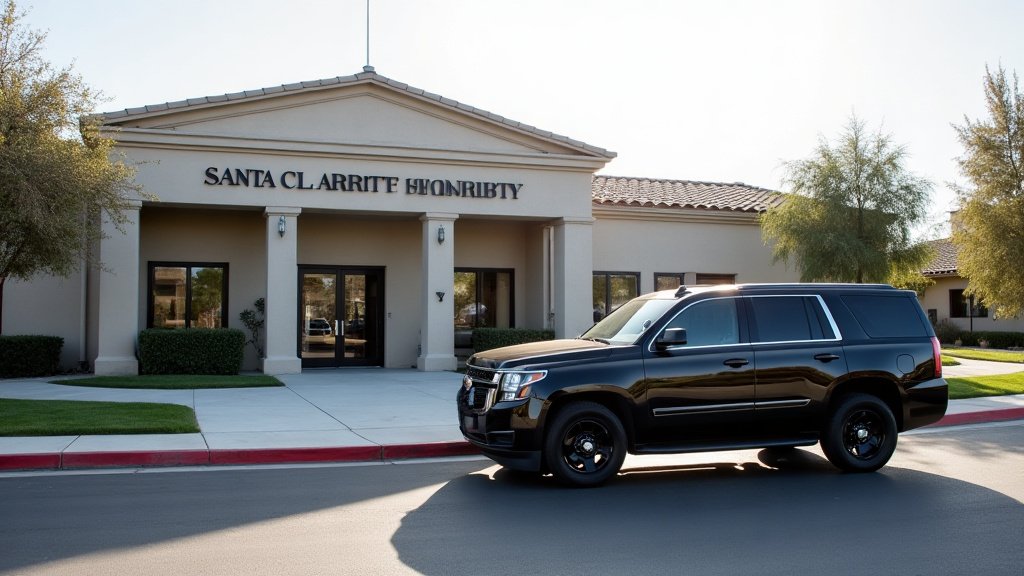
A viral video capturing an Immigration and Customs Enforcement (ICE) agent using a baton to shatter the rear window of a vehicle at the Santa Clarita Valley Sheriff’s Station has ignited a firestorm of public debate regarding federal enforcement tactics. The incident, which resulted in the detention of an unidentified individual, prompted immediate inquiries from local residents and news outlets alike. While the Los Angeles County Sheriff’s Department (LASD) was quick to clarify that they were not involved in the operation, the Department of Homeland Security (DHS) has remained largely silent, citing operational security as the reason for declining to provide further details.
Key Highlights
- Incident Details: Video footage shows an ICE agent deploying a baton to break the rear window of a vehicle, followed by the detainment of a man who was then placed into a black SUV.
- Location Conflict: The event occurred at the Santa Clarita Valley Sheriff’s Station, leading to public confusion regarding the involvement of local law enforcement.
- Official Response: The LASD confirmed the station was merely the location of the incident, distancing local deputies from the federal operation. DHS officials have declined to comment on specifics, invoking security protocols.
- Public Concern: The intensity of the tactics used in a public, semi-governmental space has raised questions about the boundaries of federal immigration enforcement actions in local communities.
Examining the Mechanics of Federal Enforcement in Local Spaces
The footage, which circulated rapidly across social media platforms, depicts a high-tension scenario in what is ostensibly a secure or semi-secure area near a sheriff’s station. For many residents of Santa Clarita, the presence of federal agents taking such drastic action—namely the destruction of personal property to facilitate an arrest—raises fundamental questions about how federal immigration enforcement intersects with local jurisdictions.
The Optics of Federal Intervention
Visual evidence of a baton-wielding officer shattering glass provides a visceral, unfiltered look at the reality of “at-large” immigration enforcement operations. Unlike coordinated raids that might involve local law enforcement cooperation, this event appeared to be a unilateral federal action. The deployment of a baton to gain entry to a vehicle is a force-escalation technique that carries significant legal and ethical weight. When such actions occur in the parking lot of a local law enforcement facility, it naturally creates the public perception that local agencies are complicit or assisting, even when, as in this case, the Sheriff’s department explicitly states otherwise.
The ‘Operational Security’ Shield
When queried by reporters regarding the specific circumstances of the arrest—including the identity of the detainee, the legal basis for the vehicle entry, and the nature of the operation—DHS officials offered a standard, albeit frustrating, response: operational security. This “sec-ops” defense is a double-edged sword. While it is designed to protect agents and the integrity of ongoing investigations, it leaves a significant information vacuum. In the absence of official communication, the public relies entirely on bystander video, which, while useful, lacks context regarding the legal “why” or “how” of the situation. This lack of transparency often erodes community trust, as the public is left to speculate on the necessity and proportionality of the force used.
The Jurisdictional Gray Zone
The tension between federal agencies like ICE and local law enforcement is not new, but it remains a complex and often misunderstood dynamic. The Santa Clarita incident underscores a critical reality: federal agents operate under a different set of mandates and directives than local police officers. Local sheriff’s stations, while appearing to be “neutral ground” or symbols of local authority, are not shielded from federal jurisdiction.
Federal Authority vs. Local Oversight
ICE agents possess the authority to conduct enforcement actions throughout the United States. They are not beholden to local policies that might limit local police from assisting in immigration enforcement. This creates a “jurisdictional gray zone” where residents might assume they are interacting with local deputies who follow local department policies, only to be engaged by federal officers whose protocols, training, and operational directives are entirely distinct. The public reaction to the Santa Clarita video is largely rooted in this confusion; when the line between “local” and “federal” is blurred, the accountability chain becomes difficult to trace for the average citizen.
The Impact of High-Visibility Tactics
Using force in a highly public area—such as a sheriff’s station parking lot—serves to heighten the visibility of these operations. While DHS may view this simply as an efficient location for an apprehension, the psychological impact on the community cannot be understated. It transforms a government building from a site of community safety into a potential flashpoint for federal detention. This can lead to a chilling effect, where community members may avoid interacting with local government facilities, fearing that federal agents might be waiting in the shadows or the parking lot.
Future Implications for Public Trust
As surveillance technology and smartphone usage continue to proliferate, incidents like the one in Santa Clarita will inevitably reach the public eye. This presents a growing challenge for federal agencies: the traditional “no comment” strategy may no longer be sufficient in an era of viral accountability.
The Need for Transparency
To maintain public order and community cooperation, there must be a middle ground. While “operational security” is a valid concern, there must be a mechanism for post-incident transparency. When an aggressive physical act, such as smashing a vehicle window, is captured on camera, failing to provide context allows the public to fill the void with their own narratives, which can range from suspicion of abuse of power to outright fear of government overreach.
Evolving Policy Requirements
Looking forward, legislative bodies may face increasing pressure to clarify the rules of engagement for federal agents in public spaces. Are there limitations to using destruction-of-property tactics in non-emergency situations? Does the proximity to a local law enforcement facility require a higher threshold for coordination? These questions will likely dominate the conversation in the coming months as local governments grapple with how to respond to constituents who are increasingly unsettled by federal operations occurring in their backyard.
FAQ: People Also Ask
1. Why was an ICE agent at a Sheriff’s station?
ICE agents have the authority to operate anywhere in the U.S. They do not need the permission of local law enforcement to conduct operations, and they often choose locations that offer operational advantages, though this specific location caused confusion regarding the involvement of local deputies.
2. Did the Sheriff’s Department participate in the arrest?
No. The Los Angeles County Sheriff’s Department clarified that they were not involved in the operation. The use of their facility as a backdrop for the incident was the federal agency’s own operational choice, separate from local law enforcement activities.
3. Is it legal for ICE to break a car window to detain someone?
While federal agents generally need a warrant to enter private property or a vehicle, there are specific legal exceptions regarding “exigent circumstances” or specific law enforcement authorities. The legality of this specific action would be subject to internal review and potential legal challenge.
4. Will there be an investigation into the agent’s conduct?
DHS has declined to disclose details, citing security. Typically, federal agencies conduct internal reviews of force incidents, but these are rarely released to the public unless there is significant political or legal pressure to do so.