Summary Lead
In a stark reminder of the escalating risks to global commerce, the Port of Los Angeles has reported a massive, unprecedented surge in cybersecurity threats, successfully blocking 120 million attempted cyberattacks during the month of August alone. This figure, representing nearly double the monthly average recorded throughout 2023, underscores the vulnerability of critical maritime trade hubs to sophisticated digital incursions. As global reliance on digitized logistics networks increases, the battle for the security of US ports has shifted from the physical docks to the frontlines of cyberspace, where malicious actors are probing deep into network architectures to identify and exploit infrastructure weaknesses.
Key Highlights
- Unprecedented Volume: The Port of Los Angeles successfully mitigated 120 million cyberattack attempts in August, a massive escalation in frequency compared to the previous year.
- Doubling Down: The August surge effectively doubled the monthly average of cyber-incidents observed by the port’s security operations in 2023.
- Systemic Vulnerabilities: Hackers are increasingly targeting Operational Technology (OT) networks that manage critical cranes, gate operating systems, and automated terminals.
- National Security Implication: The frequency of these attacks highlights a growing threat to the broader US maritime transportation system, necessitating stronger partnerships with agencies like CISA.
The Digital Siege on America’s Maritime Gateways
The maritime industry, long viewed as the backbone of the global economy, is currently facing a dual challenge: the physical demands of moving record volumes of cargo and the invisible, unrelenting pressure of cyber-warfare. The recent report from the Port of Los Angeles—which acts as the busiest container port in the Western Hemisphere—is not merely an isolated incident of high traffic; it is a signal of a systemic shift in how infrastructure is being targeted.
The Anatomy of an Infrastructure Attack
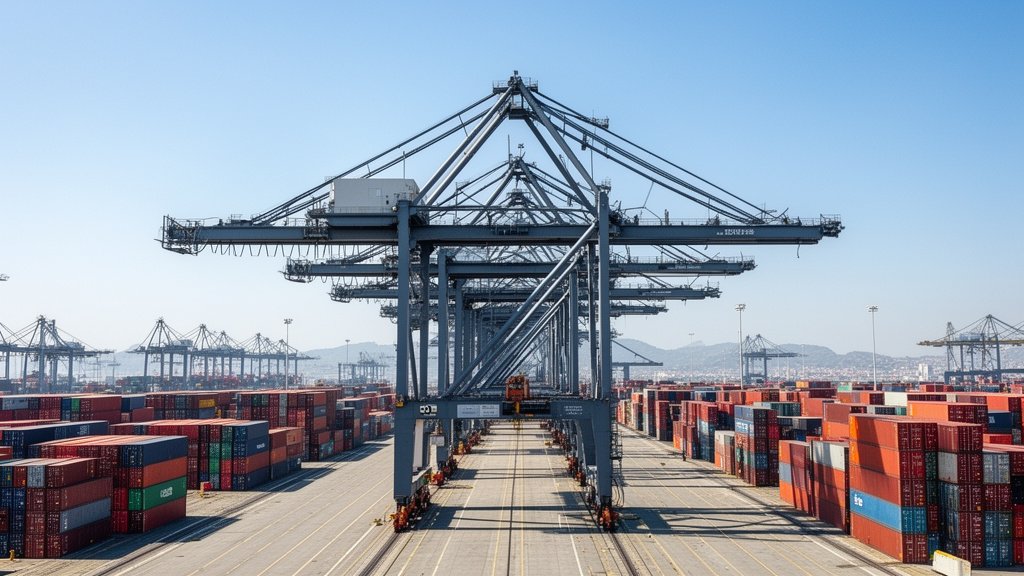
Cyberattacks on ports are rarely simple attempts to crash a website. Instead, sophisticated actors—ranging from nation-state advanced persistent threats (APTs) to organized ransomware syndicates—are targeting specific industrial control systems. These systems, often referred to as Operational Technology (OT), are the digital nervous system of the port. They control the automated gantry cranes that stack containers, the terminal operating systems that track cargo movement, and the gate infrastructure that manages truck entry and exit.
When these systems are compromised, the impact is immediate and physical. A successful breach doesn’t just result in data loss; it halts the movement of goods, creates backlogs that ripple through global supply chains, and can jeopardize the integrity of dangerous or perishable cargo. The 120 million attempts reported in August suggest an environment of persistent automated probing, where attackers continuously scan for unpatched software, weak credentials, or misconfigured network entry points.
Why the Surge? The Evolution of ‘Smart Ports’
The drive for efficiency in global trade has led ports to adopt ‘Smart Port’ technologies, utilizing IoT sensors, 5G connectivity, and AI-driven automation to maximize container throughput. While these technologies are essential for maintaining competitiveness in an era of ‘just-in-time’ logistics, they have also dramatically expanded the attack surface.
Before the digitalization of the docks, an attack required physical proximity. Today, the perimeter is porous and global. Every sensor on a smart container, every digital manifest upload, and every automated truck gate represents a potential vector for entry. As the Port of Los Angeles modernizes to handle increased volume, the complexity of its network security must evolve at an equal or faster pace to outmaneuver increasingly capable adversaries.
The Strategic Role of Federal Collaboration
Recognizing the threat, the collaboration between private port operators and federal agencies, particularly the Cybersecurity and Infrastructure Security Agency (CISA), has become critical. The federal government has increasingly focused on maritime cybersecurity as a pillar of national security. This involves real-time intelligence sharing, where the patterns identified in attacks against the Port of Los Angeles are cross-referenced with data from other critical infrastructure sectors to prevent widespread contagion.
This intelligence-sharing model is vital because it transforms individual ports from isolated fortresses into a collective defensive network. By analyzing the 120 million blocked attempts, security experts can identify the specific signatures, IP ranges, and tactics (TTPs) used by attackers, effectively creating digital vaccines to immunize the entire maritime network against similar future incursions.
Economic Resilience in an Age of Disruption
Beyond the technical statistics, the economic implications are profound. A major cyber-disruption at a gateway like Los Angeles could result in hundreds of millions of dollars in lost trade per day. In a post-pandemic world where the fragility of the supply chain has been laid bare, port authorities and shipping conglomerates are now treating cybersecurity as a core operational expense, akin to dock maintenance or labor costs. The transition toward a zero-trust architecture, where no device or user is trusted by default, is no longer theoretical—it is becoming the standard for the modern maritime terminal.
FAQ: People Also Ask
Q: What is an OT network, and why is it targeted at ports?
A: Operational Technology (OT) networks control physical machinery like cranes and gate sensors. They are targeted because disrupting these systems causes physical halts in operations, creating maximum disruption to trade, which provides high leverage for attackers.
Q: How does a port ‘block’ 120 million attacks?
A: Ports utilize sophisticated enterprise-grade firewalls, intrusion detection systems (IDS), and AI-driven traffic analysis that filter incoming network requests. The vast majority of these ‘attacks’ are automated botnet probes seeking low-hanging fruit, which are mitigated automatically by the port’s defensive perimeter.
Q: Are these attacks being linked to specific nation-states?
A: While the Port of Los Angeles has not publicly attributed the August attacks to a specific state actor, the complexity, persistence, and volume are consistent with state-sponsored reconnaissance operations that seek to map critical infrastructure for future leverage or sabotage.
Q: What happens if a cyberattack succeeds at a major port?
A: A successful breach could lead to operational paralysis, delayed cargo processing, supply chain bottlenecks, and potential leaks of sensitive commercial data. This is why investment in resilience and disaster recovery protocols is currently the highest priority for port administrators.