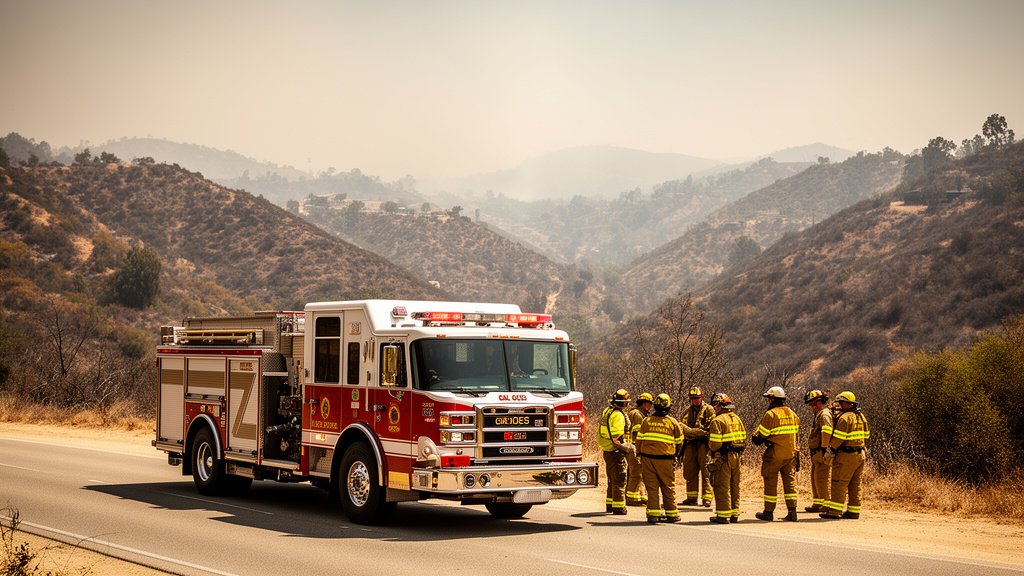
The California Governor’s Office of Emergency Services (Cal OES) has officially activated a tactical prepositioning plan, positioning a suite of critical firefighting resources—including engines, water tenders, and specialized hand crews—directly within Los Angeles County. This mobilization, spanning from July 23 to July 25, marks a decisive intervention in the face of a high-stakes meteorological event. A persistent, long-duration heat wave has combined with plummeting humidity levels and erratic, gusty winds to create a volatility profile that emergency planners identify as a peak threat for rapid wildfire ignition and spread.
The Shift to Predictive Suppression
The prepositioning of assets is a cornerstone of modern wildfire management in California. By moving heavy equipment and highly trained personnel into the heart of high-risk zones before a fire event occurs, Cal OES effectively compresses the ‘response time’ variable in the fire-suppression equation. When the window for initial attack—the critical period where a small spark can be contained before becoming a landscape-consuming conflagration—shrinks due to environmental factors, positioning crews at the ‘doorstep’ is no longer a luxury; it is a necessity.
In Los Angeles County, the topography alone presents a formidable challenge. With urban-wildland interfaces (WUI) that abut dry, fire-prone chaparral and steep canyons, the region is uniquely vulnerable. The current heat wave, characterized by sustained high temperatures that strip moisture from vegetation, makes fuels exceptionally ‘ready’ to ignite. Adding gusty winds to this mix creates a ‘perfect storm’ scenario where fire behavior becomes unpredictable and rapid. The deployment of water tenders and hand crews is specifically designed to address these distinct threats: engines provide structural protection, while hand crews are essential for building containment lines in terrain where heavy machinery cannot tread.
Operational Doctrine and Asset Deployment
To understand the magnitude of this deployment, one must look at the standard operating procedure for Cal OES. This is not merely a precautionary measure; it is a calculated deployment based on data modeling. The agency continuously monitors weather telemetry from sources like the National Weather Service, looking for specific thresholds—humidity levels below a certain percentage, wind speeds exceeding critical knots, and temperature indices that exceed local averages for the date.
When these metrics are breached, as they have been during this July 23–25 window, Cal OES initiates a mobilization. These resources are drawn from local fire departments and county agencies throughout the state, forming ‘Strike Teams.’ These teams are highly mobile, self-sufficient units capable of operating independently for the duration of the deployment. By centralizing these assets in Los Angeles, Cal OES ensures that when an ‘all-hands’ call goes out, response times are measured in minutes rather than hours. This logistical pivot relies heavily on Incident Command System (ICS) protocols, which coordinate the disparate agencies to function as a singular, cohesive force.
Secondary Angle: The Evolution of Heat-Induced Fire Risk
The current heat wave serves as a stark reminder of the changing nature of California’s fire season. Historically, the state saw distinct ‘dry’ and ‘wet’ seasons, with fires peaking in the late autumn due to Santa Ana winds. However, modern climate trends have introduced longer, hotter summers that extend the risk period. Heat-induced fire risk is distinct from wind-driven risk; it relies on the ‘fuel moisture’ content of vegetation. When prolonged heat evaporates all internal moisture from brush and trees, the forest essentially becomes dry tinder. This phenomenon is increasing the frequency of summer-based fire mobilizations, forcing Cal OES to maintain a higher state of readiness for longer periods than previously budgeted.
Secondary Angle: Economic Impact of Pre-Positioning
While the cost of prepositioning is significant—involving overtime pay, fuel, maintenance, and the displacement of personnel—the economic rationale is overwhelmingly clear. The ‘pre-positioning’ model represents a massive cost-saving strategy when compared to the alternative. A single large wildfire in the Los Angeles region can result in hundreds of millions, if not billions, of dollars in direct property damage, infrastructure loss, and suppression costs. By spending funds to place assets in the field for 72 hours, the state is effectively purchasing a form of ‘insurance.’ The cost of preventing a catastrophic blaze is a fraction of the cost of managing the aftermath of a major disaster, making this proactive stance the primary economic defense against climate-driven fire risks.
Secondary Angle: The Human Factor in ‘Red Flag’ Conditions
Behind every prepositioned engine and hand crew is a human element that often goes unheralded. Firefighters in these units are operating in the same brutal heat and humidity that increase the fire risk. This creates a dual burden: the physical exhaustion of fighting potential fires in extreme temperatures, and the psychological weight of standing ready, knowing that a single shift in the wind could turn a quiet day into a life-threatening inferno. The prepositioning strategy also accounts for this, as it allows for the rotation of crews, ensuring that when the call comes, the teams are as rested as possible and fully equipped to maintain focus during complex and rapidly evolving incidents.
FAQ: People Also Ask
Q: What does ‘prepositioning’ mean in firefighting terms?
A: Prepositioning refers to the strategic movement of fire suppression resources (engines, crews, aircraft, water tenders) into high-risk areas before an actual emergency begins, based on weather forecasts, to ensure immediate response if a fire starts.
Q: Why is Los Angeles County specifically targeted for this deployment?
A: Los Angeles County is targeted due to its unique combination of dense population centers, wildland-urban interface (WUI) areas, and rugged, steep terrain. Coupled with current high-heat and low-humidity ‘Red Flag’ conditions, it presents one of the highest ignition-to-catastrophe risk profiles in the state.
Q: How do citizens know if they are at risk during these heat waves?
A: Residents should monitor local ‘Red Flag Warning’ alerts issued by the National Weather Service and check their local county’s emergency management website for evacuation orders. Staying informed through official Cal OES or local fire department social media channels is recommended.
Q: Are these resources only from Cal OES?
A: No, these are often mutual aid resources. Cal OES coordinates and manages the assets, but the engines, crews, and specialized equipment are frequently sourced from local municipal fire departments across California that have been tapped to support the regional surge capacity.