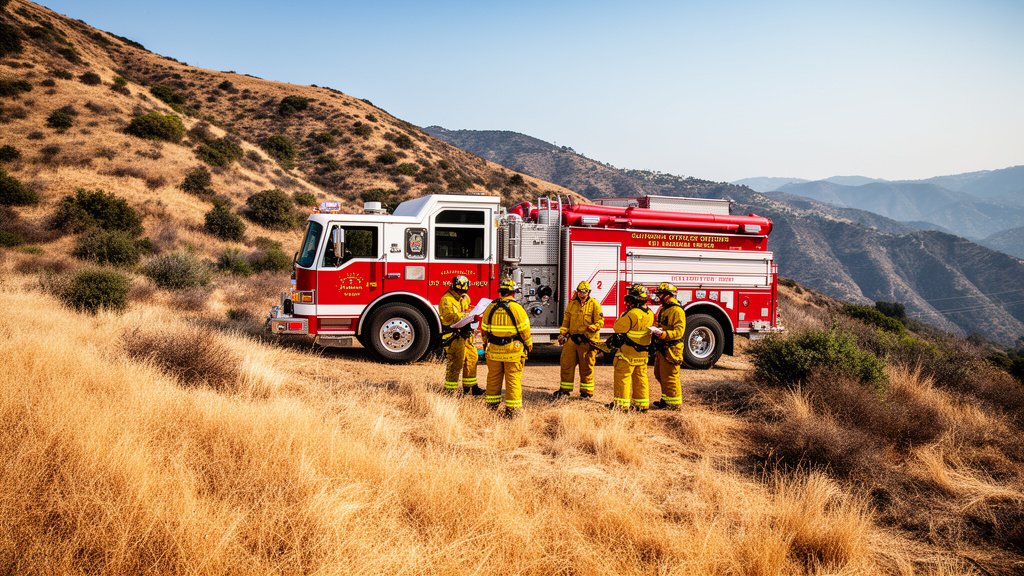
In a strategic shift toward proactive disaster management, the California Office of Emergency Services (Cal OES) has officially prepositioned essential firefighting resources throughout Los Angeles County. This tactical maneuver comes in direct response to a meteorological forecast predicting severe hot, dry, and windy conditions—a combination that historically serves as a catalyst for catastrophic, fast-moving wildfires across Southern California. By placing personnel and equipment in high-risk zones before the ignition of a fire, the state aims to slash response times and contain potential blazes in their infancy, before they can escalate into landscape-altering emergencies.
Key Highlights
- Strategic Deployment: Cal OES has surged specific firefighting assets into Los Angeles County, including frontline engines, a dedicated water tender, a specialized hand crew, and a rapid-response dispatcher.
- Weather-Driven Tactics: The mobilization is a direct result of predictive modeling showing extreme fire weather—defined by high heat, low humidity, and significant wind gusts—which increases the probability of ignition and rapid fire spread.
- Response Time Optimization: The goal of ‘prepositioning’ is to ensure that assets are already on-site or nearby, effectively neutralizing the ‘travel time’ penalty during the critical initial attack phase of a wildfire.
- Operational Coordination: The effort integrates state-level Cal OES resources with local jurisdiction agencies, such as the Los Angeles County Fire Department, to form a unified, multi-agency incident response framework.
The Strategic Architecture of Wildfire Prepositioning
In the era of climate-exacerbated wildfire seasons, the doctrine of California’s emergency management has shifted from reactive response to proactive defense. The decision to preposition resources in Los Angeles County is not merely a precautionary measure; it is a calculated operational decision based on the Incident Command System (ICS) methodology. When the National Weather Service issues warnings regarding ‘Red Flag’ weather conditions—characterized by a trifecta of low relative humidity, high temperatures, and sustained winds—Cal OES executes a pre-planned mobilization of personnel and hardware.
Dissecting the Asset Mix
The specific assets deployed into the region are chosen for their versatility in wildland and wildland-urban interface (WUI) environments. Engines provide the primary suppression capability, acting as mobile command and water delivery units. The inclusion of a water tender is particularly critical in rural or mountainous segments of Los Angeles County, where municipal hydrant infrastructure is non-existent. Without a water tender, suppression efforts rely entirely on water stored within the engine or aircraft drops, which are subject to availability and flight restrictions.
Furthermore, the hand crew serves as the ‘boots on the ground’ for rugged terrain where heavy equipment cannot traverse. These crews utilize hand tools—Pulaskis, McLeods, and shovels—to cut fire lines and remove fuel, preventing the fire from advancing. The presence of a dedicated dispatcher is equally vital; they manage radio traffic, track personnel location in real-time, and coordinate mutual aid if the incident grows, preventing the ‘radio congestion’ that often plagues early-stage fire suppression operations.
The Meteorological Trigger
The environmental context for this deployment is rooted in specific atmospheric patterns that plague the Southern California basin. During the autumn and winter months, pressure differentials between the Great Basin and the California coast can drive ‘Santa Ana’ winds—warm, desiccating gusts that dry out vegetation, bringing moisture levels into the single digits. When these winds align with existing dry vegetation, the potential for fire ignition increases exponentially. By monitoring these triggers, Cal OES effectively creates a ‘buffer zone’ of safety, positioning assets in areas with the highest fuel load and historical fire frequency.
Evolutionary Shifts in Fire Management Doctrine
Historically, wildfire management in the United States operated on a ‘call-out’ basis: resources were mobilized only after a 911 call confirmed smoke. However, the paradigm shift toward prepositioning recognizes that in high-wind conditions, the first 60 minutes of a fire—the ‘initial attack’—are the most important. If a fire can be contained within the first hour, the economic, ecological, and human costs are significantly mitigated. This strategy, while expensive in terms of personnel hours and overtime pay, represents a massive cost-saving measure when compared to the multi-billion-dollar price tags associated with uncontrolled urban-interface megafires.
The Economic and Ecological Calculus
The economic implications of this proactive stance are profound. Prepositioning resources involves significant taxpayer funding for overtime pay, fuel, and equipment maintenance. Yet, these costs are fractional compared to the property loss, insurance market volatility, and public health costs incurred by smoke inhalation and displacement caused by large-scale evacuations. Furthermore, by keeping wildfires small, the state protects critical infrastructure, including electrical grids and telecommunications towers that are often vulnerable during fire events. Ecologically, this strategy helps reduce the total acreage burned, preserving carbon-sequestering biomass and protecting sensitive habitats that might otherwise be destroyed by high-intensity, wind-driven fires.
Public Preparedness and Local Agency Integration
While Cal OES provides the backbone of state-level support, the effectiveness of these resources depends on seamless integration with local agencies, most notably the Los Angeles County Fire Department. This integration involves unified command structures where state and local commanders share a common operating picture. Residents in these high-risk zones are encouraged to leverage this state-level awareness by maintaining their own ‘Ready, Set, Go’ preparedness plans. The state prepositioning effort serves as a critical stopgap, but it is not a substitute for personal preparedness; the agency emphasizes that residents should monitor local alerts, clear defensible space around homes, and remain vigilant during these high-risk weather windows.
FAQ: People Also Ask
Q: What exactly does ‘prepositioned’ mean in the context of firefighting?
A: It refers to the strategic movement of firefighting personnel, heavy equipment, and support units into high-risk areas before an incident occurs. Instead of deploying after a fire is reported, these resources are already stationed in the field, ready to respond instantly, thereby minimizing critical response times.
Q: How does Cal OES determine where to send resources?
A: They rely on advanced predictive analytics, including National Weather Service forecast models, historical fire data, vegetation moisture mapping, and current fuel loading conditions. When a ‘Red Flag’ warning is issued or high-risk thresholds are met, resources are allocated to the areas of highest predicted danger.
Q: Are these resources only from Cal OES?
A: No, these deployments are usually a collaborative effort. While Cal OES coordinates the state-level response and mutual aid, the resources may consist of personnel and equipment from various local, state, and sometimes federal agencies, all operating under a unified incident command structure.
Q: Does this mean a fire is definitely going to happen?
A: No. Prepositioning is a defensive, risk-reduction strategy. It is based on conditions that create the potential for fire, not on the certainty of an ignition. It is an insurance policy against high-risk meteorological events.