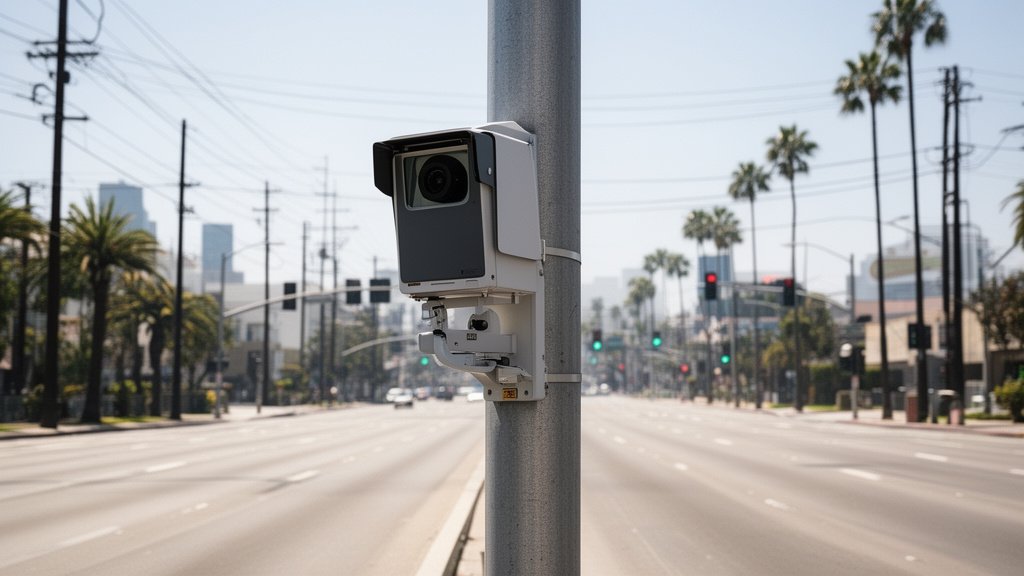
On Monday, October 26, the City of Los Angeles officially activated its first 20 speed safety cameras, signaling a transformative shift in how the municipality handles traffic enforcement. This rollout is the first phase of a broader pilot program designed to drastically reduce speeding and traffic-related fatalities on the city’s most dangerous thoroughfares. By automating the detection of excessive speeds, the Los Angeles Department of Transportation (LADOT) hopes to curb dangerous driving behaviors, specifically targeting locations identified as part of the city’s High Injury Network. For millions of L.A. drivers, the streets have just become a much more regulated environment, with technology now serving as the primary monitor for road safety.
Key Highlights
- Automated Enforcement: 20 new speed safety cameras are now active across Los Angeles.
- Threshold: Cameras capture rear license plates of vehicles traveling at least 11 mph over the posted speed limit.
- Grace Period: A 60-day warning period is currently in effect, during which drivers will receive warnings instead of monetary fines.
- Legislative Basis: The program is authorized under California Assembly Bill 645 (AB 645), specifically focused on the High Injury Network.
Understanding the Speed Safety System Pilot
The implementation of these 20 speed cameras is not merely a bureaucratic shift in traffic control; it is the culmination of years of legislative effort and urban planning aimed at achieving the city’s Vision Zero goals—a project intended to eliminate all traffic deaths and severe injuries on city streets. The Speed Safety System, as it is formally known, represents a shift away from traditional, resource-intensive human policing toward a data-driven, automated model of traffic enforcement.
The Legislative Backbone: AB 645
To understand the legality and mechanics of this rollout, one must look at California Assembly Bill 645. This legislation was essential in clearing the path for Los Angeles to deploy automated speed enforcement. For years, California law prohibited the use of automated speed cameras, citing privacy concerns and questions about due process. AB 645 was carefully crafted to address these issues, creating a strictly defined framework for how these cameras can be used. The bill limits the cameras to “High Injury Network” streets—roads where traffic data shows a statistically higher frequency of accidents involving injuries or fatalities. By focusing on these specific corridors, the city argues that the system is not a “revenue grab” but a targeted safety intervention.
The Technical Mechanics of Enforcement
The technology underpinning the L.A. Speed Safety System is designed for precision. Unlike human officers who rely on radar or lidar guns and visual judgment, these cameras utilize high-resolution optical character recognition (OCR) technology. When a vehicle passes a camera sensor at a speed exceeding the posted limit by 11 mph or more, the system triggers.
It captures the rear license plate, which is crucial for identifying the vehicle owner. The system then processes this data, cross-referencing it with vehicle registration databases. A key distinction in this rollout is the threshold; by setting the bar at 11 mph over the limit, the city is explicitly targeting “reckless” speeding rather than minor variances that often occur in flowing traffic. This threshold is intentional, aiming to penalize behavior that statistically correlates with a higher risk of fatal accidents.
The 60-Day Grace Period
In a strategic move to facilitate public adoption and minimize immediate economic shock, the city has implemented a 60-day warning period. Starting from the October 26 activation date, drivers caught by the cameras will not be fined. Instead, they will receive a formal warning notice in the mail. This period is designed to educate the public, allowing drivers to adjust their habits and become accustomed to the new enforcement infrastructure without the burden of immediate financial penalties. After these 60 days elapse, the program will transition to full enforcement, with citations carrying specific fines that increase based on the severity of the violation.
Secondary Angles: Future Implications and Economic Shifts
1. The Evolution of Commuter Culture: The introduction of these cameras will likely alter the driving culture in L.A. Historically, L.A. has been characterized by a “flow of traffic” mentality where speed limits were treated as suggestions. This system enforces a “rule-of-law” environment. Future data will likely show a shift in average speeds, and potentially a redistribution of traffic as drivers avoid camera-monitored streets.
2. Privacy and the Algorithmic City: The use of license plate scanning technology raises inherent questions about government surveillance. While the city has promised that the data is limited to traffic enforcement, privacy advocates continue to watch the program closely. The integration of this technology into the urban fabric creates a “digital dragnet” that could, in the future, be expanded for other administrative purposes, creating a new societal debate about the trade-off between safety and anonymity.
3. Economic Impact on Low-Income Drivers: A critical point of contention regarding the Speed Safety System is the disproportionate impact of fines on low-income residents. Unlike a parking ticket, speed fines can escalate rapidly. While the safety benefits are clear, the economic impact on the working class, who may rely on driving as a primary means of employment, remains a significant secondary concern for local policymakers.
FAQ: People Also Ask
Q: How will I know if I have been caught by a speed camera?
A: If you trigger the camera, a warning (during the first 60 days) or a citation (thereafter) will be mailed to the registered owner of the vehicle. You will not be pulled over by police.
Q: Are these cameras everywhere in Los Angeles?
A: No. The 20 initial cameras are placed specifically along corridors identified as part of the city’s High Injury Network, where crash data indicates a high risk of fatal and severe injury accidents.
Q: Does the 11 mph rule apply everywhere?
A: Yes, the system is calibrated to detect vehicles traveling at least 11 mph over the posted speed limit. Minor speed variances are generally not targeted by the system.
Q: What happens if I ignore a speed camera citation?
A: Ignoring a citation after the grace period can lead to increased fines and potential holds on vehicle registration, similar to other traffic violations. It is advised to address the citation promptly according to the instructions on the notice.