Los Angeles is approaching the 2028 Olympic and Paralympic Games with a critical infrastructure dilemma: continue the pursuit of massive, time-consuming construction projects or pivot toward the tactical integration of existing systems. A growing consensus among urban planners and logistical analysts suggests that the city’s most effective path forward does not lie in pouring new concrete, but in the sophisticated synchronization of the transit networks already in place, drawing heavily from the successful operational blueprint established during the 2026 FIFA World Cup.
Key Highlights
- Integration Over Expansion: Shifting the focus from capital-intensive infrastructure projects to operational synchronization and cross-system data sharing.
- The 2026 FIFA Blueprint: Utilizing lessons from the FIFA World Cup to create efficient, temporary transit demand management strategies that move crowds without requiring permanent structural changes.
- The ‘First and Last Mile’ Solution: Prioritizing localized shuttle networks and micro-mobility to bridge the gap between existing rail stations and Olympic venues.
- Fiscal Responsibility: Avoiding the ‘Olympic cost trap’ by maximizing existing assets, ensuring the city does not face debt from underutilized post-Games infrastructure.
Rethinking the Olympic Transit Strategy
The narrative surrounding Los Angeles infrastructure has long been dominated by the “Twenty-Eight by ’28” initiative—a plan to complete 28 major transit projects before the Olympic Opening Ceremony. While ambitious, recent analysis suggests that the timeline is increasingly incompatible with the realities of construction cycles, funding gaps, and the specific, highly localized demands of the 2028 Games. Instead, experts are advocating for a “Network Synergy” model. This approach posits that the LA Metro (LACMTA), Metrolink, and municipal bus lines are sufficient in capacity if they are unified through a single, seamless digital and operational interface.
The 2026 FIFA World Cup as a Test Case
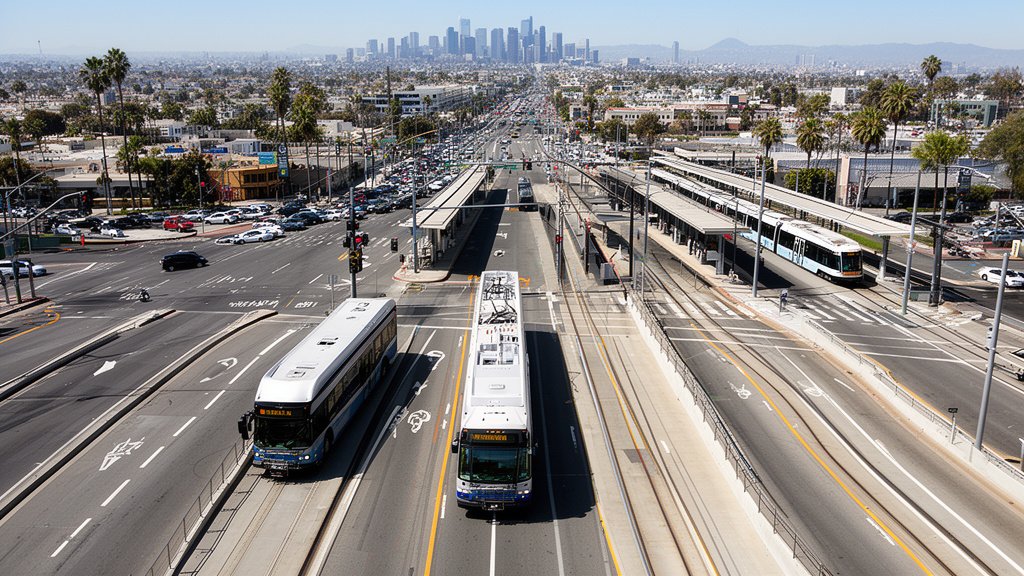
The operational success of the 2026 FIFA World Cup provided a vital proof-of-concept for this integration strategy. During the tournament, Los Angeles and host partners utilized a multi-modal transit management system that prioritized “event-day mobility.” Rather than building new rail lines, the strategy focused on high-frequency bus rapid transit (BRT) corridors, demand-responsive shuttle networks, and a unified ticketing and information system that bridged different transit agencies.
This experience highlighted that the primary issue with LA transit is not a lack of tracks or buses, but the fragmentation between agencies. For the 2028 Games, the recommendation is to formalize the “FIFA Blueprint” into a permanent operational framework. By creating a unified “LA28 Transit Command,” the city could consolidate the dispatching, routing, and passenger information systems of the multiple independent transit providers that currently operate in the region.
Overcoming the ‘First and Last Mile’ Deficit
One of the most persistent criticisms of the current Los Angeles transit network is the “last mile” problem—the difficulty of moving passengers from major rail hubs to specific venues or destinations. The new analysis argues that this is not an infrastructure failure, but a service deployment failure.
By leveraging the existing street grid and implementing dedicated Olympic-only bus lanes—similar to the practices in London 2012 or Paris 2024—the city can create high-speed connectivity to venues like SoFi Stadium, the Crypto.com Arena, and the UCLA campus. This requires no new tunneling or heavy construction; it requires the political will to repurpose existing road space for transit-first lanes during the competition window. This dynamic adaptation is both cheaper and faster to implement than building permanent rail extensions that may not be completed by 2028.
Economic Imperatives and Future-Proofing
Investing billions in new infrastructure solely for a two-week event is a high-risk proposition with a historical track record of fiscal volatility. The “Integration-First” approach offers a more sustainable economic legacy. By investing in better software, signaling systems, and operational staffing, the city builds a legacy of efficiency that remains long after the athletes have left.
Furthermore, this strategy addresses the inevitable reality of construction delays. By pivoting away from reliance on incomplete megaprojects, the LA28 Committee can minimize the risk of logistical failures caused by behind-schedule construction. The focus shifts from physical assets to “Service Assets,” ensuring that the user experience for both residents and visitors is optimized through technology—real-time tracking, unified payment systems, and responsive route adjustments—rather than raw capacity.
FAQ: People Also Ask
Q: Why is new construction being discouraged for LA28?
A: Construction projects in Los Angeles face significant regulatory and timeline risks. With the 2028 deadline approaching, there is a high probability that new major infrastructure projects would not be completed in time or would suffer from budget overruns, making operational integration a safer and more reliable alternative.
Q: How did the FIFA World Cup act as a test case for LA transit?
A: The 2026 FIFA World Cup demonstrated that Los Angeles could successfully manage massive crowd inflows by coordinating existing assets rather than expanding capacity. It showcased the power of temporary BRT lines and inter-agency dispatching, proving that efficiency is a matter of management, not just mileage.
Q: What happens to the ‘Twenty-Eight by ’28’ initiative?
A: The initiative remains a long-term goal for the city’s general transit improvement. However, for the specific scope and timeline of the Olympic and Paralympic Games, the focus is shifting toward ensuring these projects are ‘operational’—meaning they don’t necessarily need to be fully finished, but the transit corridors they serve must be functional and integrated into the broader Games-time network.
Q: Does this mean no new transit projects will be finished?
A: No, projects already significantly underway will continue. However, the strategy emphasizes that the success of the Games will not depend on them, but rather on the ability of current operators to synchronize their services to handle the peak demand of the event.