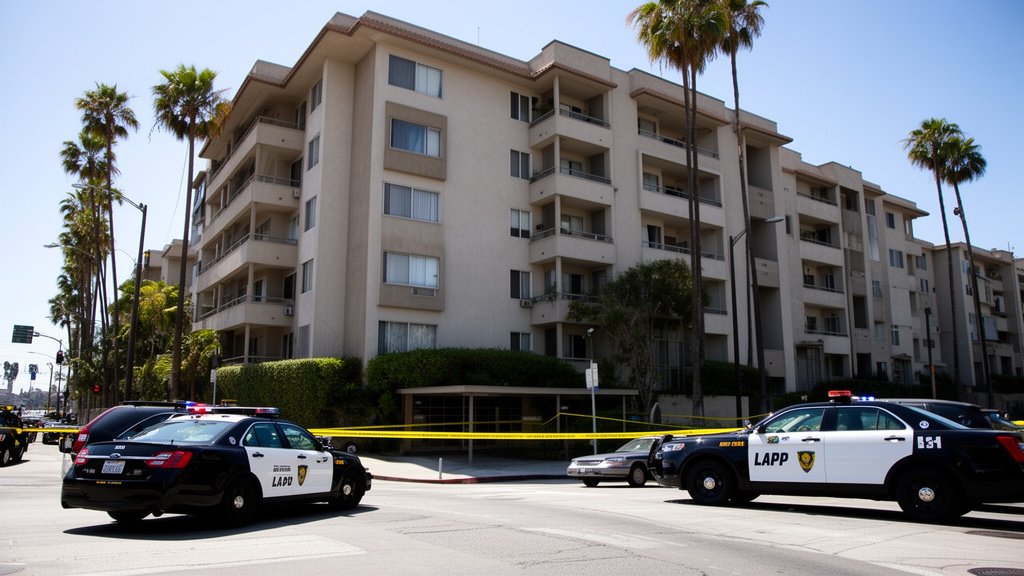
Three individuals were discovered dead from gunshot wounds inside a residential unit in the Hollywood area, prompting a major investigation by the Los Angeles Police Department (LAPD). The grim discovery occurred during a routine welfare check, triggering a massive police presence and sending shockwaves through the neighborhood as investigators began the complex process of reconstructing the events that led to the multiple fatalities.
Key Highlights
- Incident Discovery: LAPD officers discovered three deceased individuals inside an apartment following a welfare check requested by concerned acquaintances.
- Confirmed Injuries: Authorities have confirmed that all three victims succumbed to gunshot wounds.
- Active Investigation: The LAPD’s specialized homicide units are currently processing the scene to determine if the event was a homicide or a potential murder-suicide.
- Public Safety: There is currently no active search for a shooter, though officials have cordoned off the area to maintain the integrity of the forensic evidence.
Anatomy of a Triple Homicide Investigation in Hollywood
The discovery of three deceased individuals in a densely populated urban center like Hollywood initiates a highly structured, multi-agency response. When LAPD officers arrived at the scene, the priority immediately shifted from a welfare check to a secured crime scene operation. In instances involving multiple victims in a confined residential space, the investigation requires significant coordination between patrol officers, specialized detectives, and the Los Angeles County Department of Medical Examiner.
The Role of the Welfare Check
In urban environments, welfare checks often serve as the first line of defense for community safety. These checks are typically requested by family members, friends, or neighbors who note a disruption in typical activity patterns, such as uncollected mail, pets left unattended, or a lack of communication. In this specific case, the prompt request for a welfare check by concerned parties allowed authorities to enter the premises, though the outcome was devastating. The efficiency of the response is a critical factor in such cases, as securing the scene early helps prevent the contamination of potential forensic evidence, which is vital for later courtroom proceedings.
Forensic and Investigative Protocols
The Hollywood Division has deployed resources from the Forensic Science Division to meticulously document the apartment. Forensic experts examine the trajectory of ballistics, analyze blood spatter patterns, and collect physical evidence that can confirm the sequence of the shooting. For a triple-homicide scenario, the investigative team must look for signs of struggle, forced entry, or signs of domestic disturbance. Each piece of evidence—from electronic devices to shell casings—is cataloged to determine whether a third party was involved or if the incident was self-contained. The involvement of the Los Angeles County Department of Medical Examiner is also crucial; they will perform autopsies to determine the official cause and time of death, providing a timestamp that serves as the anchor for the investigative timeline.
The Challenge of High-Density Crime Scenes
Hollywood presents unique challenges for homicide investigations. The area’s transient nature, high-density housing, and significant foot traffic often mean that witnesses are sparse or difficult to track. Detectives must rely on a combination of digital evidence—such as surveillance feeds from doorbell cameras, parking structure security footage, and vehicle license plate readers—to reconstruct the timeline. Unlike suburban settings, where neighbors might be more familiar with one another, apartment living in Hollywood can sometimes result in ‘social isolation,’ where incidents occur without immediate visual or auditory witnesses. This necessitates a more technological approach to evidence gathering, prioritizing data extraction from smartphones and smart home devices found within the residence.
Intersection of Crisis and Mental Health
While the investigation is in its early stages, many such incidents in metropolitan areas are scrutinized through the lens of mental health and domestic crisis. If the evidence points toward a domestic origin, it highlights a critical issue in modern urban sociology: the lack of early-warning systems for high-conflict households. Community resources are often stretched thin, and identifying individuals in crisis before they reach a violent breaking point remains a significant public safety hurdle. The LAPD’s Behavioral Science Unit may eventually be involved to profile the incident and determine if there were prior indicators or warning signs that could have alerted authorities or social services to the escalating danger within the household.
Next Steps for Law Enforcement
As the investigation continues, the focus will shift from the immediate scene to the broader context of the victims’ lives. This includes interviewing associates, reviewing financial records, and analyzing communications. The department will also be working to notify the next of kin, a process that is often delayed to ensure accuracy and respect for the grieving families. The public can expect updates as ballistics reports are finalized and as the Medical Examiner releases the identities of the deceased. Until then, the LAPD maintains a tight perimeter, ensuring that the integrity of the scene remains uncompromised for the sake of potential prosecution and closure for the victims’ loved ones.
FAQ: People Also Ask
1. Was there a shooter on the loose after the discovery?
At this stage, the police have indicated that they are not actively searching for a shooter at large, suggesting that the event may have been contained within the apartment. However, investigators are keeping an open mind until forensic reports are finalized.
2. How long does a welfare check take to be initiated?
Once a report is filed by a family member or concerned citizen, the response time depends on the urgency of the situation and the current volume of emergency calls. In non-emergency welfare checks, it can take hours; however, when circumstances suggest immediate danger, priority is escalated.
3. What is the role of the Forensic Science Division in this case?
They are responsible for the scientific collection and analysis of physical evidence. This includes ballistic analysis, DNA swabbing, and scene reconstruction, which are essential to proving the sequence of events and identifying who fired the weapon or if it was a self-inflicted incident.
4. Will the names of the victims be released immediately?
Typically, the names of the deceased are withheld until the next of kin have been notified. This standard procedure ensures that family members do not learn about the tragedy through news media or social networks first.