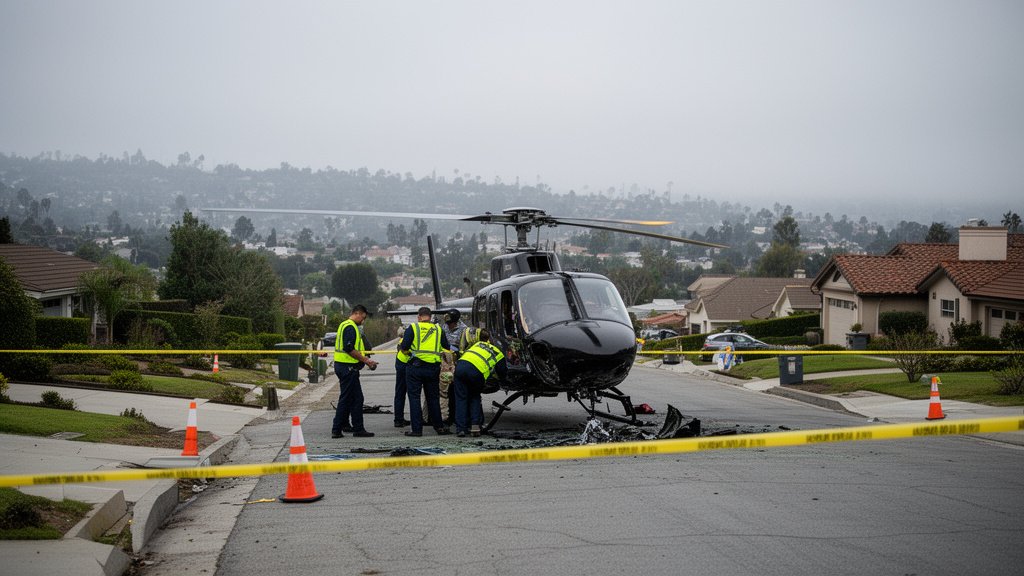

The Los Angeles news community is in mourning today following a catastrophic incident in the Chatsworth neighborhood, where an NBC Los Angeles news helicopter crashed while en route to cover a separate fatal bus accident. This tragedy has claimed the lives of three individuals, marking a dark day for both the news organization and the aviation community at large. As authorities work to secure the crash site and begin the harrowing process of recovery, questions regarding the safety of aerial news operations and the inherent risks of live, breaking news coverage have moved to the forefront of the public conversation.
A Community in Shock
The incident occurred in the mid-morning hours, a time when the skies over Los Angeles are typically buzzing with activity. The helicopter, which was operating in a capacity to provide live visuals for an ongoing story regarding a fatal bus accident on the ground, went down under circumstances that remain under investigation. Residents of the Chatsworth area reported seeing the aircraft maneuvering before the crash, describing a sudden change in the flight path that ended in the tragic impact. For local residents, the scene was one of confusion and horror, as the news teams they rely on for information suddenly became the subject of the breaking news themselves.
First responders arrived on the scene within minutes, setting up a perimeter around the wreckage to facilitate emergency procedures and eventual investigation protocols. The area has been cordoned off, with local law enforcement working alongside federal authorities to manage the scene. The loss of the crew has sent a profound ripple effect through the local media ecosystem, leaving colleagues and competitors alike to grapple with the reality that, in the high-stakes world of modern journalism, the path to reporting the truth can be fraught with unforeseen danger.
The Complexities of Aerial Journalism in Los Angeles
Los Angeles is perhaps the most helicopter-dense airspace in the United States, if not the world. Aerial news coverage has long been a staple of Southern California media, driven by the constant need to track traffic congestion, police pursuits, and emergency events across the sprawling metropolitan landscape. The demand for immediate, bird’s-eye visuals has normalized the presence of news helicopters hovering over neighborhoods and freeways, often in close proximity to one another and other general aviation traffic.
Operating in this environment requires extreme precision and constant vigilance. Pilots must navigate not only the physical obstacles of the LA basin—ranging from high-rise buildings in the city center to the mountainous terrain surrounding the San Fernando Valley—but also the unpredictable nature of live broadcasting. The pressure to maintain a steady, clear shot while managing aircraft stability, communications with the newsroom, and monitoring air traffic control frequencies creates a complex multitasking environment. This incident serves as a grim reminder of the operational demands placed on these flight crews, whose primary mission is to inform the public, even when the environment is far from hospitable.
Investigation and the Regulatory Framework
The National Transportation Safety Board (NTSB) and the Federal Aviation Administration (FAA) have launched a comprehensive investigation into the causes of the crash. This process is meticulous, involving the retrieval of wreckage for forensic analysis, the examination of flight data recorders (if available), and the review of pilot communication logs with air traffic control. Investigators will look for mechanical failures, environmental factors, and human factors that may have contributed to the tragedy.
Standard protocols in aviation accidents require a deep dive into the maintenance history of the specific aircraft involved. Every news helicopter operates under strict FAA regulations, with mandatory inspections and service intervals designed to ensure airworthiness. While early speculation often swirls in the immediate aftermath of such events, the NTSB investigation is designed to cut through the noise, relying on hard data and expert analysis to reconstruct the final moments of the flight. For the media organization and the industry at large, these findings will be critical in determining whether existing safety protocols need to be updated or if additional training and technology are required to mitigate risk in future aerial operations.
The Changing Landscape of News Gathering
Beyond the immediate tragedy, this crash highlights an ongoing debate in the journalism industry: the future of aerial news gathering. For years, the helicopter has been the gold standard for breaking news. However, the rise of sophisticated, high-definition drone technology offers a potential alternative for certain types of coverage. Drones can capture high-quality footage without the presence of a flight crew in the air, thereby removing the potential for human loss during high-risk assignments.
While drones cannot replace the range, speed, and endurance of a full-sized helicopter—especially in a region as geographically vast as Los Angeles—they are increasingly being integrated into newsroom workflows. This event will likely accelerate discussions within news organizations about the risk-benefit ratio of crewed aircraft versus unmanned systems. The industry must reconcile the public’s appetite for real-time aerial footage with the imperative to prioritize the safety of the professionals who provide it.
As the investigation proceeds and the names of those lost are shared with the public, the focus remains on supporting the families affected and understanding how such a catastrophe occurred. The media, often tasked with being the messenger of tragedy, is currently standing in the center of one, serving as a reminder of the fragility of life and the immense dedication required by those who work to keep the public informed.
FAQ: People Also Ask
1. What is the role of the NTSB in a helicopter crash investigation?
The National Transportation Safety Board (NTSB) is the primary federal agency responsible for investigating civil aviation accidents. Their goal is to determine the probable cause of the crash through evidence collection, data analysis, and expert testimony. They do not assign blame but issue recommendations to improve aviation safety based on their findings.
2. Are news helicopters subject to stricter regulations than private aircraft?
News helicopters generally follow the same FAA airworthiness and operation standards as other commercial rotorcraft. However, they often operate in high-traffic environments and engage in maneuvers—such as tight circling for camera shots—that require specialized pilot training and constant coordination with local air traffic control to ensure safety.
3. How does the industry typically respond to such aviation tragedies?
Following a fatal crash, news organizations often conduct internal safety reviews, reassess their aerial coverage policies, and pause operations temporarily out of respect and to evaluate risk. The aviation community also conducts ‘safety stand-downs’ to review standard operating procedures and flight safety protocols to prevent future incidents.
4. Will this crash change how news stations cover breaking events in Los Angeles?
It is likely to trigger a re-evaluation of risk assessment protocols. Stations may look to increase their reliance on drone technology or implement stricter guidelines regarding weather conditions, flight duration, and proximity to incident scenes, balancing the need for news coverage with the preservation of crew safety.