
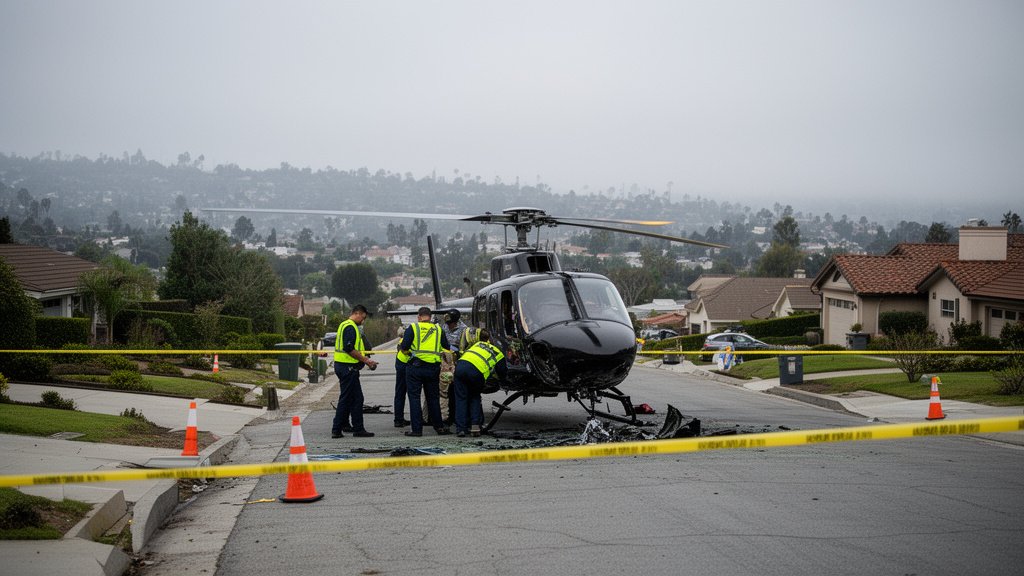
A somber atmosphere has descended upon the Chatsworth neighborhood following a catastrophic aerial incident that claimed three lives. An NBC Los Angeles AS350 B2 helicopter, which had been deployed to provide live coverage of a fatal bus accident in the vicinity, suffered a fatal crash while navigating the airspace over the community. The incident resulted in the immediate deaths of pilot George Marciniw and reporter Eliana Moreno, while a third individual, who was on the ground at the crash site, also succumbed to injuries sustained in the event. The tragedy has sent shockwaves through the local community and the broader media landscape, prompting an immediate investigation by federal authorities.
Key Highlights
- Fatal Incident: An NBC Los Angeles AS350 B2 helicopter crashed in the Chatsworth neighborhood during a news assignment.
- Victims Identified: The crash claimed the lives of pilot George Marciniw, reporter Eliana Moreno, and one individual on the ground.
- Federal Probe: The National Transportation Safety Board (NTSB) has initiated an investigation to determine the root cause of the crash.
- Context: The aircraft was actively covering a separate fatal bus accident when the loss of control occurred.
Investigation and Aerial Safety Protocols
The National Transportation Safety Board (NTSB) has deployed a “Go Team” to the Chatsworth site to initiate a comprehensive investigation. Investigators are currently focused on recovering the wreckage, which will be transported to a secure facility for detailed forensic analysis. The primary goal of this probe is to determine the precise sequence of events leading up to the impact. Analysts will examine the AS350 B2’s flight data recorder (FDR), commonly referred to as the “black box,” as well as communication logs between the pilot and air traffic control.
Analyzing the AS350 B2
The AS350 B2, a widely used light utility helicopter, is a staple in the media industry due to its agility and reliability in urban environments. Known for its performance in “hot and high” conditions, the aircraft is highly maneuverable; however, investigating the mechanical integrity of the airframe, the turbine engine, and the rotor assembly is standard procedure in such high-profile investigations. Experts will look for signs of mechanical failure, but will also consider external factors, including potential bird strikes, sudden weather shifts, or mechanical distress. The NTSB’s preliminary report is expected to shed light on whether flight maneuvers performed during the breaking news coverage contributed to the incident or if an unforeseen mechanical anomaly occurred.
The Intersection of Breaking News and Aviation Risk
The incident in Chatsworth raises significant questions about the inherent risks associated with electronic news gathering (ENG). News helicopters operate in complex urban environments, often hovering at low altitudes to capture live footage of accidents, fires, or natural disasters. This work requires pilot precision and constant communication with other aircraft and ground crews.
Navigating Dense Airspace
Los Angeles presents a unique challenge for aviation. With heavy congestion and complex topography, the risk density for news aircraft is higher than in most other major cities. The pressure to provide real-time updates for news outlets can create a stressful environment for crews. Industry experts argue that this tragedy may force a re-evaluation of safety protocols, potentially leading to stricter regulations regarding low-altitude flight durations for ENG aircraft. The reliance on drones has increased, but the need for human-operated helicopters remains, primarily due to their ability to provide high-quality, long-range footage.
Future Implications for News Organizations
This catastrophe is likely to serve as a turning point for media aviation policy. Several secondary angles emerge from this event, including the psychological impact on newsroom staff and the future of safety tech in news gathering.
1. Technological Advancements: We may see an accelerated push for automated crash-avoidance systems and advanced redundant flight computers specifically calibrated for the erratic flight patterns often required by news coverage.
2. Shift in Operational Culture: Media organizations may begin to prioritize the use of high-definition unmanned aerial vehicles (UAVs) in high-risk areas, reserving crewed helicopters only for environments where situational awareness is maximized and risk is minimized.
3. Psychological Toll: The loss of colleagues in the line of duty forces a reckoning within newsrooms. The “race to the scene” culture, long a hallmark of local television, is being scrutinized for the immense pressure it places on personnel. Future corporate policies may prioritize mental health support and mandate “no-go” conditions that were previously left to the discretion of the flight crew.
FAQ: People Also Ask
1. What is the status of the NTSB investigation?
The NTSB has begun its investigation, including site mapping and wreckage recovery. A preliminary report is expected in the coming weeks, while a full factual report may take 12-18 months to finalize.
2. Is the AS350 B2 considered a safe helicopter?
The AS350 B2 is a widely used and well-regarded aircraft in the aviation industry. Like all aircraft, its safety record is dependent on rigorous maintenance schedules and strict adherence to operating parameters.
3. Will this change how local news covers breaking events?
It is highly probable. Major networks will likely review their aviation insurance, safety protocols, and the use of manned aircraft vs. drone technology in urban settings following the completion of the NTSB findings.


