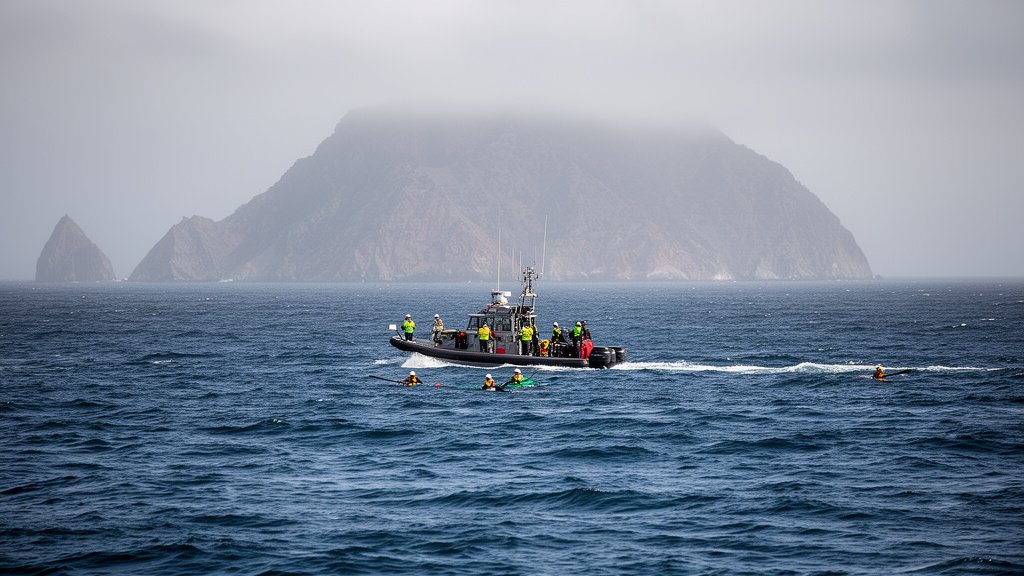
A somber search-and-rescue operation is currently underway off the coast of Catalina Island after a medical helicopter crash claimed the lives of two individuals, leaving two others hospitalized and one person missing. The incident has mobilized regional emergency response teams, who are working against time and difficult maritime conditions to locate the remaining occupant.
Key Highlights
- Confirmed Fatalities: Two individuals have been pronounced dead at the scene following the crash.
- Survivors: Two passengers were recovered with injuries and are currently receiving medical attention.
- Ongoing Search: The Los Angeles County Fire Department is actively leading the rescue efforts for the fifth individual who remains unaccounted for.
- Incident Location: The crash occurred in the waters off the coast of Catalina Island, near the Los Angeles coastline, requiring coordination between air and sea rescue units.
Anatomy of a Maritime Aviation Disaster and Response Protocol
The crash of a medical helicopter—a vehicle designed specifically for life-saving operations—is a jarring event that highlights the inherent risks of aerial emergency services. While the investigation into the specific mechanical or environmental cause of this crash remains in its infancy, the response phase is a highly coordinated, multi-agency effort. The Los Angeles County Fire Department, known for its robust Air Operations section, is currently operating in a challenging environment. Maritime rescue operations are notoriously difficult; the combination of low visibility, ocean currents, and the potential for wreckage to shift or submerge makes the recovery of the fifth missing person a logistical challenge of the highest order.
The Operational Hazards of Air Medical Transport
Medical helicopters, or ‘Medevac’ units, operate in high-pressure environments. Pilots are frequently tasked with navigating into unprepared landing zones, often during inclement weather or at night, to retrieve critically ill or injured patients. Statistically, air medical services face higher risk profiles than commercial aviation due to the urgent nature of their missions. The proximity to Catalina Island introduces specific geographic complications. The airspace around the Channel Islands is complex, influenced by marine layer fog and rapidly changing wind patterns. As authorities and investigators from the National Transportation Safety Board (NTSB) begin their work, a primary focus will likely be on whether environmental conditions, mechanical failure, or human factor variables played a role in this tragic trajectory.
Multi-Agency Coordination and Rescue Mechanics
The involvement of the Los Angeles County Fire Department underscores the gravity of the incident. Such operations involve a ‘triage’ approach to search and rescue. Initially, assets are deployed to stabilize the site, prevent further injury to responders, and search for immediate survivors. Once the scene is secured, the focus transitions to a systematic grid search, utilizing sonar, divers, and aerial observation to locate the missing occupant. This requires seamless communication between the Fire Department, the U.S. Coast Guard, and local law enforcement. For the families of those involved, this period of uncertainty is excruciating, while for the agencies, it is a race against time where the golden hour of potential survival passes with every minute of exposure in the Pacific waters.
The Lifecycle of an Aviation Investigation
Following the rescue phase, the focus will inevitably shift to the investigative process. The NTSB, alongside the Federal Aviation Administration (FAA), will launch a comprehensive investigation. This process is painstaking. Investigators will look for the ‘black box’—the flight data recorder—and the cockpit voice recorder, if equipped. They will analyze maintenance logs of the specific aircraft to determine if it was up to current safety standards. They will also look at the flight crew’s duty logs to assess for potential fatigue, a known risk factor in emergency aviation. Finally, investigators will cross-reference the flight path with radar data to establish a precise timeline of the helicopter’s final moments. This institutional scrutiny is essential not only to determine culpability but to introduce safety reforms that prevent future tragedies in the medical transport sector.
Strategic Implications for Emergency Aviation
Beyond the immediate tragedy, this event forces a reckoning regarding the safety protocols of medical aviation providers. Over the last decade, there has been a push to integrate better ‘Terrain Awareness and Warning Systems’ (TAWS) and night-vision goggle capabilities across all EMS fleets. However, the limitation often lies in the nature of the mission itself: the urgency to save a life often pushes pilots to fly in conditions that commercial pilots would avoid. Future policy debates will likely focus on whether the threshold for ‘go/no-go’ flight decisions needs to be further codified or if autonomous flight aids can bridge the safety gap in future air medical models. The Catalina Island incident will serve as a case study for future industry safety seminars and policy changes within the California emergency services ecosystem.
FAQ: People Also Ask
Q: What is the current status of the search for the missing individual?
A: The Los Angeles County Fire Department remains in an active rescue posture. Divers and aerial assets are continuously scouring the crash site off Catalina Island, though details regarding the progress of the search are updated by the agency as conditions and findings evolve.
Q: Were the individuals on board patients or crew?
A: Official reports are currently prioritizing the rescue and recovery phase. The specific identities and roles of those on board—whether medical personnel, flight crew, or patients—are typically released by authorities only after next-of-kin notification and preliminary identification.
Q: How does the NTSB investigate a crash in the water?
A: Investigating a water-based crash involves recovering wreckage from the seabed, which is far more complex than terrestrial recovery. It requires specialized underwater recovery equipment, sonar mapping, and often the use of remotely operated vehicles (ROVs) to locate and retrieve the flight data recorders and fragmented airframe components.