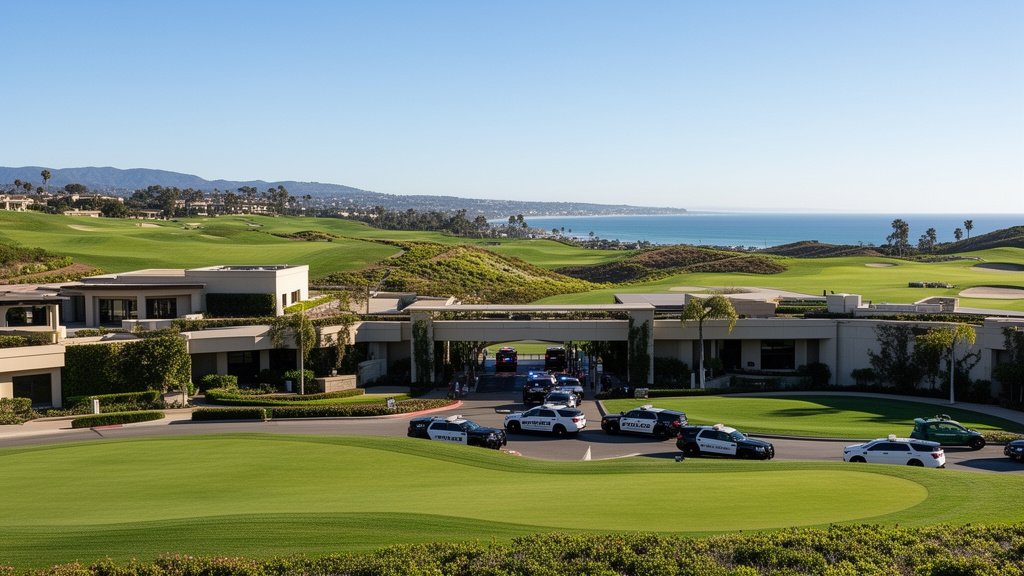
Law enforcement officials arrested a 38-year-old man at the Trump National Golf Club in Rancho Palos Verdes, California, following a high-stakes security incident involving a loaded handgun and ammunition. The apprehension occurred while authorities were conducting pre-event security sweeps in anticipation of a high-profile fundraiser visit by former President Donald Trump. The arrest highlights the intensifying security challenges facing high-level political figures, particularly when navigating the logistical complexities of securing private, sprawling commercial properties against unauthorized access.
Key Highlights
- Immediate Security Response: Local law enforcement and security details apprehended the 38-year-old male suspect before any interaction occurred with the former president.
- Weapon Confiscation: The individual was found in possession of a loaded handgun and accompanying ammunition, prompting an immediate investigation.
- High-Stakes Venue: The incident took place at the Trump National Golf Club in Rancho Palos Verdes, a location that demands significant perimeter control during political events.
- Preventative Measures: The suspect was reportedly observed monitoring security measures, underscoring the vital nature of pre-arrival sweeps conducted by the Secret Service and local police departments.
The Architecture of Presidential Perimeter Defense
The apprehension of the 38-year-old suspect at the Trump National Golf Club in Rancho Palos Verdes serves as a stark case study in the evolving methodologies of protective detail. Securing a public figure is a task of immense logistical difficulty, one that shifts from the controlled environments of convention centers to the open, rugged landscapes of private sporting venues like golf clubs. Unlike purpose-built arenas, golf courses present unique challenges due to their vast, undulating perimeters, public accessibility points, and scenic vistas that often overlook public roadways or high-density areas.
The Intersection of Public and Private Security
When a candidate or former president schedules an appearance, a multi-layered security net is deployed. This typically involves the United States Secret Service working in tandem with the Los Angeles County Sheriff’s Department and local municipal police. The primary goal is the creation of a ‘sterilized’ zone. In this instance, the suspect was identified while monitoring the facility’s security protocols—a behavior pattern often categorized by intelligence analysts as ‘pre-attack surveillance.’ The speed of the response by on-site officers likely prevented a potentially catastrophic escalation. This incident illustrates that the most effective tool in modern protective intelligence is not reactive firepower, but proactive observation and the rapid identification of anomalies within a crowd or perimeter.
Challenges of the Open-Air Venue
Golf courses are notoriously difficult to lock down. They are designed for leisure, featuring long sightlines and multiple egress points. Protecting a high-value target in such an environment requires a massive deployment of personnel and technology, including drone surveillance, K-9 units, and plainclothes assets embedded in the surrounding geography. The fact that the individual possessed a loaded firearm suggests a level of premeditation that shifts the investigation from a simple case of trespassing to a more complex inquiry regarding potential violent intent. This creates a ripple effect, forcing campaigns to reconsider the viability of outdoor, non-traditional venues in an era of heightened political polarization.
The Psychology of Threat Detection
The 38-year-old suspect’s actions, as reported, involve monitoring security measures. This is a critical detail in threat assessment. Protective details are trained to look for ‘baseline’ behavior—how a normal visitor acts. Someone observing security staff rather than enjoying the facility immediately triggers a red flag. The subsequent search and discovery of the loaded handgun and ammunition validated the initial suspicion. This incident serves as a reminder that the Secret Service and local law enforcement operate on a razor’s edge, where the difference between a tragic headline and a routine arrest is often determined by a split-second decision made by a vigilant officer on the ground. As we move closer to election cycles, the burden on these agencies to interpret intent and act decisively will only grow, necessitating even more rigorous training in behavioral detection and rapid response protocols.
FAQ: People Also Ask
Q: What is the current security status of the Trump National Golf Club?
A: Following the incident, security protocols at the facility and for upcoming campaign visits have been significantly elevated. Authorities are conducting exhaustive perimeter sweeps to ensure the safety of all guests and the former president.
Q: How does the Secret Service coordinate with local law enforcement in LA?
A: The Secret Service maintains a constant liaison with the Los Angeles County Sheriff’s Department and the Los Angeles Police Department. They share intelligence, integrate communication channels, and divide patrol zones to create a comprehensive protective net.
Q: Are there specific risks associated with hosting political events at golf courses?
A: Yes. Golf courses are inherently difficult to secure due to their open nature, lack of single entry points, and large geographic footprints. This requires a significantly higher number of personnel and technological assets compared to an indoor venue.