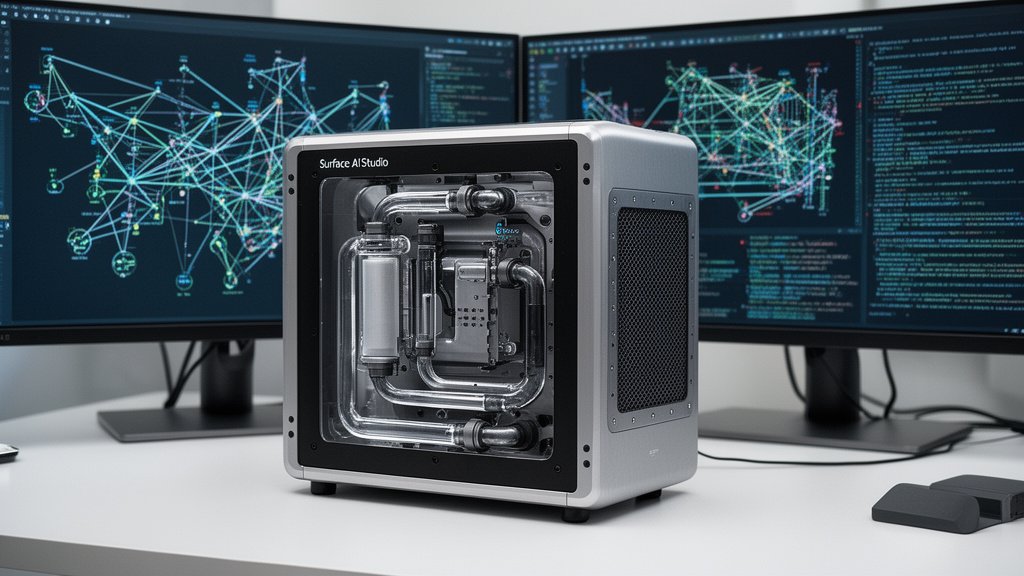
Microsoft is officially changing the landscape of AI development with the introduction of the ‘Surface AI Studio,’ a specialized desktop workstation engineered from the ground up for AI researchers and developers. In a significant pivot from the industry’s heavy reliance on cloud-only computing, this new hardware targets the growing demand for secure, high-performance local training of large language models (LLMs). By combining proprietary silicon with advanced thermal management, Microsoft is positioning the Surface AI Studio as the definitive tool for those pushing the boundaries of generative AI.
The Desktop Revolution: Bridging the Gap Between Cloud and Edge
For years, the development of sophisticated artificial intelligence has been gated by the limitations of local hardware. Researchers were often forced to rely on massive server clusters and cloud-based instances through platforms like Azure to train models or perform fine-tuning. This workflow introduced latency issues, prohibitive costs, and significant security concerns regarding proprietary datasets. The Surface AI Studio aims to disrupt this paradigm by delivering server-grade compute power directly to the developer’s desk.
At the core of the Surface AI Studio lies the new proprietary Neural Processing Unit (NPU) architecture. Unlike generic consumer-grade chips, these custom neural processing chips are optimized specifically for the matrix multiplication and parallel processing tasks that underpin modern neural networks. By offloading these intensive mathematical workloads to dedicated hardware, the system allows for significant speed increases in training cycles, enabling developers to iterate on fine-tuning processes without waiting for cloud deployment pipelines.
Thermal Engineering: The Liquid-Cooled Promise
High-performance AI training is notoriously heat-intensive. Running GPUs and NPUs at 100% utilization for hours—or days—generates thermal loads that typically throttle performance in standard desktop towers. To solve this, Microsoft has integrated a proprietary closed-loop liquid cooling system into the Surface AI Studio.
This system is not merely aesthetic; it is a critical component of the machine’s architecture. The liquid cooling loops are designed to circulate thermal energy away from both the primary GPU clusters and the new neural chips. By maintaining a stable temperature, the workstation avoids the thermal throttling that plagues traditional air-cooled systems, ensuring that developers can run large-model training loops for extended periods at peak clock speeds without degradation. This reliability is essential for the reproducibility of scientific research and the stability of production-grade model fine-tuning.
Why Developers Need Local AI Workstations
The move toward local AI hardware represents a broader trend in the tech industry: sovereignty over data. For enterprises and research institutions dealing with sensitive, non-public data, training models in the cloud—even on private instances—presents a persistent risk profile. With the Surface AI Studio, data never leaves the physical premises. This ‘air-gapped’ development capability is becoming a requirement for developers working in healthcare, finance, and defense, where data privacy is non-negotiable.
Furthermore, the integration with existing development ecosystems is seamless. The Surface AI Studio is pre-configured to interface with VS Code and major AI development frameworks, allowing for a ‘plug-and-play’ experience that reduces the setup time for new AI environments. By shortening the feedback loop between code changes and model performance analysis, Microsoft is betting that developers will prioritize the workflow efficiency of a local powerhouse over the scalability of the cloud.
Competitive Landscape and Industry Implications
The introduction of this hardware puts Microsoft in direct competition with traditional workstation manufacturers like Dell and Lenovo, while also potentially influencing the roadmap for NVIDIA and AMD. By creating a ‘first-party’ AI machine, Microsoft is setting a benchmark for what a dedicated AI workstation should look like in 2024 and beyond. If the Surface AI Studio succeeds in capturing the high-end developer market, we can expect a trickle-down effect where features like advanced liquid cooling and specialized neural chips become standard across the professional workstation segment.
Ultimately, the Surface AI Studio is an acknowledgment that the ‘intelligence’ era is moving from the cloud back to the local device. As AI models become more specialized and privacy concerns grow, the ability to train, test, and fine-tune models on local silicon will likely become a competitive advantage for developers and corporations alike.
FAQ: People Also Ask
Q: What is the primary difference between the Surface AI Studio and a standard high-end gaming PC?
A: While both might share high-end GPUs, the Surface AI Studio features custom, integrated neural processing chips designed for AI-specific workloads, not gaming. Additionally, its liquid cooling system is engineered for sustained, long-term high-utilization cycles, whereas gaming PCs are optimized for burst performance.
Q: Is this hardware suitable for training models from scratch?
A: The Surface AI Studio is primarily marketed for fine-tuning and localized training of large models. While it possesses significant power, training massive foundational models from scratch still requires the massive server farms typical of data centers; however, it is highly efficient for domain-specific fine-tuning.
Q: Does the Surface AI Studio require a constant internet connection?
A: No. One of the primary advantages of this hardware is the ability to operate offline for local model training, which enhances security and allows for development in environments where high-speed, persistent internet is not available or where data privacy is paramount.
Q: How does this align with Microsoft’s cloud-first strategy?
A: The Surface AI Studio represents a ‘hybrid’ strategy. Microsoft continues to dominate the cloud with Azure, but they are providing the local hardware necessary to feed that ecosystem, recognizing that the developer workflow is increasingly becoming a hybrid of local testing and cloud scaling.