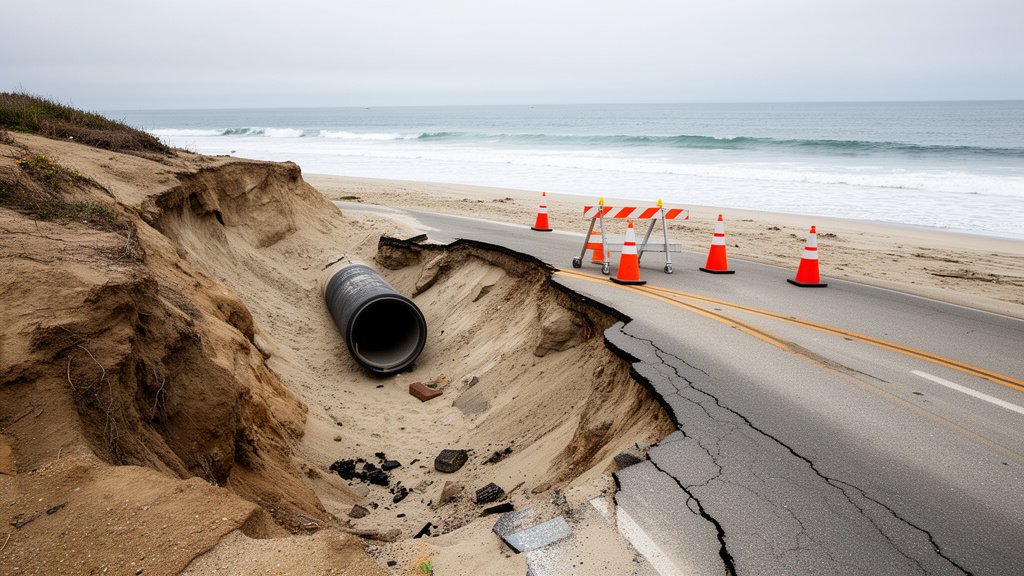
The intersection of Southern California’s iconic coastline and its aging utility infrastructure has reached a breaking point. Authorities have been forced to implement emergency road closures near Westward Beach in Malibu after significant coastal erosion exposed a Los Angeles County water main. The situation, which poses both an environmental and utility threat, underscores the precarious nature of maintaining essential services along a coastline currently experiencing accelerated rates of geological instability.
The Incident: A Sudden Discovery
The emergency response began when L.A. County Public Works officials identified that the foundational soil supporting local access roads and utility lines had been washed away by heavy surf and high tides. This erosion uncovered a primary water main, which is now dangerously exposed to the elements and the constant force of the Pacific Ocean. While immediate utility failures were averted through swift intervention, the structural integrity of the surrounding roadway has been compromised, necessitating an indefinite closure to both vehicular and pedestrian traffic in the immediate vicinity to prevent a catastrophic rupture.
The Geologic and Engineering Dilemma
This event is not an isolated occurrence but rather a symptom of the broader geomorphological shifts affecting the Malibu coastline. The bluffs overlooking Westward Beach are composed of unstable marine sedimentary rock, which is highly susceptible to weathering and wave-induced undercutting. As sea levels rise and storm surges become more intense, the ‘buffer zone’ between the ocean and vital infrastructure is shrinking.
From an engineering perspective, this presents a nightmare scenario. Utility lines are typically buried at specific depths to protect them from environmental damage; however, when the land around them disappears, these lines become ‘suspended’ in the air or subjected to direct hydraulic stress from wave action. Repairing or relocating such infrastructure in a protected coastal environment requires a complex interplay of permits from the California Coastal Commission, environmental impact assessments, and expensive, specialized deep-foundation engineering.
Economic and Community Impact
For the Malibu community, the road closure at Westward Beach is more than a minor traffic inconvenience—it represents a disruption to a vital access point for one of the region’s most popular recreational areas. Point Dume and Westward Beach serve as primary nodes for tourism and local recreation. The closure of access roads ripples through the local economy, affecting small businesses that rely on beach traffic, parking revenue, and the overall accessibility of the coastline. Furthermore, the presence of heavy machinery and construction crews necessary for emergency repairs will dominate the visual and auditory landscape of the area, potentially deterring visitors and complicating daily life for local residents.
The Long-Term Resilience Strategy
This incident serves as a critical case study for the Los Angeles County Waterworks District and local policymakers. The current ‘reactive’ model of infrastructure management—fixing pipes only after they are exposed—is increasingly untenable.
Local authorities are now under pressure to consider ‘managed retreat’ or massive fortification strategies. Managed retreat involves relocating infrastructure further inland, away from the encroaching shoreline, which is a costly and politically sensitive endeavor involving private property and complex zoning laws. Fortification, conversely, involves building sea walls, riprap, or other armoring. However, armoring the coast often accelerates erosion in adjacent areas (a phenomenon known as ‘flanking’) and is frequently opposed by environmental groups who advocate for natural beach preservation.
As the county evaluates the next steps, the primary goal remains the restoration of service security. The immediate task is to stabilize the bank to protect the exposed main from a total breach, which would have immediate and severe consequences, including the potential for localized flooding, contamination of the beach area, and the loss of water service to residents and businesses in the surrounding vicinity.
Environmental Considerations
Environmental advocacy groups are watching the situation closely. Any repair efforts must comply with stringent regulations to prevent construction runoff from entering the marine sanctuary or damaging the delicate beach ecosystem. The use of heavy equipment in this area carries the risk of sediment discharge and chemical spills, requiring the deployment of sophisticated mitigation strategies. The balance between public utility safety and environmental stewardship remains the defining tension of coastal management in the 21st century.
FAQ: People Also Ask
1. Is Pacific Coast Highway (PCH) closed due to this incident?
No. The closure is limited to local access roads near Westward Beach. Pacific Coast Highway remains open, though motorists are advised to expect localized traffic delays if repair crews are operating near the intersection points.
2. Is the water supply to Malibu residents currently interrupted?
At the time of reporting, the water main remains operational despite the exposure. The L.A. County Waterworks District is monitoring the situation around the clock to ensure service continuity. There is no active ‘boil water’ advisory or service outage related to this incident.
3. How long will the road closure last?
There is no official timeline for reopening. The closure is expected to remain in effect until engineering teams can stabilize the erosion site and perform the necessary repairs to re-bury or relocate the exposed utility lines safely. Updates will be provided by L.A. County Public Works via official municipal channels.