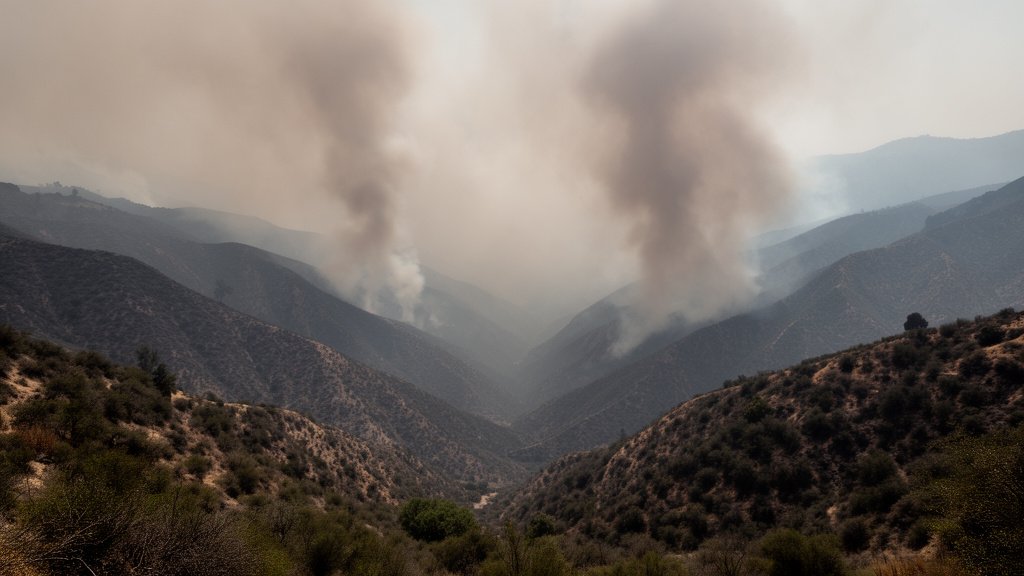
Health officials in Los Angeles County have issued an urgent smoke advisory as the Bouquet Fire continues to burn across 1,000 acres of rugged terrain. The fire, which has prompted emergency response efforts, is creating significant air quality concerns for the Santa Clarita Valley and its surrounding communities. Officials have set the expiration for the current advisory at October 4, at 8:00 p.m., urging residents to limit outdoor exposure as smoke plumes drift through the region.
Key Highlights:
- Burn Area: The Bouquet Fire has currently consumed approximately 1,000 acres, requiring aggressive suppression efforts.
- Advisory Timeline: The active smoke advisory remains in effect until October 4 at 8:00 p.m.
- Affected Areas: Residents in the Santa Clarita Valley and surrounding L.A. County communities are under health alerts.
- Health Warning: Officials advise minimizing outdoor activity, as air quality levels are currently classified as unhealthy for sensitive groups.
Crisis in the Canyon: The Bouquet Fire and Air Quality Emergency
The Bouquet Fire represents a significant escalation in wildfire activity within Los Angeles County, bringing environmental hazards directly to the doorsteps of Santa Clarita residents. While emergency crews work to contain the blaze, the primary secondary threat—particulate matter—has triggered an immediate health response from local authorities. The intersection of topographical challenges and shifting wind patterns has turned this wildfire into a multi-faceted crisis, forcing a pivot from immediate fire suppression to long-term public health management.
The Anatomy of the Smoke Advisory
When a wildfire of this magnitude occurs, the South Coast Air Quality Management District (AQMD) monitors the plume’s movement. A smoke advisory is not merely a precautionary notification; it is a clinical assessment of atmospheric conditions. As the Bouquet Fire burns through brush and vegetation, it releases fine particulate matter (PM2.5) into the atmosphere. These microscopic particles are capable of penetrating deep into the lungs and entering the bloodstream, posing a severe risk to individuals with pre-existing cardiovascular or respiratory conditions.
By issuing this advisory through October 4, health officials are acknowledging that the containment of the fire is only half the battle. Even as ground crews secure the perimeter of the 1,000-acre burn area, the lingering smoke acts as a slow-moving hazard that can settle in valleys, trapped by temperature inversions that are common in Southern California geography.
Challenges of the Bouquet Canyon Terrain
The Bouquet Canyon area presents a classic challenge for the Los Angeles County Fire Department and inter-agency partners. The terrain is characterized by steep ridges and narrow canyons, which serve as natural chimneys for fire development. When fire hits these canyons, wind speed increases, and the erratic behavior of the blaze complicates containment strategies.
This specific geography also makes smoke dispersion unpredictable. During the day, heating of the canyon walls pushes smoke upward, but as temperatures drop in the evening, cool air sinks back into the valley, pulling smoke and ash with it. This cycle is precisely why the advisory spans multiple days—even if the fire is actively suppressed, the secondary environmental impact continues to affect local air quality until the fuel is fully extinguished and atmospheric conditions stabilize.
Public Health Preparedness and Mitigation
For residents in the Santa Clarita Valley, the current directive is clear: stay indoors. While it may seem counterintuitive for those not in the immediate path of the flames, the smoke threat is pervasive. Health officials recommend that residents keep windows and doors closed, utilize high-efficiency air cleaners (HEPA filters), and avoid high-intensity outdoor exercise until the air quality index (AQI) improves.
Beyond individual health, the incident highlights the ongoing vulnerability of the Santa Clarita region. Historical data indicates that the proximity of suburban developments to the wildland-urban interface requires constant vigilance. The Bouquet Fire serves as a potent reminder that despite advances in technology and satellite monitoring, the physical reality of fire remains a dominant force in California’s seasonal cycle.
Broader Implications: Climate and Infrastructure
Beyond the immediate emergency, the Bouquet Fire contributes to a broader discussion regarding the economic and systemic impact of wildfires. The cost of such incidents extends far beyond the firefighting efforts; it involves the disruption of local infrastructure, potential damage to utility grids, and the economic toll of temporary displacement. Furthermore, as the climate landscape shifts toward longer and more intense fire seasons, regional planning committees are forced to reconsider zoning laws and vegetation management practices to mitigate the speed at which 1,000 acres can be lost.
This event also underscores the necessity for robust emergency notification systems. The prompt issuance of the smoke advisory by the L.A. County Public Health department is essential for reducing the burden on emergency rooms and urgent care facilities, which often see a spike in respiratory complaints during wildfire events. Proactive communication helps the community manage the health crisis efficiently, preventing widespread panic while providing actionable, data-driven guidance.
FAQ: People Also Ask
1. What does the current smoke advisory mean for my daily routine?
It means you should limit outdoor physical activity. The L.A. County Public Health department advises keeping windows and doors closed. If you have respiratory or heart disease, consider staying indoors entirely until the advisory is lifted on October 4, at 8:00 p.m.
2. Why is the Santa Clarita Valley specifically affected by the Bouquet Fire?
Due to the canyon-heavy topography of the area, smoke tends to get trapped in the valley floor. Prevailing wind patterns can channel the smoke directly into populated residential zones, leading to concentrated levels of air pollution compared to more open regions.
3. How can I track the air quality in my neighborhood?
Residents can monitor the South Coast Air Quality Management District (AQMD) website, which provides real-time air quality index (AQI) maps. These resources use local monitoring stations to provide data specific to Santa Clarita and surrounding zip codes.
4. What are the long-term health risks of smoke inhalation from wildfires?
Short-term exposure can cause coughing, eye irritation, and difficulty breathing. However, prolonged exposure to PM2.5 can exacerbate chronic lung diseases like asthma and may contribute to cardiovascular issues. It is vital to limit exposure as much as possible during the advisory window.