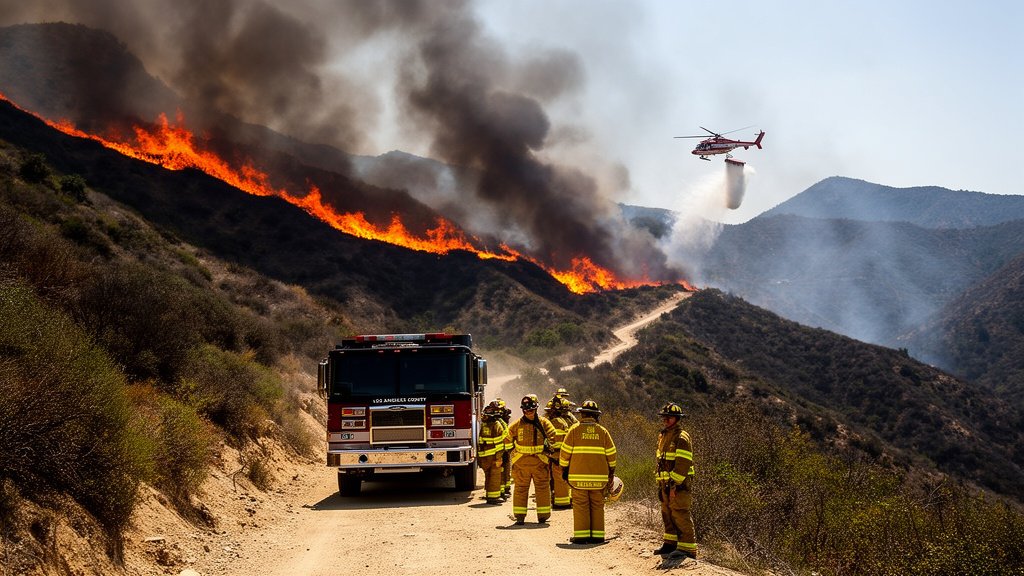
As a fast-moving wildfire continues to rage north of Los Angeles, local authorities have implemented mandatory evacuation orders for several sectors of the Santa Clarita region. The incident, which began as a small brush fire, escalated rapidly due to challenging topographical conditions and dry vegetation, forcing fire departments to shift from a containment posture to an emergency life-safety response. The Los Angeles County Fire Department, supported by state and federal partners, is currently battling the blaze, which has created thick plumes of smoke visible for miles, raising concerns for both air quality and infrastructure safety along critical transit corridors.
Key Highlights
- Evacuation Mandates: Mandatory evacuation orders have been issued for residents in designated zones north of Santa Clarita, with temporary evacuation points established at local community centers.
- Emergency Mobilization: Massive inter-agency coordination is underway, involving the Los Angeles County Fire Department (LACoFD), the Angeles National Forest service, and support from California Highway Patrol (CHP) to manage road closures.
- Fire Progression: The fire is exhibiting extreme behavior due to low humidity and strong winds, complicating efforts to establish a defensive perimeter.
- Public Safety Alerts: Officials have activated emergency notification systems, urging residents to prepare ‘go-bags’ and monitor official channels for real-time changes in containment status.
Battling the Blaze: Assessing the Santa Clarita Wildfire Crisis
The current wildfire incident north of Los Angeles represents a critical test of modern emergency management protocols in Southern California. The fire, which ignited in a high-risk area characterized by dense chaparral and steep canyons, has capitalized on the region’s volatile environmental conditions. Fire officials at the scene have emphasized that the primary objective remains the protection of life and property, a task made exponentially more difficult by the rapid, unpredictable spread of the flames.
The Anatomy of the Incident
Wildfires in the northern Los Angeles County corridor are historically aggressive, often driven by the unique ‘funnel effect’ created by the local topography. As winds channel through the canyons, fires can exhibit erratic behavior, shifting direction with little warning. In this specific incident, the fire capitalized on sustained dry periods, which significantly increased the fuel load—the amount of dead vegetation available to burn. Experts on the ground noted that the blaze reached a high rate of spread within the first few hours, necessitating the immediate escalation of response units from regional task forces to heavy aerial support.
Emergency Coordination and Logistics
Managing the chaos of an active wildfire requires a seamless integration of the Incident Command System (ICS). The Los Angeles County Fire Department has established a unified command structure to streamline communications between ground crews, air tankers performing water drops, and law enforcement agencies managing traffic control. The closure of major access routes, including segments of regional highways, has been vital to allow fire apparatus unhindered access to the front lines. Residents are advised that these closures are fluid and subject to change based on the fire’s current path.
Environmental and Structural Challenges
The terrain north of Santa Clarita presents significant tactical obstacles. Unlike flatland fires, this incident is concentrated in rugged, mountainous areas where heavy equipment cannot easily traverse. Consequently, air operations have become the linchpin of the strategy, with fixed-wing aircraft and helicopters performing constant drops to cool the fire’s edge. However, these operations are often hampered by high winds and smoke, which can ground aircraft for safety reasons. Furthermore, the proximity of residential communities to the wildland-urban interface (WUI) has triggered localized structure protection plans, where firefighters are actively positioning to defend homes directly in the path of the flames.
Secondary Angles: Examining the Broader Impact
1. The ‘New Normal’ of SoCal Fire Seasons
This incident underscores a shifting paradigm in Southern California. With climate trends leading to longer, hotter summers and more unpredictable precipitation, the traditional ‘fire season’ is effectively becoming a year-round threat. Urban planners and fire safety experts are increasingly looking at long-term strategies, such as wider fire breaks and aggressive vegetation management, to reduce the severity of these events before they start.
2. Economic Costs of Emergency Response
Beyond the immediate threat to homes, the economic impact of such a fire is substantial. The cost of mobilizing hundreds of firefighters, aerial assets, and support vehicles can reach millions of dollars in a matter of days. Furthermore, the interruption of local commerce and the potential long-term devaluation of properties in fire-prone areas create a secondary layer of financial distress that the region must navigate after the smoke clears.
3. Public Infrastructure and Power Grid Reliability
During severe wildfires, the integrity of regional infrastructure is a major concern. Utilities often implement preemptive power shutoffs or suffer damage to distribution lines, leading to potential outages. This creates a cascade effect, as residents without power may lose the ability to receive real-time emergency information via internet or television, emphasizing the need for robust, decentralized emergency communication systems like battery-operated radios.
FAQ: People Also Ask
Q: How can residents stay updated on evacuation status?
A: Residents should monitor the official website of the Los Angeles County Fire Department and local emergency management services. Signing up for ‘AlertLA’ notifications is the most effective way to receive instant SMS or email updates regarding mandatory evacuation zones.
Q: What should I include in an emergency ‘go-bag’?
A: A standard go-bag should contain essential medications, important documents (IDs, insurance papers), at least three days of water and non-perishable food, flashlights, portable chargers, and hygiene items. It should be kept in an accessible location for rapid departure.
Q: Why are air tankers sometimes grounded during wildfires?
A: Aerial firefighting is extremely dangerous. Pilots require visibility to maneuver aircraft safely. If smoke is too dense, winds are too high, or if there is conflicting aircraft traffic, incident commanders will ground air operations until conditions improve.
Q: Are there long-term health risks from the smoke?
A: Yes. Particulate matter from wildfire smoke can travel long distances. Health officials typically advise individuals with respiratory issues to remain indoors, use HEPA air purifiers, and keep windows and doors closed to maintain indoor air quality during the height of the blaze.