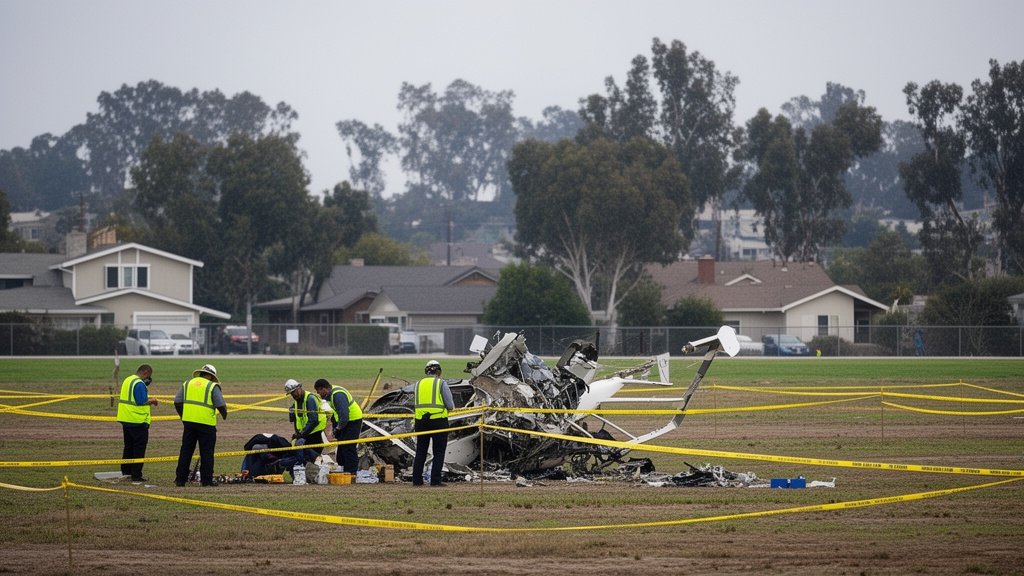
The quiet streets of Chatsworth were transformed into a scene of unspeakable tragedy when a news helicopter, engaged in its routine duty of monitoring traffic conditions, plummeted from the sky. The incident has sent shockwaves through the Southern California journalism community, casting a somber pall over newsrooms that rely daily on aerial reporting to keep the public informed. This catastrophic failure—resulting in the immediate loss of a dedicated news reporter, an experienced pilot, and a person on the ground—marks a dark day for aviation and local news media alike.
A Community in Mourning
In the immediate aftermath of the crash, the atmosphere in Los Angeles was one of collective grief. Local news stations, often fierce competitors in the race for ratings, united in an outpouring of solidarity. The phrase, “Our hearts are broken,” echoed across television broadcasts and social media platforms as colleagues and viewers alike grappled with the reality of the loss. The individuals involved were more than just staff; they were the eyes in the sky for millions of Angelenos, trusted voices who brought the city’s complex traffic and breaking news stories into living rooms across the region.
For the families of those lost, the grief is compounded by the suddenness and public nature of the tragedy. The victim on the ground, an innocent bystander going about their day, highlights the terrifying unpredictability of aviation accidents. Authorities have cordoned off the area to allow for a meticulous investigation, while vigils and tributes have begun to emerge near the crash site, symbolizing the city’s shared pain.
The NTSB Investigation Protocol
The National Transportation Safety Board (NTSB) has launched a comprehensive investigation to determine the probable cause of the crash. Aerial accidents involving helicopters are notoriously complex, requiring the examination of mechanical, environmental, and human factors. Investigators are currently focused on several key areas:
- Flight Data Recorder Analysis: Determining if the “black box” captured any anomalies in altitude, speed, or engine performance in the moments leading up to the descent.
- Mechanical Integrity: Inspection of the rotor system, engine components, and flight control linkages to rule out catastrophic mechanical failure.
- Environmental Factors: Assessing the weather conditions at the time, including wind shears or visibility issues that may have impacted flight dynamics in the Chatsworth area.
- Operational History: Reviewing the maintenance logs of the aircraft and the certification records of the pilot to ensure all regulatory standards were met.
This process is exhaustive and can take months, sometimes years, to yield a final report. However, the initial findings will be critical for the aviation industry to understand if this was an isolated incident or part of a wider trend in airborne news gathering.
The High Stakes of Airborne News Gathering
This accident forces a critical conversation regarding the necessity and risk profile of news helicopters in an era dominated by drone technology and satellite data. For decades, the “eye in the sky” has been a staple of L.A. news, providing crucial, real-time context for traffic accidents, police pursuits, and wildfires. However, the inherent danger of operating low-altitude, manned aircraft in congested urban airspace has long been a point of concern for safety advocates.
Broadcasting executives are now facing difficult questions about the future of live aerial reporting. The reliance on manned helicopters provides a unique, high-resolution perspective that drones, with their battery and range limitations, often cannot replicate. Yet, the cost—measured not just in dollars, but in human life—is coming under renewed scrutiny. We may see a temporary grounding of similar fleets as stations across the country conduct safety audits and re-evaluate their reliance on manned aerial platforms.
The Psychological Toll on Newsrooms
Beyond the logistics and the investigations, there is the human element: the trauma inflicted upon the newsroom. Journalists work in a high-stress, fast-paced environment where resilience is often prioritized over emotional processing. Losing a colleague in such a visceral, public manner shatters that veneer. The mental health support systems for news staff are currently being tested, as reporters and producers attempt to report on a story that hits uncomfortably close to home. The industry is currently rallying to provide counseling and support services, recognizing that the healing process will be long and arduous for all involved.
A Legacy of Service
As the investigation proceeds, the legacy of the fallen journalist and pilot will not be defined by the crash, but by their contribution to public information. They were part of a team dedicated to transparency and truth. Their work ensured that the public was aware of hazardous road conditions, assisting in traffic flow and safety long before navigation apps became ubiquitous. The media landscape in Los Angeles will undoubtedly be quieter, and perhaps more cautious, in the weeks to come as the industry reflects on the heavy price paid for the information they deliver daily.
FAQ: People Also Ask
What is the typical protocol for a news helicopter flight?
News helicopters operate under strict FAA regulations for Part 135 operations (commuter and on-demand operations). Pilots are required to maintain specific altitudes and flight paths, especially in urban environments, to ensure separation from other aircraft and populated areas. Daily flights are planned around major traffic arteries and breaking news events.
How are investigators determining the cause of this crash?
The NTSB (National Transportation Safety Board) utilizes the “party system,” inviting representatives from the aircraft manufacturer, the FAA, and the operating company to assist in the investigation. They conduct a wreckage recovery, interview witnesses, analyze ATC (Air Traffic Control) communications, and examine radar data to reconstruct the final moments of the flight.
Will this accident lead to a ban on news helicopters?
While a total ban is unlikely given the competitive need for unique aerial footage, this tragedy will almost certainly lead to enhanced safety mandates, stricter maintenance intervals, and perhaps a transition toward more advanced automated systems or high-end heavy-lift drones where appropriate. The industry is highly reactive to such incidents, often implementing self-imposed “safety stands” immediately following a fatality.
What happens to the footage captured during the flight?
Any data recorded by the aircraft’s onboard systems or the news feed is preserved as part of the legal evidence. News stations are required to hand over all relevant footage to federal investigators, who treat the raw material as critical evidence in reconstructing the event.