Verizon customers across Southern California are grappling with significant service disruptions today, as company officials confirmed that the ongoing connectivity failures are the direct result of targeted acts of vandalism. The incident has sent shockwaves through the region’s communications network, prompting an immediate investigation involving local law enforcement and utility security teams to secure critical infrastructure and restore services to affected businesses and households.
The Anatomy of the Network Disruption
The service outages, which began earlier this week, were initially suspected to be a technical glitch or maintenance issue. However, internal Verizon diagnostic teams quickly pivoted after discovering physical interference with critical telecommunications conduits. The vandalism involves the intentional destruction of fiber optic cabling, the backbone of modern data transmission. Unlike copper wiring, which was the target of metal theft in the past, these fiber optic cuts appear to be a deliberate attempt to sabotage communication flow, as fiber holds little to no scrap value, suggesting a more sinister motive behind the destruction.
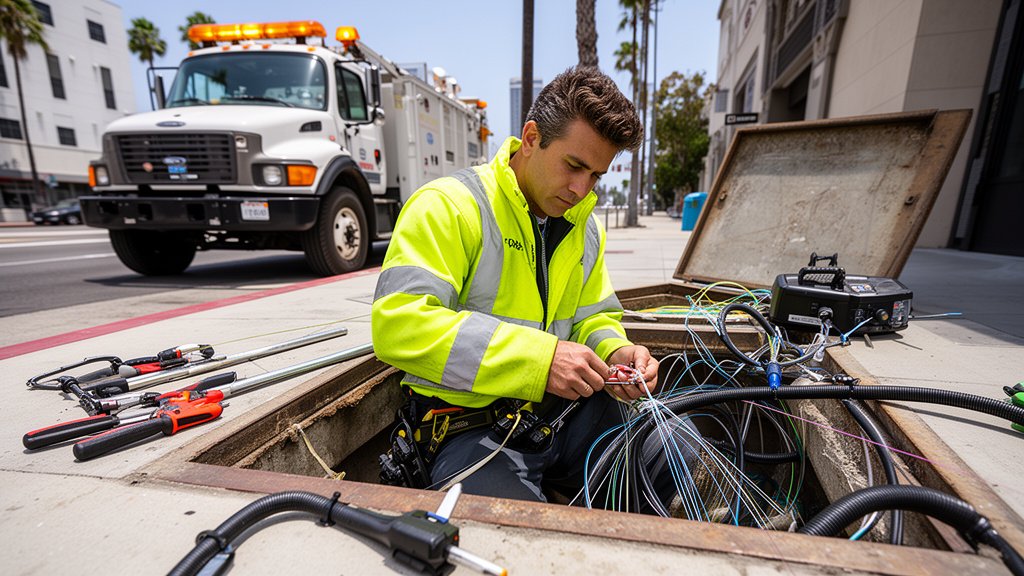
Technicians dispatched to the site of the outages found that protective conduits had been breached at multiple subterranean points. This type of damage is notoriously difficult to repair because fiber optic cabling requires precise splicing—often conducted in a controlled environment—to ensure signal integrity. The physical destruction of these lines has effectively ‘severed’ the digital arteries connecting key hubs across Southern California, leading to a cascade of service losses for Verizon customers, ranging from high-speed internet and cellular data to landline voice services.
The Economic Ripple Effect on Southern California
The impact of this vandalism extends far beyond simple inconvenience for residential users; it represents a significant economic disruption for the Southern California region. Local businesses, which have become increasingly reliant on cloud-based infrastructure and seamless connectivity, have reported operational paralysis. Point-of-sale systems, supply chain logistics software, and remote workforce communication tools have been rendered non-functional in the affected zones.
Furthermore, the outage has complicated public safety communications. While emergency services (911) are often routed through redundant, hardened fiber paths, the degradation of the commercial cellular network can create congestion and confusion during critical windows. Business analysts suggest that the cumulative economic loss from this outage, given the duration of the repairs and the density of the affected commercial districts, will reach into the millions of dollars. The disruption highlights a vulnerability in modern city planning: the reliance on exposed, singular points of physical network infrastructure.
Law Enforcement and Infrastructure Security
Verizon has confirmed that they are working in lockstep with law enforcement agencies to identify the perpetrators. Given the sophistication and specificity of the damage—which suggests the attackers had knowledge of where the lines were buried—the investigation is treating this as an act of criminal sabotage rather than random vandalism. Specialized units are currently reviewing surveillance footage from nearby commercial buildings and traffic cameras, hoping to pinpoint the exact time of the breach.
This incident has ignited a wider conversation regarding the security of critical telecommunications infrastructure. Historically, fiber optic lines have been treated with the same physical security protocols as public utilities like sewage or gas, but the rising frequency of infrastructure attacks suggests that telecom providers may need to implement more rigorous surveillance, intrusion detection, and alarm systems. There is growing pressure from municipal leaders for Verizon to invest in hardened, armored conduit infrastructure to prevent future occurrences of such debilitating sabotage.
Building Resilient Networks
In the wake of this crisis, Verizon has mobilized emergency response crews, working around the clock to re-route traffic and splice the damaged lines. While service restoration is the immediate priority, the long-term question remains: how does a major telecommunications provider protect thousands of miles of exposed cable from bad actors? Experts in critical infrastructure protection argue that the solution involves a combination of better subterranean mapping security, real-time pressure and light-leakage monitoring, and stricter penalties for those found tampering with communication networks. As the investigation into the Southern California sabotage continues, the tech community is watching closely, anticipating potential policy shifts regarding the legal classification of telecommunications infrastructure damage as a serious federal crime.
FAQ: People Also Ask
1. Are these Verizon outages currently affecting emergency 911 calls?
Verizon officials have stated that while commercial voice and data services are severely impacted, they are working to ensure that emergency communications remain prioritized. However, users in affected areas are encouraged to use landlines or Wi-Fi calling options where available if cellular signal remains unstable.
2. Is there a timeline for full service restoration?
Verizon has activated emergency response teams to handle the physical repairs. While the company has not provided a minute-by-minute ETA due to the complexity of splicing fiber optic cables, they have committed to prioritizing high-density commercial hubs and residential areas to restore baseline connectivity as quickly as possible.
3. Why would someone target fiber optic lines if they have no scrap value?
Unlike copper wiring, which can be stolen and sold to scrapyards, fiber optic cables contain glass strands with almost no resale value. The targeting of these lines is almost exclusively motivated by sabotage, disruption, or civil unrest, making these incidents distinct from traditional utility theft.