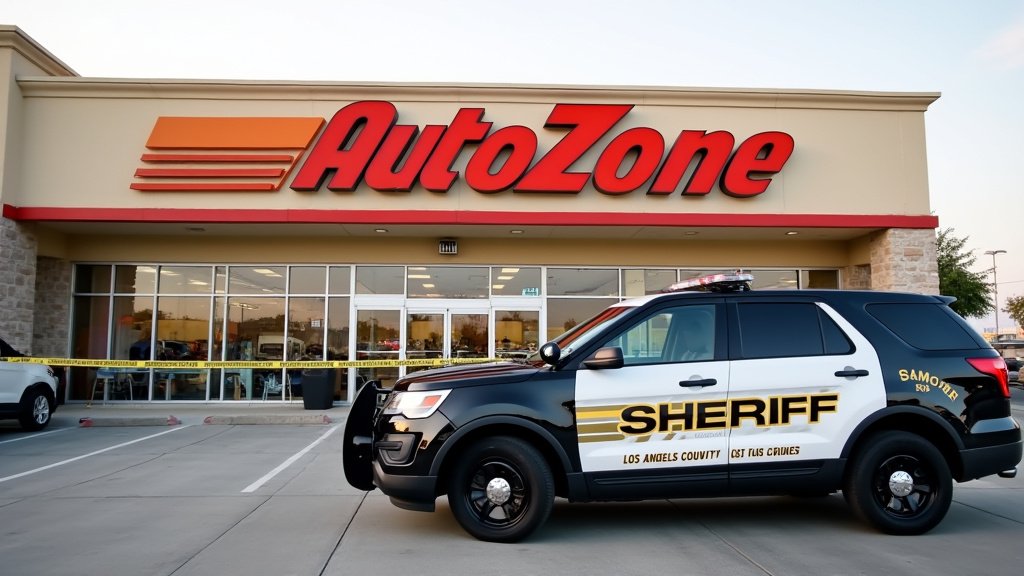
The Los Angeles County Sheriff’s Department (LASD) has launched an intensive investigation following a brazen, coordinated burglary at an AutoZone located in East Los Angeles. Law enforcement officials are currently seeking the public’s assistance in identifying 16 suspects who were captured on surveillance footage during the incident, which occurred on August 9. This high-profile investigation highlights the escalating challenge of large-group retail thefts, known as ‘flash mob’ burglaries, which have increasingly plagued Southern California businesses. Detectives are not treating this as an isolated event; they are actively exploring potential connections to a separate, chaotic street takeover event that occurred at the same location, suggesting a disturbing crossover between illegal vehicular gatherings and organized commercial crime.
Key Highlights
- Incident Overview: On August 9, a group of 16 individuals carried out a coordinated burglary at an AutoZone in East Los Angeles, resulting in significant loss and property damage.
- Active Investigation: The Los Angeles County Sheriff’s Department is requesting public help to identify the suspects, releasing surveillance footage to assist in the identification process.
- Potential Links: Investigators are probing whether this burglary is linked to a prior ‘street takeover’ event at the same commercial intersection, signaling a broader pattern of criminal activity.
- Community Safety: The incident has sparked urgent discussions regarding retail security and the policing of street takeovers in the East Los Angeles region.
Anatomy of the East LA AutoZone Burglary
The events of August 9 began as an organized disruption, rapidly evolving into a commercial burglary. According to reports from the LASD, the group entered the AutoZone location in East Los Angeles with a singular focus: to overwhelm the store’s capacity to react and remove merchandise in a systematic, high-speed manner. Unlike traditional shoplifting, which typically involves individual acts of theft, this incident was characterized by the sheer volume of participants.
For store employees, the sudden influx of 16 individuals creates a scenario that is practically impossible to manage without escalating the risk of violence. Modern retail security protocols emphasize ‘de-escalation’ and the protection of human life over merchandise, a reality that these criminal groups increasingly exploit. By operating in such large numbers, the suspects minimize their individual risk of being tackled or detained, relying on the ‘safety in numbers’ phenomenon to exit the premises before law enforcement can arrive at the scene.
The Intersection of Street Takeovers and Retail Crime
One of the most concerning aspects of this investigation is the potential link to a previous street takeover at the same AutoZone location. Street takeovers—illicit gatherings where motorists block intersections to perform stunts and donuts—have become a significant public safety crisis in Los Angeles. The convergence of these two criminal activities suggests a new, highly mobile modus operandi for local gangs and organized retail theft rings.
In many instances, the chaotic environment of a street takeover serves as a tactical diversion. When vehicles block major intersections, it delays police response times, effectively creating a ‘safe zone’ for nearby criminal activity. Investigators are now analyzing whether the AutoZone burglary was a target of opportunity facilitated by such a disruption, or if the street takeover itself was a planned cover for the retail crime. This evolution in criminal methodology creates a multi-layered headache for the LASD, as they must simultaneously manage crowd control, vehicular offenses, and felony-level property crimes.
Law Enforcement Challenges and Public Cooperation
Identifying 16 distinct suspects presents a logistical challenge for the Los Angeles County Sheriff’s Department. While surveillance technology in retail environments has improved, these suspects often utilize masks, hoodies, and other facial coverings to obstruct identification. Furthermore, tracking 16 different individuals requires significant detective hours, forensic analysis, and the synthesis of digital evidence from various sources, including social media posts—which are frequently where these ‘flash mobs’ are organized and boasted about.
‘The public is our greatest force multiplier,’ stated a spokesperson for the LASD, emphasizing that the department relies heavily on tips submitted through anonymous channels like Crime Stoppers. The investigation is currently relying on analyzing the unique characteristics of the suspects, such as clothing, tattoos, or vehicles seen arriving or departing the area. The integration of community intelligence with traditional investigative methods remains the primary strategy for narrowing the net on these suspects.
Broader Economic and Community Impact
Beyond the immediate financial loss to the AutoZone franchise, such events have a chilling effect on the local community. Small businesses in East Los Angeles operate on thin margins; when their security is compromised, the cost of doing business rises. This includes increased insurance premiums, the cost of hiring private security, and the psychological impact on staff and customers who no longer feel safe in their local retail environments. If such locations are perceived as high-risk by national chains, it can lead to store closures, creating ‘retail deserts’ that negatively impact the local economy and limit access to essential automotive parts for residents who rely on their vehicles for work.
Moving forward, the LASD is coordinating with other local agencies to increase patrols and surveillance in areas known to be hotspots for street takeovers. The objective is to deter these coordinated retail ‘smash and grabs’ before they begin by maintaining a visible presence and acting on intelligence gathered from past incidents.
FAQ: People Also Ask
Q: How can the public assist the LASD in this investigation?
A: The Los Angeles County Sheriff’s Department urges anyone with information regarding the identity or whereabouts of these 16 suspects to contact the East Los Angeles Station directly or provide anonymous tips via L.A. Regional Crime Stoppers. Every detail, no matter how small, could be critical.
Q: What is the significance of the link between the burglary and street takeovers?
A: The potential connection suggests a sophisticated coordination where street takeovers are used as tactical distractions to impede law enforcement response times, allowing retail crimes to occur with minimal interference.
Q: Are retail ‘flash mob’ crimes increasing in Los Angeles?
A: While law enforcement and major retailers have implemented stricter security measures, these events remain a persistent challenge in Los Angeles. The group dynamic used in these thefts is specifically designed to overwhelm store personnel and bypass traditional loss prevention efforts.
Q: What are the potential charges for these suspects?
A: Depending on the value of the goods stolen and the level of force or intimidation used, the suspects could face charges ranging from grand theft to commercial burglary, with potential enhancements for acting in a coordinated criminal conspiracy.