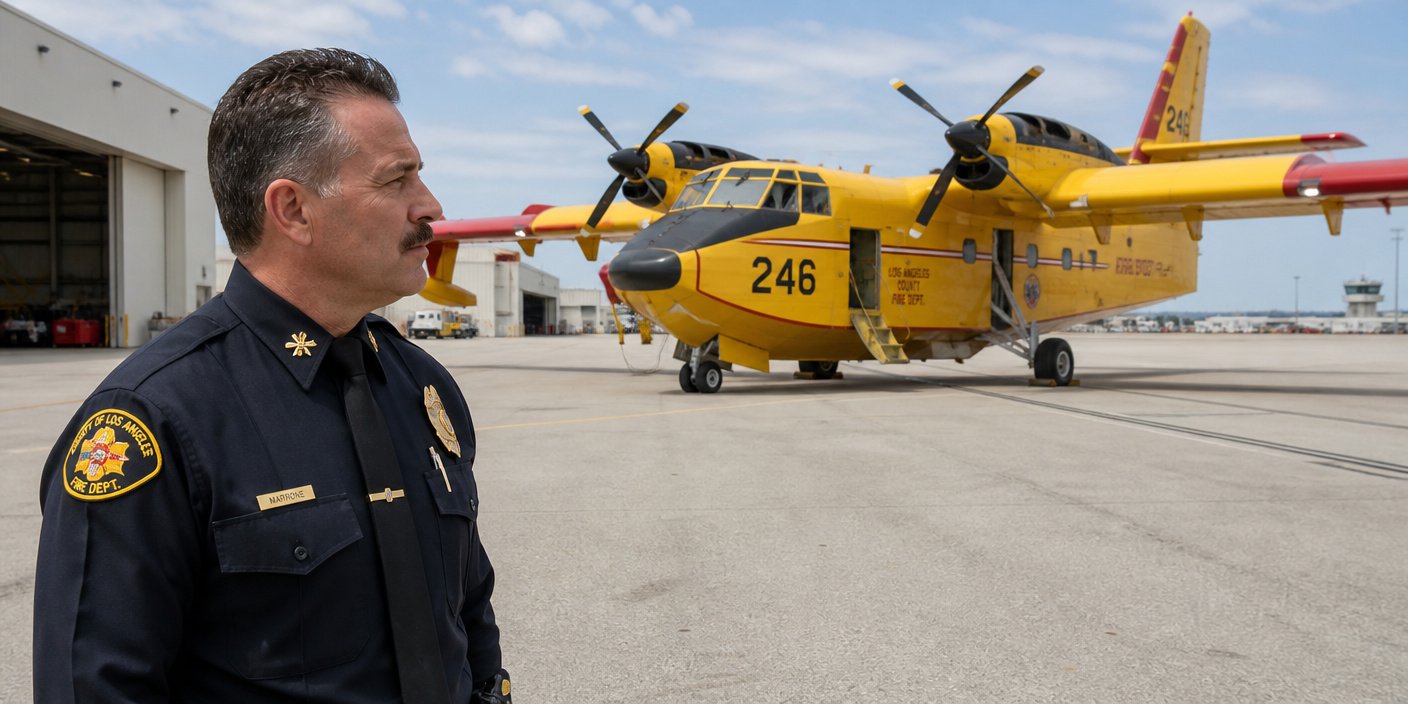
The Los Angeles County Fire Department (LACoFD), under the leadership of Fire Chief Anthony Marrone, has officially commenced its seasonal aerial firefighting readiness program. In a high-visibility event at Van Nuys Airport, the agency showcased its comprehensive air-support fleet, signaling a robust and proactive stance against the mounting threats posed by the upcoming 2026 wildfire season. With climate volatility continuing to reshape the Southern California landscape, the return of the iconic, Québec-leased SuperScoopers marks a critical milestone in the county’s defensive capabilities.
Key Highlights
- Aerial Reinforcements: The return of the Canadair CL-415 ‘SuperScoopers,’ leased through an ongoing international partnership with the Province of Québec, bolsters the county’s initial attack capacity.
- Leadership Directives: Fire Chief Anthony Marrone emphasized a pivot toward early detection and rapid deployment, utilizing the fleet to stop brush fires before they escalate into conflagrations.
- Strategic Location: The demonstration at Van Nuys Airport highlighted the logistical efficiency of placing heavy-lift aerial assets in proximity to high-risk zones.
- Community Empowerment: Beyond aviation hardware, LACoFD underscored new ‘Ready! Set! Go!’ initiatives to help residents harden their properties against ember casts and rapid fire spread.
Fortifying the Skyline: The 2026 Aerial Defense Strategy
The showcase at Van Nuys Airport was more than a ceremonial display; it was a tactical signal to the region that the Los Angeles County Fire Department is shifting its wildfire management posture. As the 2026 fire season approaches, the emphasis is heavily weighted toward suppression speed. The return of the SuperScoopers—specialized amphibious aircraft capable of skimming across lakes to refill their water tanks in seconds—provides the department with an unmatched tactical advantage in mountain and foothill environments.
The Strategic Value of the SuperScooper
The Canadair CL-415, widely known as the SuperScooper, remains a cornerstone of the LACoFD’s wildfire mitigation strategy. Unlike traditional helicopters that require landing or hovering over specific fill points, the SuperScoopers can ‘scoop’ water from reservoirs and the Pacific Ocean. This capability allows for continuous, rapid-turnaround water drops, effectively cooling fire perimeters while ground crews establish containment lines. During the demonstration, technical teams reviewed maintenance logs and flight readiness protocols to ensure these aircraft are mission-ready the moment the first dry, gusty Santa Ana wind conditions are detected.
Chief Marrone’s Operational Pivot
Fire Chief Anthony Marrone has been vocal about the need for a ‘whole-of-government’ approach to fire safety. During his remarks, he pointed to the increasing intersection of urban sprawl and wildland interfaces (WUI) as a primary driver of risk. The deployment strategy for 2026 is data-driven, utilizing predictive modeling to position the aerial fleet at Van Nuys—a central aviation hub—allowing for rapid response to fires in both the Santa Monica Mountains and the northern reaches of the county. Marrone noted that while technology is vital, the human element—coordination between ground crews, incident commanders, and aerial pilots—remains the department’s greatest asset.
The Québec-LA Pipeline: A Global Solution to Local Threats
One of the most intriguing aspects of this operation is the cross-continental partnership with the Province of Québec. This leasing program has become a vital component of Southern California’s fire defense. Because wildfire seasons are seasonal and geographically distinct, the ability to lease these high-performance aircraft during the peak risk periods in California offers an economically efficient alternative to purchasing and maintaining a permanent fleet of CL-415s year-round. This arrangement serves as a global model for resource sharing, proving that climate-driven risks require international cooperation.
Technological Integration and Future Forecasting
The LACoFD is also integrating new sensory technologies into its flight operations. Beyond the hardware of the planes themselves, the department is deploying advanced infrared mapping equipment that transmits real-time fire spread data directly to the cockpit. This allows pilots to target ‘hot spots’ with surgical precision rather than dispersing water over wide, less-critical areas. This evolution in technical proficiency is expected to be a force multiplier for the 2026 season, reducing the overall acreage burned per incident.
Community Resilience and Home Hardening
While the aerial display commanded the headlines, Chief Marrone was careful to remind the public that air support is the final line of defense, not the first. The department is doubling down on public education regarding ‘home hardening.’ The ‘Ready! Set! Go!’ program, which is being updated for 2026, emphasizes simple, high-impact changes for homeowners: removing combustible vegetation within five feet of structures, ensuring roof gutters are clear of debris, and utilizing non-combustible building materials. The department’s goal is to reduce the number of structures lost, allowing aerial assets to focus their efforts on aggressive containment in the wildlands.
FAQ: People Also Ask
Q: Why does LA County lease firefighting aircraft from Québec?
A: It is a strategic cost-saving measure. By leasing the SuperScoopers during the peak Southern California wildfire season, the county gains access to elite aerial firefighting assets without the immense long-term capital expense of purchasing, housing, and maintaining them year-round.
Q: How do SuperScoopers actually work during a fire?
A: The Canadair CL-415s are amphibious aircraft. They can skim across a body of water—such as a reservoir or the ocean—at high speed, scooping over 1,600 gallons of water in approximately 12 seconds, allowing them to return to the fire line rapidly without needing to return to an airport base to refill.
Q: How can residents prepare for the 2026 fire season?
A: The LACoFD recommends strictly following the ‘Ready! Set! Go!’ protocol. This includes creating defensible space by clearing brush, hardening homes with fire-resistant materials, and having an emergency evacuation plan ready for all family members, including pets, before the fire season reaches its peak.