
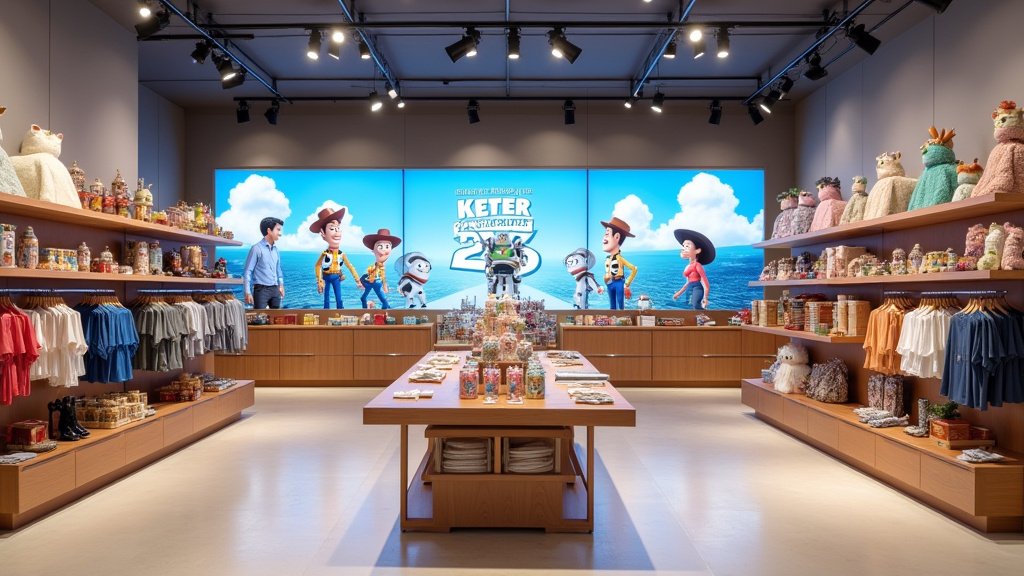
Disney’s latest Q3 fiscal report has delivered a seismic shift in the entertainment landscape, confirming that the studio’s latest animation powerhouse, ‘Toy Story 5’, has officially surpassed the $1 billion mark at the global box office. Even more impressive is the simultaneous revelation that the film has generated an additional $1 billion in global merchandise sales, highlighting a rare, dual-stream revenue performance that underscores the enduring strength of the franchise.
Key Highlights
- Global Box Office: ‘Toy Story 5’ has officially crossed the $1 billion revenue threshold, reaffirming Disney’s dominance in the theatrical space.
- Merchandising Success: An additional $1 billion in consumer merchandise sales highlights the deep, cross-platform engagement of the franchise.
- Q3 Fiscal Performance: The dual $1 billion milestone marks a significant highlight in Disney’s latest quarterly fiscal report, signaling robust health for the animation division.
- Strategic Synergy: This data points to the effectiveness of Disney’s “Total Franchise” strategy, where content and physical retail experiences are synchronized to maximize value.
The Anatomy of a $2 Billion Animation Juggernaut
The figures released in Disney’s Q3 report are not merely numbers; they represent a masterclass in modern media economics. By achieving a split of $1 billion in ticket sales and $1 billion in retail merchandise, ‘Toy Story 5’ has effectively created a $2 billion revenue event. This level of performance is rare in the post-pandemic cinema landscape and provides critical insight into how the Walt Disney Company is pivoting its strategy to emphasize high-value, high-engagement intellectual properties (IP) that transcend the screen.
Scaling the Box Office
The theatrical performance of ‘Toy Story 5’ serves as the anchor for the entire corporate narrative this quarter. Crossing the $1 billion global threshold is a testament to the brand’s resilience and its ability to capture both the nostalgia of older generations and the excitement of new audiences. In an era where streaming has fragmented the entertainment market, the theatrical success of this film proves that Disney’s core strategy—prioritizing “event cinema” that demands a shared cultural experience—remains the most reliable path to massive revenue growth. The global distribution network, which has been optimized over the last few years, played a pivotal role in ensuring this film reached audiences in key emerging markets, further bolstering these record-breaking numbers.
The Merchandise Synergy
Equally vital is the secondary revenue stream: the $1 billion in merchandise. Often, merchandise revenue is considered a “long tail” effect, yet for ‘Toy Story 5’, it has proven to be an immediate force multiplier. This success highlights the effectiveness of Disney’s consumer products division in aligning product releases with theatrical windows. By ensuring that tangible, collectable items are available at the moment of peak cultural awareness, Disney has successfully converted passive viewership into active consumer participation. This symbiotic relationship between the film and its retail presence allows Disney to mitigate the inherent risks of theatrical release windows while building a perpetual revenue cycle that extends long after the film exits theaters.
Strategic Implications for Disney
The Q3 results provide a clear roadmap for the company’s future. By proving that a single IP can dominate in both digital and physical retail spaces, Disney is likely to double down on this “ecosystem” approach. Investors have long looked for proof that Disney’s pivot away from purely chasing subscriber counts on Disney+ back toward a hybrid model of theatrical prestige and physical retail dominance would pay off. This report offers that proof. The success of ‘Toy Story 5’ validates the decision to leverage Pixar’s most iconic franchise to anchor their balance sheet, providing the capital necessary for the company to explore bolder, more experimental projects in the coming years. Furthermore, it reinforces the value of their vast library; by continuing to invest in legacy characters that have been meticulously nurtured over decades, Disney has effectively created an “immune system” against the volatility of the entertainment industry.
FAQ: People Also Ask
1. Does the $1 billion merchandise figure include digital sales?
While the specific breakdown is proprietary, the $1 billion figure typically reflects global sales of physical consumer products, including toys, apparel, and home goods associated with the film’s licensing, as noted in the Q3 fiscal data.
2. Why is the merchandise-to-box-office ratio significant?
The 1:1 ratio—generating as much in merchandise as in ticket sales—is a gold standard in the entertainment industry. It demonstrates that the movie is successfully driving “lifestyle” engagement, which is far more profitable for the company long-term than ticket sales alone.
3. How does this impact future Pixar projects?
This success provides a massive capital injection into Pixar Animation Studios. It signals to shareholders that Disney’s investment in its core animation pillars remains highly profitable, ensuring continued support for both sequels and new, original storytelling ventures.
4. Is the $2 billion figure considered a record for Disney?
While specific historical records vary, this performance ranks among the top-tier revenue events for a single property within a fiscal cycle, confirming that the ‘Toy Story’ franchise remains one of the most bankable assets in the history of the company.