
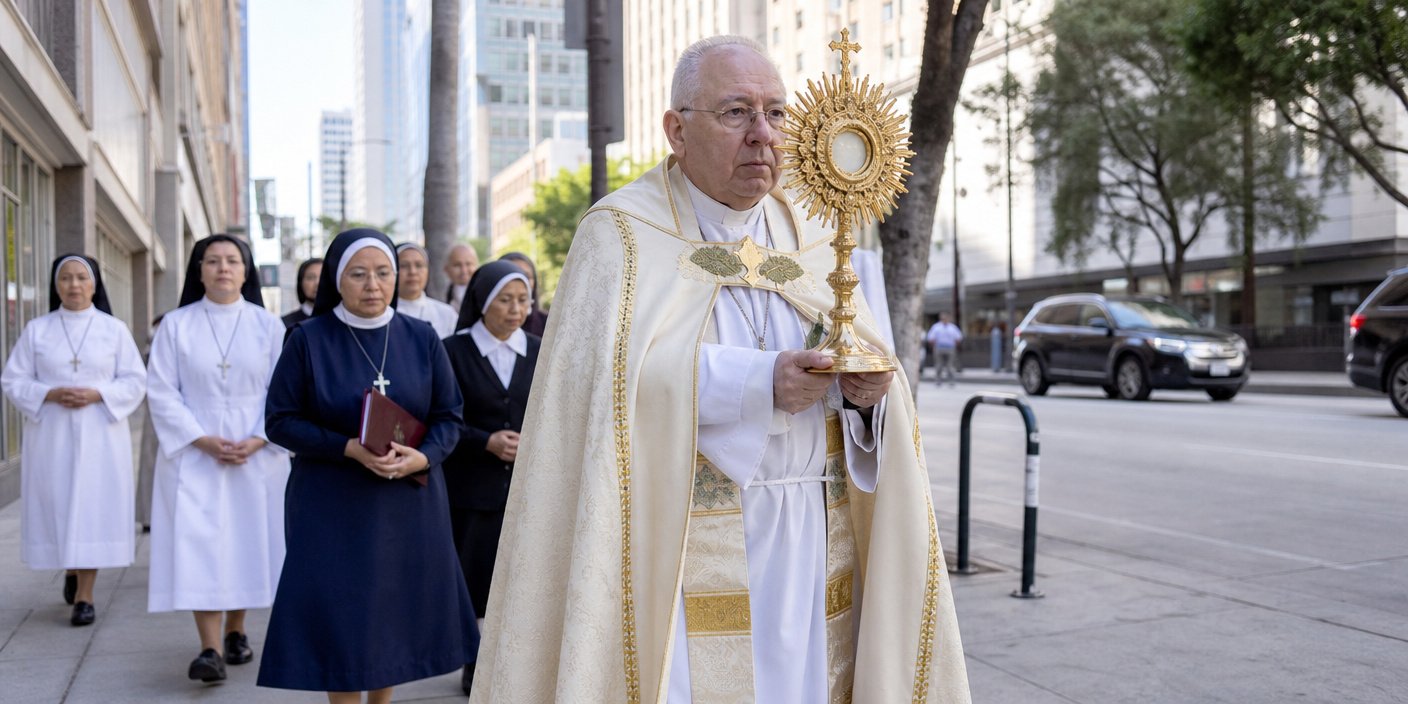
In a poignant intersection of traditional liturgy and contemporary humanitarian advocacy, Archbishop José Gomez of Los Angeles traversed the challenging streets of Skid Row this week. The Archbishop led a solemn Eucharistic procession, a practice rooted in centuries of Catholic tradition, through the heart of the downtown district. The event was organized in collaboration with the Sisters Poor of Jesus Christ, an international religious community whose mission is explicitly focused on serving the homeless and the abandoned populations within urban centers. As the procession moved through the blocks characterized by temporary shelters and significant societal challenges, the primary objective remained clear: to provide spiritual visibility and tangible support to a community often marginalized by mainstream society.
Key Highlights
- Missionary Collaboration: The event was a coordinated effort between the Archdiocese of Los Angeles and the Sisters Poor of Jesus Christ, emphasizing a shared commitment to ‘street ministry.’
- Spiritual Outreach: The Eucharistic procession serves as a form of public prayer, bringing the focus of the Catholic faith directly into the environment where residents live and struggle daily.
- Addressing Urban Crisis: The procession highlighted the ongoing challenges in Skid Row, drawing attention to the needs of the homeless population in the downtown Los Angeles core.
- Pastoral Presence: Archbishop Gomez’s participation underscores the Archdiocese’s commitment to consistent, ‘on-the-ground’ pastoral presence rather than relying solely on institutional charity.
A Theology of the Streets: Bridging Faith and Reality
The decision to conduct a Eucharistic procession in Skid Row is deeply rooted in the concept of ‘missionary discipleship’ emphasized by current church leadership. Unlike a traditional parish setting, where the faithful gather in a sanctuary, this procession brings the sanctuary into the public square. For Archbishop José Gomez, this action is not merely symbolic; it reflects a broader theological conviction that the church must go where the suffering is most acute.
The Historical Context of Eucharistic Processions
Eucharistic processions, historically referred to as Corpus Christi processions, date back to the 13th century. Traditionally, they serve as a public witness of faith, where the consecrated host is carried through the streets to bless the community. By transplanting this ancient tradition into the contemporary reality of Skid Row, the Archdiocese is making a profound statement about the inherent dignity of every human person. This is not about conversion in a coercive sense, but about the presence of the divine in the midst of squalor. It challenges the observer to rethink the architecture of their own compassion and the physical boundaries of their charitable work.
The Charisma of the Sisters Poor of Jesus Christ
The Sisters Poor of Jesus Christ play a pivotal role in this narrative. Founded in Brazil, this religious community has made a significant mark on the Los Angeles landscape. Their charism—or spiritual ‘gift’—is distinctly focused on the ‘poor of the poor.’ They are known for living a life of voluntary poverty, often residing in or very near the communities they serve. Their collaboration with Archbishop Gomez is strategic. The sisters possess an intimate knowledge of the daily realities of Skid Row residents—the lack of sanitation, the prevalence of mental health crises, and the constant struggle for basic nutrition. By acting as the bridge between the high office of the Archbishop and the street-level reality of the homeless, they ensure that the procession is not an isolated event, but a continuation of their daily pastoral work.
The Sociological Impact of Skid Row
Skid Row, covering roughly 50 blocks in downtown Los Angeles, remains one of the most concentrated areas of homelessness in the United States. It is a place of complex sociological layers, encompassing a history of urban planning, economic displacement, and social service clustering. When the Archbishop walks these streets, he is interacting with a demographic that is often the subject of intense political debate but frequently lacking in consistent, personal engagement from institutional leaders. The procession serves to de-stigmatize the location. It forces the public eye, and indeed the eye of the wider city, to acknowledge that this neighborhood is part of the living, breathing body of Los Angeles.
Future Implications for Urban Ministry
Looking forward, this event suggests a shift in how major metropolitan dioceses approach urban poverty. There is a growing movement toward ‘proximity’—the idea that you cannot understand or solve a problem from a distance. The success of this procession, measured by the engagement of the local community and the subsequent attention brought to the Sisters’ work, may serve as a blueprint for other urban areas. It demonstrates that the future of religious engagement in major US cities lies in physical presence, consistent collaboration with specialized religious orders, and the willingness to take tradition out of the cathedral and onto the concrete.
FAQ: People Also Ask
What is a Eucharistic Procession?
A Eucharistic procession is a Catholic tradition in which the Eucharist—the consecrated bread believed to be the body of Christ—is placed in a monstrance (a sacred vessel) and carried publicly through streets or communities. It is intended as an act of prayer, blessing, and public witness to the faith.
Who are the Sisters Poor of Jesus Christ?
The Sisters Poor of Jesus Christ are a religious order founded in Brazil that specializes in ministering to the homeless, the addicted, and the marginalized. They operate in various cities worldwide, including Los Angeles, where they maintain a daily presence in Skid Row to provide both spiritual and practical aid.
Why did the Archbishop choose Skid Row for this event?
The choice of location was intentional, aimed at bringing the ‘peripheries’ to the center of the Church’s attention. By processing through Skid Row, Archbishop Gomez aimed to offer spiritual support to the homeless population and highlight the ongoing efforts of religious orders working to alleviate their suffering.
How does this differ from standard charity work?
While standard charity work often focuses on material needs—food, clothing, or housing—this event added a spiritual dimension. It was intended to offer dignity, acknowledgement, and prayer to individuals who are often ignored or treated as invisible by the wider society.