The aviation industry is currently navigating an intense recovery phase after a widespread Federal Aviation Administration (FAA) ground stop forced a pause in air traffic nationwide. As the agency lifted the stop, airlines immediately pivoted to ‘reset’ mode, a complex, multi-layered logistical operation that involves thousands of aircraft, tens of thousands of crew members, and millions of passengers. The scale of the disruption has hit major international gateways particularly hard, with Los Angeles International Airport (LAX) serving as a focal point for the cascading delays and cancellations that have ripple-effected across the entire country.
Key Highlights
- Operational Reset: Airlines are forced to manually re-sync flight schedules, aircraft rotations, and crew pairings, a process that can take 24 to 48 hours to fully resolve.
- LAX Impact: As a premier international hub, LAX is seeing heightened congestion as international flights attempt to secure takeoff slots, exacerbating delays for domestic commuters.
- The Crew Pairing Dilemma: Beyond just moving planes, airlines are struggling to reconnect pilots and flight attendants with their assigned aircraft, which is often the primary bottleneck in recovery.
- Passenger Rights: Travelers are facing widespread rebooking challenges, with airlines prioritizing safety protocols and FAA regulatory compliance over previous scheduling commitments.
The Anatomy of a Nationwide Aviation Recovery
When the FAA issues a nationwide ground stop, it is effectively a total ‘stop-work’ order for civil aviation in the affected airspace. This is rarely a simple ‘pause and play’ event. For the airlines, the recovery is a massive, high-stakes game of Tetris played in real-time. Once the ground stop is lifted, carriers do not simply resume their schedule from the point of interruption. Instead, they must perform an ‘operational reset’ that requires a methodical recalibration of their entire network.
The Logistics of the ‘Reset’
The primary challenge following any ground stop is the mismatch between aircraft and crew. In a healthy operation, flight schedules are tightly coupled. A pilot might fly four legs in a single day, and the aircraft itself might be scheduled for six flights, each with a different crew rotation. When a ground stop hits, this delicate web is shattered. A crew member might time out (exceeding federal duty limits) while sitting on the tarmac at LAX, meaning they cannot legally operate their next scheduled flight.
Airline Operations Centers (AOCs) are currently working around the clock to re-pair these crews. This involves finding available pilots and flight attendants, many of whom have been displaced or put on standby, and matching them with aircraft that are now out of position. This is further complicated by ‘slot control’ at major airports. Because LAX, JFK, and other major hubs operate at near-capacity, airlines cannot simply launch all delayed flights at once. They must coordinate with the FAA to slot these flights back into the departure queue, often leading to a protracted series of delays that bleed into the next 24 to 48 hours.
LAX: A Case Study in Operational Gridlock
Los Angeles International Airport (LAX) represents a particularly vulnerable node in this crisis. As one of the busiest origin-and-destination airports in the world, its throughput is critical to the national network. During this recovery phase, LAX has become a bottleneck for both domestic and international traffic.
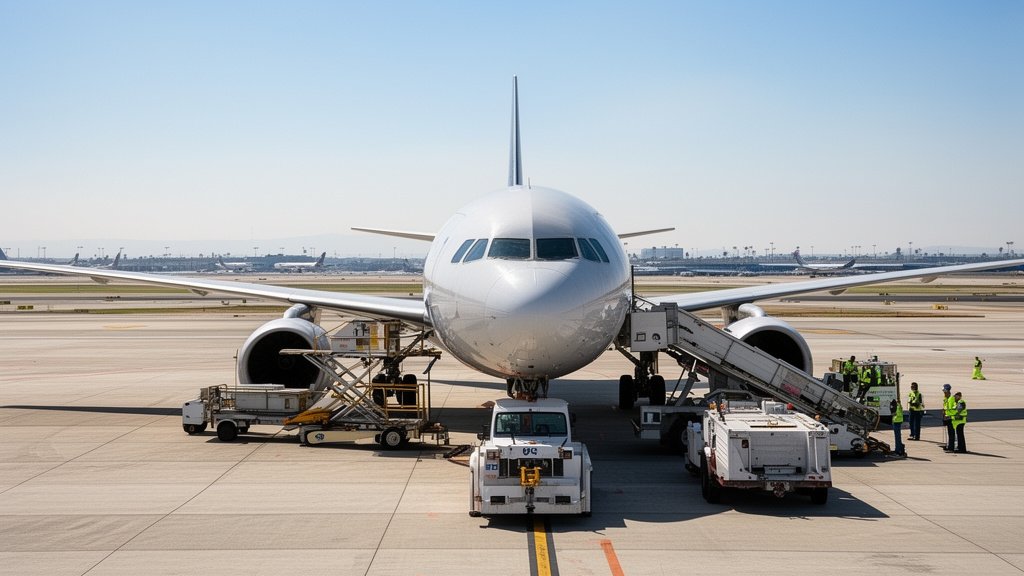
For international carriers, the ground stop is even more disruptive. Long-haul aircraft arriving from across the Pacific often have narrow arrival and departure windows to manage customs and crew rest periods. When these flights are delayed, they don’t just miss their next takeoff; they often miss their entire international turnaround window. This leads to ‘ghost flights’—instances where aircraft are grounded for extended periods, occupying gates and hardstands, preventing other aircraft from taxiing in or out. The logistical strain on ground handling teams—the teams responsible for refueling, baggage loading, and pushing aircraft back—is enormous, as they are tasked with clearing a backlog that has built up over several hours.
The Crew Pairing Crisis and Human Capital
While technology and automated dispatch systems manage the heavy lifting, the human element remains the biggest constraint. Federal regulations regarding flight crew duty hours are strict and non-negotiable. Following a ground stop, carriers often find themselves in a position where they have the aircraft and the runway capacity, but lack the legal personnel to operate the flight. This leads to the most visible sign of the recovery: flight cancellations. Airlines prioritize their most profitable and highest-demand routes, often leaving regional or less-frequent routes to be scrapped to consolidate crew resources.
This labor issue is compounded by the fact that many crew members are displaced. A pilot scheduled to fly from LAX to Chicago might have ended up in Denver due to the ground stop. Getting that pilot from Denver to LAX is not a simple taxi ride; it often requires placing them on a deadhead flight—a flight where they are a passenger—further consuming limited seat capacity on active aircraft.
Infrastructure Vulnerabilities and FAA Oversight
The frequency of these system-wide ground stops has brought renewed scrutiny to the aging infrastructure managed by the Federal Aviation Administration (FAA). Specifically, the Notam (Notice to Air Missions) system and the underlying telecommunications framework have been identified as single points of failure. While the FAA has been pushing for modernization through its NextGen program, the transition has been slow and technically demanding.
Critics and industry analysts argue that the reliance on legacy systems makes the US airspace unnecessarily fragile. During this recovery, the focus is on stability, but industry experts are already calling for a comprehensive review of the redundancies within the FAA’s traffic management protocols. The Department of Transportation (DOT) is expected to conduct a full review of the cascading failures, with an emphasis on how airlines can better manage the ‘re-entry’ of traffic into the system without causing multi-day disruption cycles.
The Passenger Perspective: What to Expect
For passengers, the post-ground-stop environment is characterized by uncertainty. When the dust settles on the initial stop, the ‘secondary wave’ of delays often hits hardest. This occurs when the backlog starts moving. Passengers at LAX and other major hubs are currently seeing a domino effect: a delay in the morning manifests as a cancellation in the afternoon.
Travelers are advised that airlines are operating under extreme stress. Rebooking algorithms are currently prioritized for high-status frequent flyers and those on international connections, which often leaves standard domestic travelers waiting in long queues. The most effective strategy during these recovery windows is to monitor airline apps for real-time changes, as gate agents are often overwhelmed and may not have the latest information compared to the centralized dispatch systems.
As the industry works through the current recovery, the primary goal for all stakeholders—from the FAA to the ground crew at LAX—is to prevent the ‘schedule creep’ that turns a four-hour ground stop into a three-day system-wide failure. While the current situation is improving, the logistical shadow of the ground stop will likely linger for the remainder of the week as the system attempts to find its equilibrium.