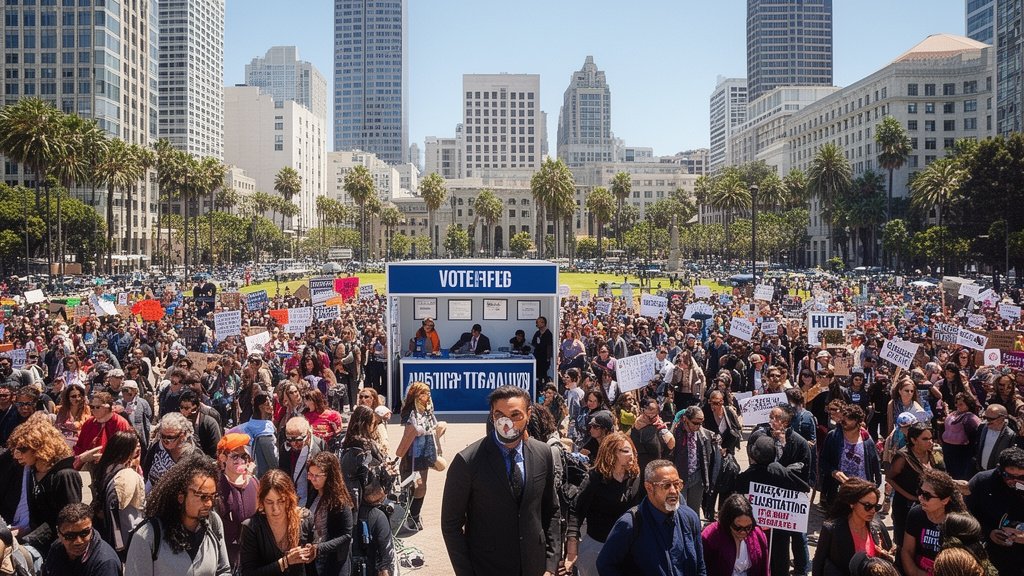
Federal authorities have initiated legal proceedings against 28 individuals, charging them with illegally registering to vote or casting ballots in California. This action follows a lawsuit initiated by the Trump administration that scrutinized noncitizen voting practices, particularly within Los Angeles County, and has brought the intersection of immigration status and electoral participation into sharp focus. The charges represent a significant effort by federal prosecutors to enforce statutes regarding voter eligibility, centering on the fundamental requirement that only U.S. citizens are permitted to participate in federal elections.
Key Highlights
- Charges Filed: 28 individuals have been charged by federal officials with crimes related to illegal voter registration or voting in California.
- Legal Basis: The prosecutions stem from federal statutes prohibiting noncitizens from falsely claiming U.S. citizenship on government forms, including those used at the Department of Motor Vehicles (DMV).
- Investigation Context: These charges are the culmination of inquiries following allegations of noncitizen voting in Los Angeles County, highlighting systemic concerns about election security.
- Potential Penalties: Convictions for these offenses can carry severe consequences, including significant fines, prison time, and potential immigration-related repercussions, such as deportation or denial of future visa applications.
The Legal and Political Fallout of Voter Registration Charges
The indictment of 28 individuals for illegal voter registration or casting ballots in California serves as a flashpoint in the ongoing debate surrounding election integrity. At the heart of the matter are federal laws that mandate strict citizenship requirements for voting in federal elections, contrasting with the operational realities of how voter rolls are maintained and how individuals interact with government agencies, such as the Department of Motor Vehicles (DMV).
The Mechanics of the Prosecution
Federal prosecutors have focused their efforts on the specific act of perjury committed on voter registration forms. When an individual registers to vote, they are legally required to sign an affidavit under penalty of perjury, attesting to their U.S. citizenship. The charges against the 28 defendants allege that these individuals knowingly provided false information on these forms. The investigation, which spanned several years, utilized data matching between various government databases to identify instances where individuals who were not U.S. citizens had nonetheless successfully navigated the registration process.
Legal experts note that the difficulty often arises from the “Motor Voter” system, created by the National Voter Registration Act (NVRA) of 1993. This act requires states to offer voter registration opportunities at motor vehicle agencies. Critics of the current system argue that this process, while designed to increase voter participation, can inadvertently lead to noncitizens being offered registration forms, potentially causing confusion or accidental registration by individuals who are ineligible. The prosecutions aim to signal that, regardless of how the registration occurred, the onus of legal compliance remains with the individual signing the affidavit.
Navigating the Complexities of Election Integrity in California
California, as the most populous state in the nation, operates a massive election apparatus. Los Angeles County alone oversees an electorate larger than that of many individual states. The sheer scale of this operation makes voter roll maintenance a Herculean task. The current federal interest in California’s voter rolls is driven by a desire to ensure that “deadwood”—voters who have moved, passed away, or are ineligible—are purged from the lists.
The lawsuit initiated by the administration aimed to compel more rigorous cross-referencing between social security databases and state voter registries. Proponents of these efforts argue that frequent “list maintenance” is essential to public confidence in election outcomes. Conversely, civil rights organizations have historically argued that aggressive list purging can inadvertently disenfranchise legitimate, eligible voters, particularly those from minority communities or those with common surnames, raising concerns about the potential for voter suppression.
The Future of Voter Eligibility Verification
Looking forward, these charges have accelerated the conversation regarding how digital infrastructure can be better utilized to verify citizenship in real-time. There is growing bipartisan discussion about implementing “e-verify” style systems for voter registration, which would allow officials to instantaneously check citizenship status against federal records. However, technical and privacy hurdles remain significant.
Furthermore, the impact on the individuals charged cannot be understated. For noncitizens, a criminal record related to voter fraud is not merely a legal hurdle; it is often a disqualifying factor for future naturalization. The federal government’s pursuit of these cases serves as a stark reminder of the long-term immigration consequences associated with violations of electoral laws. As the nation moves toward future election cycles, the tension between maximizing access to the ballot box and maintaining ironclad security measures will likely remain a central theme of domestic policy, with California serving as the primary proving ground for these competing priorities.
FAQ: People Also Ask
1. Can noncitizens vote in U.S. federal elections?
No. Under federal law, only U.S. citizens are permitted to vote in federal elections. Participating in such elections as a noncitizen is a federal crime.
2. What is the National Voter Registration Act (NVRA)?
Often referred to as the “Motor Voter Act,” the NVRA was passed in 1993 to make it easier for Americans to register to vote by requiring states to offer registration at motor vehicle departments and other public agencies.
3. How do noncitizens end up on voter rolls?
Most instances of noncitizen voter registration are cited as administrative errors or misunderstandings during the DMV application process. If an individual does not clearly understand the citizenship requirement on the registration form, they may sign it by mistake, which then triggers the legal jeopardy discussed in these charges.
4. What are the legal consequences of illegal voter registration?
Individuals convicted of falsely claiming citizenship to register to vote can face federal imprisonment, substantial monetary fines, and are typically rendered permanently ineligible for future naturalization or legal immigration status.