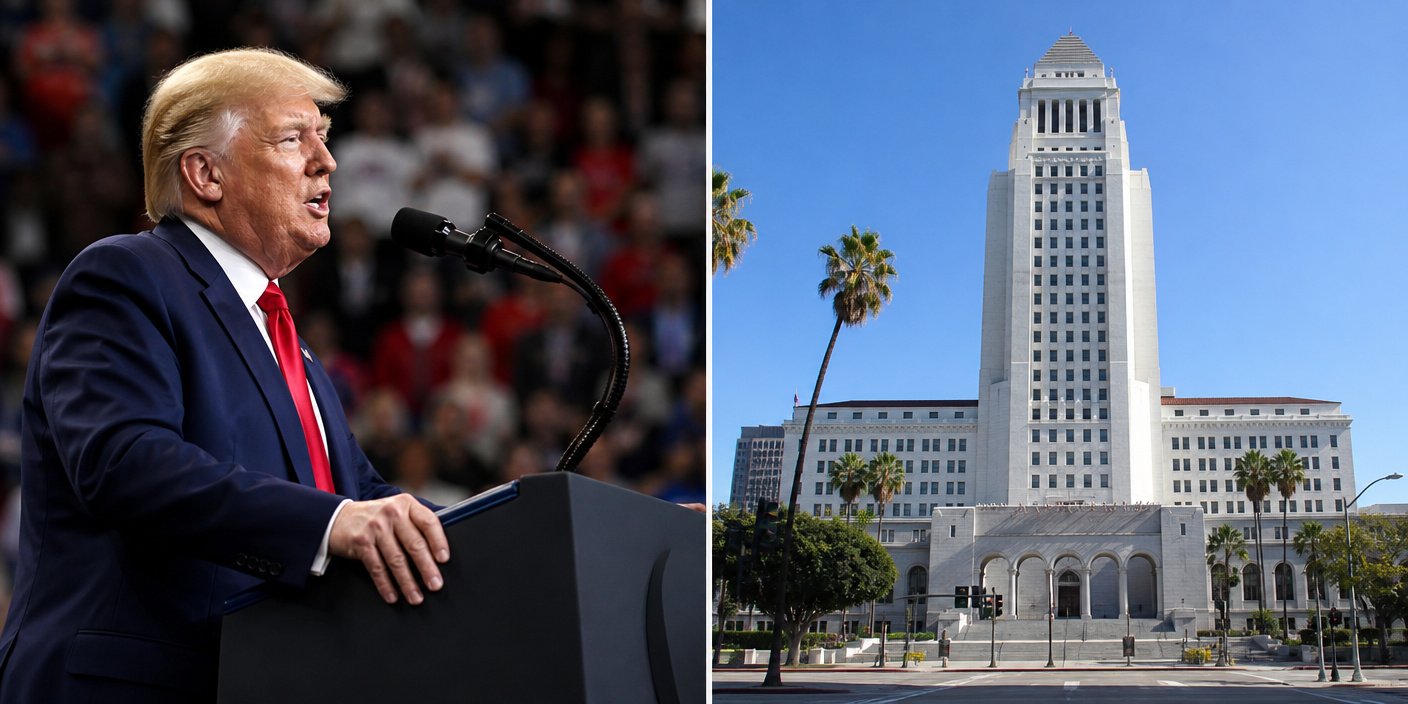
Former President Donald Trump’s recent remarks at a rally in Nebraska, in which he suggested that Iran could “take out” Los Angeles or San Diego, have ignited a firestorm of political backlash. The comments, framed as a hypothetical scenario regarding global safety, were quickly condemned by California’s highest-ranking officials, including Governor Gavin Newsom and Los Angeles Mayor Karen Bass, as both “dangerous” and “deranged.” This incident highlights the increasingly volatile nature of 2024 campaign rhetoric and its potential to unsettle domestic security discourse.
Key Highlights
- The Incident: During a campaign rally in Nebraska, Donald Trump hypothesized about Iran’s military capabilities, suggesting the nation could strike major California cities—specifically Los Angeles and San Diego—as a trade-off for current geopolitical instability.
- The Backlash: California Governor Gavin Newsom and Los Angeles Mayor Karen Bass issued scathing rebuttals, characterizing the remarks as reckless, inflammatory, and beneath the dignity of presidential discourse.
- Security Concerns: Local officials have expressed concern that using major American urban centers as “bargaining chips” or examples in rhetorical exercises undermines public trust and creates unnecessary panic.
- The Context: The comments occurred amidst a broader campaign narrative concerning foreign policy, where Trump frequently contrasts his approach with the current administration’s handling of Iran and Middle East stability.
The Rhetoric vs. Reality: Analyzing the Nebraska Incident
At the center of this controversy is the specific language used by the former President during a rally in Nebraska. While attempting to critique current U.S. foreign policy, Trump posited a hypothetical future in which Iran possesses the capability to threaten U.S. soil. By singling out Los Angeles and San Diego, he brought the abstract concept of international conflict directly into the domestic conversation, framing the hypothetical threat as a “small price to pay” for broader global safety concerns under different management.
The California Response: A Unified Condemnation
The reaction from California’s political establishment was immediate and categorical. Governor Gavin Newsom was among the first to address the comments, releasing a statement that emphasized the irresponsibility of such language. “To casually discuss the destruction of American cities—the homes of millions of citizens—is not a strategy; it is a profound dereliction of duty,” Newsom noted, echoing the sentiments of many in the Democratic base.
Similarly, Los Angeles Mayor Karen Bass underscored the potential real-world consequences of such rhetoric. Her office emphasized that rhetoric regarding the safety of major metropolitan areas should never be used as a political football. The condemnation suggests a widening gap between the former President’s campaign style and the expectations of municipal leaders responsible for the safety and psychological well-being of their constituents. The backlash has forced a conversation about the responsibilities of political figures when discussing national security and the specific vulnerability of large coastal cities.
Geopolitical Signaling and Domestic Strategy
Beyond the immediate political fallout, the comments raise deeper questions about how candidates communicate national security threats. Historically, presidential candidates tread carefully when discussing the vulnerability of specific U.S. cities to foreign attacks. By explicitly naming Los Angeles and San Diego, Trump tapped into a fear-based narrative that resonates with certain segments of his base, portraying the world as inherently dangerous and the current leadership as incapable of managing it.
However, from a security standpoint, experts argue that such statements are counterproductive. When a former President identifies specific cities as potential targets, it can inadvertently complicate the messaging of local law enforcement and federal intelligence agencies tasked with monitoring threats. The normalization of “city-targeting” scenarios in campaign speeches marks a departure from traditional foreign policy discourse, shifting toward a more aggressive, populist messaging style that prioritizes visceral impact over geopolitical nuance.
The Evolution of 2024 Campaign Language
The incident is emblematic of a larger trend in American politics: the acceleration of apocalyptic rhetoric. As the election cycle intensifies, candidates are increasingly using high-stakes, “worst-case scenario” framing to differentiate their foreign policy positions. This approach aims to cut through media noise but often results in controversies like the one surrounding the Nebraska rally. For voters, the challenge lies in distinguishing between campaign hyperbole designed to grab headlines and actionable foreign policy intent. As the discourse continues to evolve, the impact of such comments on local governance and national security sentiment remains a critical area of observation for political analysts and the public alike.
FAQ: People Also Ask
1. What exactly did Donald Trump say about Los Angeles and San Diego?
Trump suggested in a rhetorical scenario at a Nebraska rally that Iran could “take out” these specific cities, implying this was a consequence of current foreign policy decisions and framing it as a “small price to pay” for broader global issues.
2. Why are California officials so critical of these comments?
Governor Gavin Newsom, Mayor Karen Bass, and others have condemned the remarks for being dangerous and irresponsible. They argue that discussing the destruction of American cities as a bargaining chip or a political example is inappropriate and risks creating unnecessary fear among residents.
3. How has the Trump campaign responded to the backlash?
While the campaign often dismisses such criticism as political theater, the focus of the controversy remains on the actual words spoken at the rally, which sparked the initial wave of condemnation from the affected regions.
4. What are the broader implications for national security communication?
Experts suggest that publicly identifying specific U.S. cities as vulnerable targets in political speeches disrupts the standard norms of national security discourse and can create confusion or distress among the public, regardless of the rhetorical intent behind the comments.