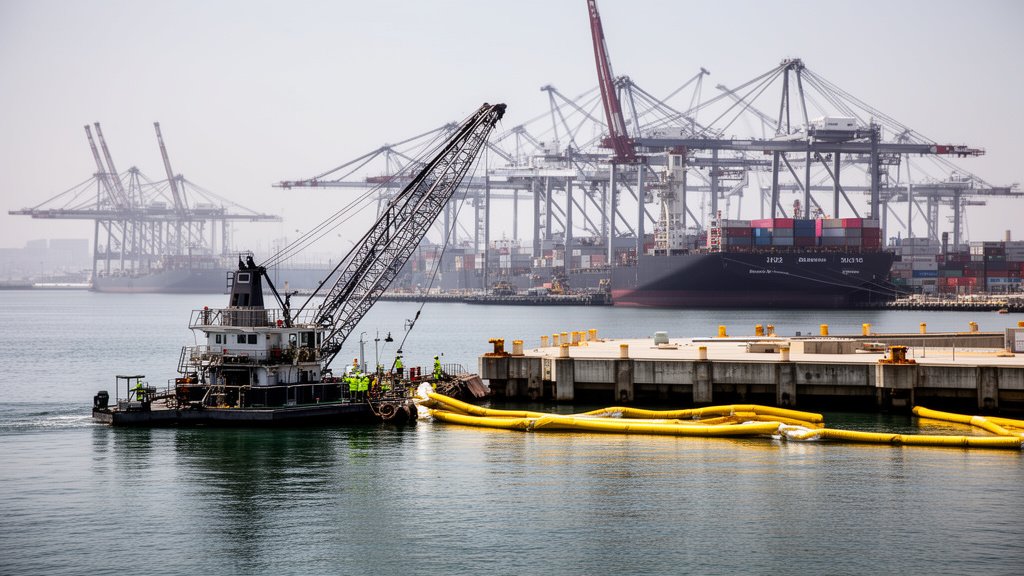
Three 40-foot shipping containers plummeted into the water near Berth 302 at the Port of Los Angeles during routine cargo operations, triggering an urgent inter-agency response to secure the area and mitigate potential hazards. The U.S. Coast Guard, Los Angeles City Fire Department, and Port Police have established a 400-yard safety zone around the incident site as recovery teams work to locate and hoist the submerged cargo from the harbor floor.
Key Highlights
- Incident Scope: Three 40-foot shipping containers were lost overboard during cargo handling at Berth 302.
- Current Status: Two containers remain submerged; recovery operations are ongoing with the assistance of specialized maritime salvage equipment.
- Safety Measures: A 400-yard safety exclusion zone has been enforced to protect vessel traffic and salvage personnel.
- Inter-Agency Coordination: The U.S. Coast Guard is working alongside the Los Angeles City Fire Department and Port Police to manage the navigational and environmental risks.
The Logistical and Safety Impact of Harbor Mishaps
The Port of Los Angeles stands as the busiest container port in the Western Hemisphere, acting as the primary gateway for international trade between the United States and the Asian market. When a disruption of this nature occurs—specifically the loss of heavy cargo into active shipping lanes—the response must be swift and highly coordinated. The incident at Berth 302 is more than a simple salvage operation; it is a complex logistical challenge involving hazardous material assessment, navigational hazard mitigation, and supply chain continuity management.
Navigational Hazards and Underwater Recovery
Submerged shipping containers present a severe, immediate threat to commercial maritime traffic. Unlike visible surface debris, a 40-foot container resting on the harbor floor—or floating just below the surface—can critically damage the hulls or propulsion systems of tugs, barges, and massive container ships entering the terminal.
The U.S. Coast Guard’s decision to establish a 400-yard safety zone is a standard, yet critical, protocol. This perimeter prevents secondary incidents by restricting movement in the immediate vicinity of the drop. Once the area is secured, the process shifts to salvage. This often involves the deployment of sonar to map the location of the submerged units, followed by the use of crane barges to hoist the containers from the harbor bed. The difficulty of these operations is compounded by currents, zero-visibility underwater conditions, and the potential structural integrity of the containers themselves.
The Role of Partner Agencies
The response highlights the integration of municipal and federal resources. While the Coast Guard focuses on the navigational safety and maritime law enforcement aspects, the Los Angeles City Fire Department brings specialized hazardous materials (HazMat) capabilities. The contents of these containers are the primary variable; depending on whether they contain consumer electronics, textiles, or chemical precursors, the environmental containment strategy must shift. Port Police, meanwhile, maintain the land-side security and traffic flow, ensuring that the necessary salvage equipment can reach the berth without further snarling the already complex terminal logistics.
Supply Chain Resilience and Terminal Operations
Incidents like the one at Berth 302 serve as a stark reminder of the fragile nature of the “just-in-time” global supply chain. Each container represents a piece of the economic puzzle, from automotive parts and medical supplies to retail inventory. When a berth is taken offline for emergency salvage, that terminal’s throughput efficiency drops significantly.
Logistics managers must often reroute vessels or adjust berthing schedules to compensate for the closure of a specific pier. For the Port of Los Angeles, where efficiency is measured in moves-per-hour, this incident necessitates a rapid resolution. The longer the containers remain submerged, the greater the impact on terminal operations and the subsequent ripple effect on the inland distribution networks that rely on these shipments.
FAQ: People Also Ask
1. Why do shipping containers fall into the water?
Cargo incidents are typically caused by mechanical failure of the ship-to-shore cranes, improper lashing and securing of the cargo, or sudden shifts in weather and vessel stability. In highly busy ports like Los Angeles, high-tempo operations can occasionally lead to equipment malfunctions.
2. Is there an environmental threat from the submerged containers?
That depends entirely on the manifest of the containers. HazMat teams are on-site specifically to determine if the containers hold any environmentally sensitive or hazardous goods that could leak into the harbor water. If so, containment booms and specialized environmental cleanup vessels are deployed.
3. Will this incident delay my shipments?
While a single-berth incident is unlikely to cause a total shutdown of the Port of Los Angeles, it may cause localized delays for cargo vessels scheduled for Berth 302. Terminal operators typically prioritize the most urgent cargo to mitigate the impact on the broader supply chain.
4. How are the containers recovered?
Recovery generally involves using divers to hook cables to the submerged containers, which are then lifted by heavy-lift crane barges. The timeline for recovery depends on current strength, water depth at Berth 302, and the structural condition of the containers.