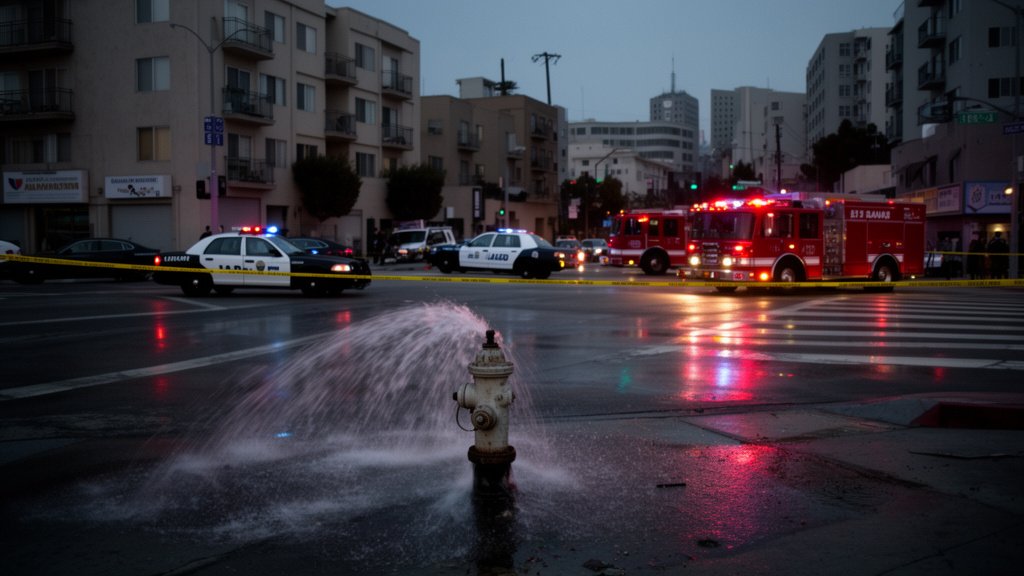
A fatal traffic collision occurred early Friday morning in the heart of Los Angeles’ Koreatown neighborhood, resulting in the death of a 30-year-old woman and leaving another individual injured. The incident, which unfolded at the intersection of Eighth Street and Ardmore Avenue, involved a single vehicle that careened off the roadway and struck a stationary fire hydrant, causing significant structural damage and mobilizing emergency response units to the scene during the early hours.
Key Highlights
- Location of Incident: The collision took place at the intersection of Eighth Street and Ardmore Avenue in Koreatown, Los Angeles.
- Victim Information: A 30-year-old woman was confirmed dead following the crash; one additional individual sustained injuries.
- Nature of the Crash: It was a single-vehicle collision where the vehicle impacted a fire hydrant.
- Status of Investigation: Local law enforcement is actively processing the scene to determine the contributing factors behind the vehicle losing control.
The Aftermath and Investigation at Eighth and Ardmore
The tranquility of the Koreatown residential and commercial corridor was shattered early Friday morning as emergency sirens converged on the intersection of Eighth Street and Ardmore Avenue. Preliminary reports from the scene indicate that the vehicle involved—the specific make and model of which remain under investigation—lost control, leading to a high-impact collision with municipal infrastructure. The primary point of impact was a fire hydrant, which, upon being struck, caused the vehicle to sustain critical damage and likely contributed to the severity of the occupant injuries.
Analyzing the Crash Mechanics
Traffic collision reconstruction is a complex process, particularly in dense urban environments like Los Angeles. The Los Angeles Police Department (LAPD) utilizes specialized units to examine the physical evidence left at the site. Investigators look for tire marks, the angle of impact, and debris fields to determine the velocity of the vehicle at the moment of contact. Hitting a stationary object like a heavy-duty fire hydrant transfers a tremendous amount of kinetic energy back into the cabin of the vehicle, which is often a decisive factor in the survivability of such accidents. The force required to rupture or shear a reinforced hydrant typically indicates a high rate of speed or a complete loss of steering control.
The Intersection of Density and Safety
Koreatown remains one of the most densely populated and active neighborhoods in Los Angeles, presenting unique challenges for road safety. The Eighth Street corridor, characterized by a mix of historic architecture, apartment complexes, and popular night-life venues, often sees increased traffic volume that oscillates significantly between the day and the early morning hours.
Experts often point to the “urban canyon” effect in such neighborhoods—where tall buildings and parked cars limit sightlines—as a contributing factor to the complexity of navigating these streets at high speeds. While the specific cause of this Friday morning collision has not yet been released, the neighborhood’s layout underscores the importance of the City of Los Angeles’ ongoing efforts regarding traffic calming measures. Urban planners often prioritize the modification of such intersections to include enhanced signaling or physical barriers, though balancing pedestrian accessibility with vehicle throughput remains a constant challenge for the Department of Transportation (LADOT).
The Role of Emergency Response and Coordination
The response to the crash was immediate, involving units from the Los Angeles Fire Department (LAFD) and the LAPD. Upon arrival, emergency personnel worked to extract the occupants from the heavily damaged vehicle and secure the ruptured fire hydrant, which posed an additional hazard in the form of flooding and water pressure concerns. The immediate aftermath of such events involves not just medical triage but also the preservation of the scene for forensic analysis. This involves closing off significant portions of Eighth Street, which often leads to major traffic disruptions that ripple through the morning commute.
As the investigation continues, authorities are likely to review surveillance footage from nearby businesses and residential buildings along Ardmore Avenue. This digital evidence is increasingly crucial in reconstructing the moments leading up to the impact, helping determine if factors such as mechanical failure, impairment, or speed were the primary catalysts for the tragedy.
FAQ: People Also Ask
Q: What is the standard process for a fatal traffic investigation in Los Angeles?
A: When a fatality occurs, the LAPD’s Traffic Division initiates a full reconstruction. This involves a specialized team documenting the scene, measuring skid marks, analyzing the vehicle’s mechanical state, and interviewing potential witnesses. The process can take several weeks or months to finalize, depending on toxicology results or the need for a warrant to download the vehicle’s “black box” (Event Data Recorder).
Q: How does hitting a fire hydrant affect the investigation?
A: A fire hydrant is a stationary, high-mass object. In an investigation, hitting one is treated similarly to hitting a concrete barrier. It provides clear data points regarding the car’s direction, speed, and point of impact, helping investigators determine if the driver attempted to brake or swerve before the collision.
Q: How can residents of Koreatown report traffic safety concerns?
A: Residents can contact the Koreatown Neighborhood Council or use the MyLA311 app to report issues such as poor lighting, obscured signage, or excessive speeding in specific corridors like Eighth Street. Proactive reporting helps the city prioritize infrastructure maintenance and traffic enforcement.
Q: Is information about the identity of the deceased public?
A: The identity of the deceased is typically withheld by authorities until the next of kin has been properly notified by the Los Angeles County Medical Examiner-Coroner’s office. Once notification is complete, the name may be released through official press channels.