The Los Angeles County Fire Department (LACoFD) has officially triggered an emergency operational augmentation, shifting to an aggressive proactive posture as the region braces for a punishing four-day heat wave commencing August 25. By increasing on-duty personnel and strategically reallocating specialized firefighting equipment to high-risk Wildland-Urban Interface (WUI) zones, the department aims to compress response times and suppress potential ignitions before they evolve into uncontrollable megafires. This tactical decision, coordinated alongside regional meteorological assessments, marks a critical pivot from reactive suppression to preemptive strike capabilities.
- Staffing Augmentation: LACoFD is increasing on-duty firefighting personnel across all divisions to ensure immediate availability of resources.
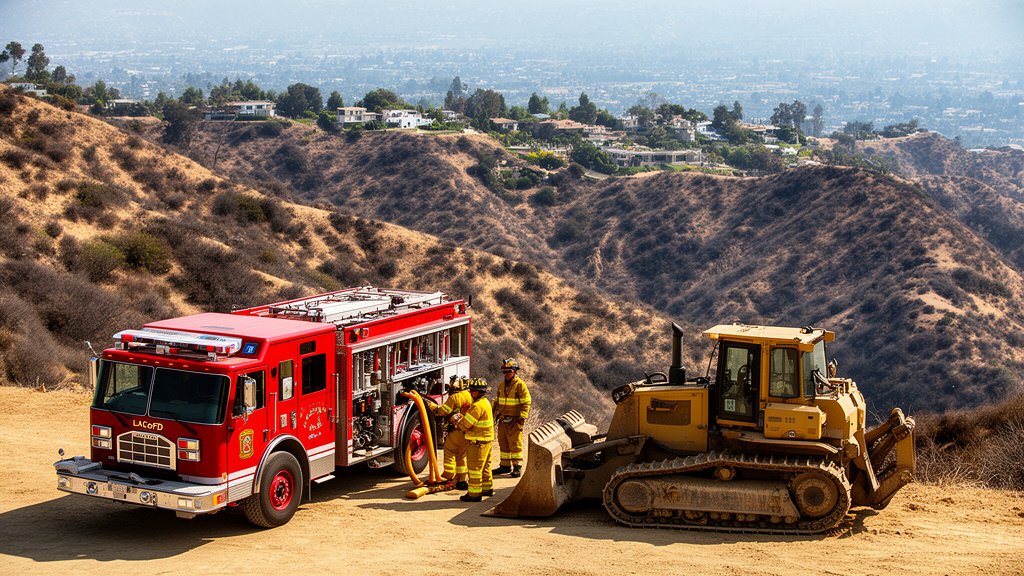
- Strategic Pre-Positioning: Heavy apparatus, including water tenders, bulldozers, and specialized hand crews, are being moved closer to historical wildfire hot spots.
- Risk Timeline: Operational intensity is set for a four-day duration starting August 25, aligning with the peak of the forecasted heat dome.
- Critical Focus: The department is prioritizing the WUI—areas where residential development meets dense, heat-stressed vegetation—to protect life and infrastructure.
Fortifying the Frontline: A Tactical Response to Environmental Stress
The Operational Doctrine of Pre-Positioning
In the realm of modern wildfire management, the concept of ‘pre-positioning’ is far more than a precautionary measure; it is a fundamental shift in the Incident Command System (ICS). As temperatures climb, the ignition probability of the local landscape—drought-laden chaparral and timber—skyrockets. LACoFD commanders are not waiting for reports of smoke; they are placing the ‘tip of the spear’ exactly where the fire behavior models predict the highest potential for spread. By stationing bulldozers, Type 3 engines, and air attack assets in predetermined strategic corridors, the department can shave critical minutes off response times. In a fire event, where the rate of spread can double in minutes under extreme heat, these saved minutes translate into saved homes.
This movement of resources is governed by the Incident Command System, a standardized hierarchy that allows for seamless integration of mutual aid partners. When LACoFD augments staffing, they are essentially expanding the department’s ‘reach’ to ensure that even as the heat wave taxes physical exertion levels of firefighters, there is a ready rotation of fresh, capable crews prepared to combat the dry, erratic winds often accompanying these high-temperature events.
The Science of Heat-Driven Wildfire Risk
The current meteorological conditions are providing the ‘fuel’ for a potentially volatile scenario. The National Weather Service (NWS) has flagged the region for significant thermal expansion, which does more than just make the air uncomfortable—it desiccates vegetation to a critical level. As humidity levels plummet and temperatures hover at the upper limits of the seasonal average, moisture is literally stripped from the fuel beds. This condition creates ‘flash fuels,’ where grasses and brush become highly receptive to even a single spark from a roadside fire or mechanical failure.
The LACoFD response is calculated to mitigate the ‘diurnal wind’ factor as well. During the day, heating causes air to rise, which can create unstable atmospheric conditions, while nighttime cooling can trap smoke and heat in canyons. By having personnel on the ground, the department can monitor these subtle atmospheric shifts, providing real-time intelligence that satellite data simply cannot capture.
The Economic and Infrastructure Impact
Beyond the immediate threat to public safety, there is an immense economic imperative driving this aggressive posture. Wildfires in Los Angeles County are not merely environmental events; they are massive economic disruptions. The cost of suppression is only a fraction of the total fiscal impact, which includes property damage, insurance market volatility, and the long-term strain on regional infrastructure. By investing in the costs associated with staffing augmentation—paying for overtime and additional fuel deployment—the department is executing a cost-avoidance strategy. It is significantly cheaper to manage a small, contained ignition in its first 30 minutes than to manage a conflagration that consumes residential tracts and requires a massive, multi-agency mobilization.
Furthermore, the protection of the Wildland-Urban Interface (WUI) is central to the county’s economic stability. Many of the areas currently being prioritized by LACoFD contain vital utilities, including power lines and water conveyance systems. A fire in these regions could threaten the connectivity that powers the wider Los Angeles basin. Thus, the LACoFD is essentially acting as a safeguard for the region’s economic and logistical backbone.
The Future of Fire Suppression: Towards Predictive Models
As the Los Angeles County Fire Department navigates the current four-day heat wave, it serves as a microcosm for the future of firefighting. We are entering an era where ‘seasonal’ fire risk is becoming a year-round reality. This has forced departments to move away from historical data—looking at what happened in the past—and toward predictive analytics—looking at what will happen in the next 96 hours.
Advancements in remote sensing, drone technology, and AI-driven predictive fire spread modeling are allowing commanders like those at LACoFD to make decisions that were unthinkable a decade ago. While the current augmentation is focused on human capital and heavy machinery, the strategy behind it is increasingly data-driven. The deployment of resources on August 25 is based on a convergence of weather forecasts, moisture levels in vegetation, and population density maps. This ‘precision firefighting’ is the future, and the residents of Los Angeles County are the primary beneficiaries of this modernized, high-tech, and highly-trained tactical approach to public safety.
FAQ: People Also Ask
Q: What does ‘pre-positioning’ mean in the context of fire management?
A: Pre-positioning refers to the strategic deployment of firefighting crews, apparatus (such as engines and water tenders), and equipment to specific locations that are identified as high-risk before a fire even starts, ensuring faster response times.
Q: How does a heat wave specifically increase wildfire danger?
A: Extreme heat lowers the moisture content in vegetation (fuel moisture), making it brittle and highly susceptible to ignition. It also affects the atmospheric stability, which can contribute to erratic fire behavior and faster rates of spread.
Q: How can residents help the LACoFD during this period?
A: Residents should practice extreme ‘fire awareness.’ This includes avoiding any activity that could spark a fire, such as lawn mowing in dry grass, using power tools that could create sparks, or discarding smoking materials, and ensuring their ‘Ready, Set, Go’ evacuation plan is current.
Q: Is this augmentation a permanent change for LACoFD?
A: While the department has robust procedures for high-alert periods, the increased frequency and intensity of heat waves are driving a trend toward more frequent, proactive staffing augmentations as a standard operational necessity.