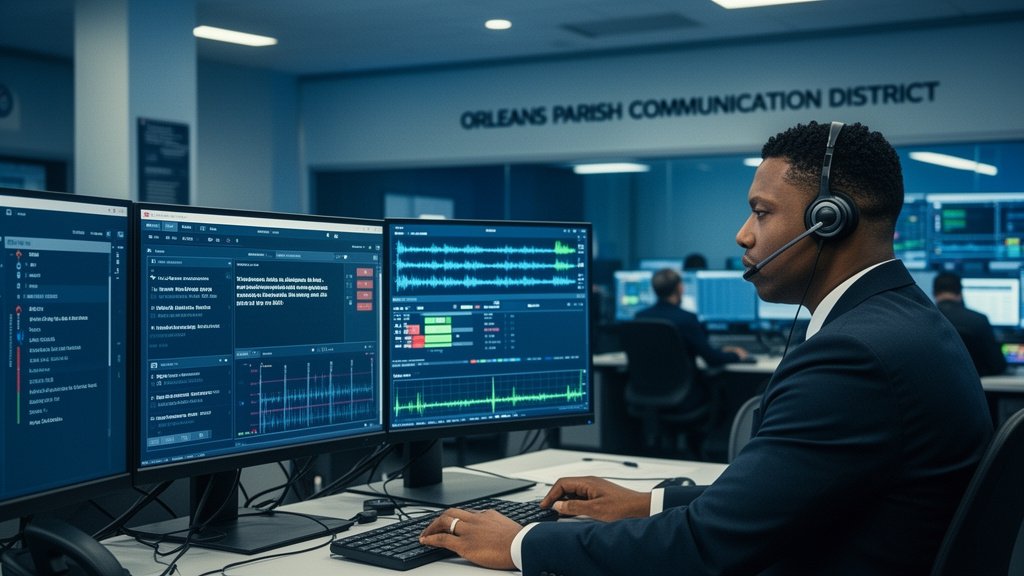
The Orleans Parish Communication District (OPCD) has officially embraced the next generation of emergency response, integrating advanced AI-driven platforms to triage and process 911 calls. As the city moves toward a future where algorithms assist human dispatchers in parsing chaotic, life-critical information, a fierce debate has erupted among public safety experts, technologists, and civil libertarians. At the heart of this shift is the deployment of platforms like ‘Prepared,’ which utilize artificial intelligence for real-time transcription, data summarization, and streamlined information sharing. While city officials tout these tools as a vital lifeline capable of shaving seconds off response times and overcoming language barriers, critics warn that the black-box nature of AI could introduce fatal errors into a system where there is zero margin for failure.
Key Highlights
- Tech Integration: New Orleans is utilizing AI-enhanced platforms to enable real-time video, text, and location data streaming from 911 callers, supplementing traditional voice calls.
- Efficiency Gains: Proponents argue that AI-assisted transcription reduces cognitive load on dispatchers, allowing them to focus on decision-making rather than data entry.
- The Liability Gap: Skeptics raise concerns about ‘AI hallucinations’ or algorithmic bias potentially misclassifying emergencies, leading to delayed or inappropriate responses.
- Human-in-the-Loop: Current protocols mandate that AI functions strictly as a decision-support tool, with certified emergency dispatchers retaining final authority over every dispatch decision.
The Digital Evolution of Dispatch
For decades, the 911 emergency system remained largely static, relying on voice communication and the spatial intuition of highly trained dispatchers. However, the Orleans Parish Communication District (OPCD) has signaled a shift toward what industry leaders call ‘Next-Generation 911’ (NG911). By adopting AI-driven platforms, the district aims to modernize a system that often struggles with the velocity of information during mass-casualty events or complex emergencies.
The Mechanics of AI-Assisted Emergency Response
The implementation centers on the ability of AI to ingest unstructured data. When a caller dials 911 in a supported jurisdiction, the system can now automatically transcribe audio, summarize key details (such as address, weapon presence, or medical symptoms), and share these data packets with first responders in real-time. This is not merely a transcription tool; it is a data aggregator. The AI serves as a filter, highlighting critical information that might be lost in the background noise of a frantic call.
Advocates emphasize that this reduces the ‘cognitive load’ on the dispatcher. In an emergency, every second counts; by automating the documentation process, the dispatcher can focus entirely on calming the caller and providing life-saving instructions (such as CPR or hemorrhage control) while the AI handles the logistics of the call log. This is the promise of efficiency: a hybrid model where human empathy meets algorithmic speed.
The Peril of Algorithmic Uncertainty
Despite the clear benefits, the integration of artificial intelligence into public safety raises profound questions about reliability and accountability. Unlike a spreadsheet or a standard database, AI models—particularly large language models (LLMs) used for summarization—operate on probabilistic logic. They ‘predict’ the next word or category rather than ‘understanding’ the truth.
This introduces the risk of ‘hallucination.’ If an AI incorrectly summarizes a 911 call—perhaps misinterpreting ‘no weapon’ for ‘now a weapon’ or misclassifying a medical emergency as a mental health crisis—the downstream consequences could be catastrophic. Skeptics within the emergency management community argue that even a 0.1% error rate is unacceptable when the stakes are human life. Furthermore, if a wrongful death suit arises due to an AI-assisted dispatch error, the legal liability becomes murky. Is the dispatch center responsible? The software vendor? The municipality? The legal precedent for ‘algorithmic negligence’ is currently non-existent.
Bridging the Language Barrier
One of the most compelling arguments for AI in 911 dispatch is its ability to handle multilingual communication. In a diverse city like New Orleans, language barriers have historically been a significant friction point in emergency services. AI-powered real-time translation offers the potential for instantaneous understanding between dispatchers and callers who do not speak English. By removing the wait time for an over-the-phone human translator, AI could theoretically save lives in time-sensitive situations. However, this relies on the model’s dialectal accuracy and cultural competency—two areas where current AI technology still faces significant hurdles.
The Future of Emergency Management
As the OPCD continues its experiment, the results will likely dictate the adoption curve for other major cities. The industry is watching closely. The consensus among experts, such as those at the National Emergency Number Association (NENA), is that AI is not a replacement for human judgment, but a specialized tool. The ‘Human-in-the-Loop’ (HITL) architecture remains the gold standard. In this model, the AI performs the heavy lifting of data processing, but the human dispatcher retains the authority to verify, correct, and override the system.
Ultimately, the success of this initiative will be measured not by how fast the technology is, but by how well it maintains the integrity of the emergency chain of custody. If New Orleans can prove that AI enhances the accuracy of dispatch without increasing the risk of mechanical failure, it may provide the blueprint for a safer, more responsive future. If not, it serves as a cautionary tale of the dangers of over-reliance on automation in a field where the cost of a ‘glitch’ is paid in blood.
FAQ: People Also Ask
Will AI replace human 911 dispatchers?
No. Currently, the consensus is that AI serves as a ‘co-pilot’ or support tool. Emergency dispatching requires complex human empathy, emotional intelligence, and critical thinking that AI cannot replicate, particularly when de-escalating domestic violence or handling distraught callers.
Is caller privacy compromised by these AI systems?
Privacy is a major concern. Public safety agencies are required to use secure, CJIS-compliant (Criminal Justice Information Services) data environments. The AI systems deployed are designed to operate within these protected networks to prevent unauthorized data exposure.
Who is liable if an AI makes a mistake that leads to a death?
Liability in AI-assisted 911 responses is a developing legal frontier. Currently, the dispatch agency remains ultimately responsible for the actions of its employees. Vendors are generally protected by service-level agreements and ‘as-is’ clauses, creating a potential accountability gap that lawmakers are only beginning to address.
How does AI handle background noise on a 911 call?
Advanced AI models are trained on thousands of hours of audio to filter out ‘noise’ (sirens, wind, screaming, gunfire) and isolate human speech. However, in extreme conditions, this technology still struggles, which is why human monitoring remains mandatory.