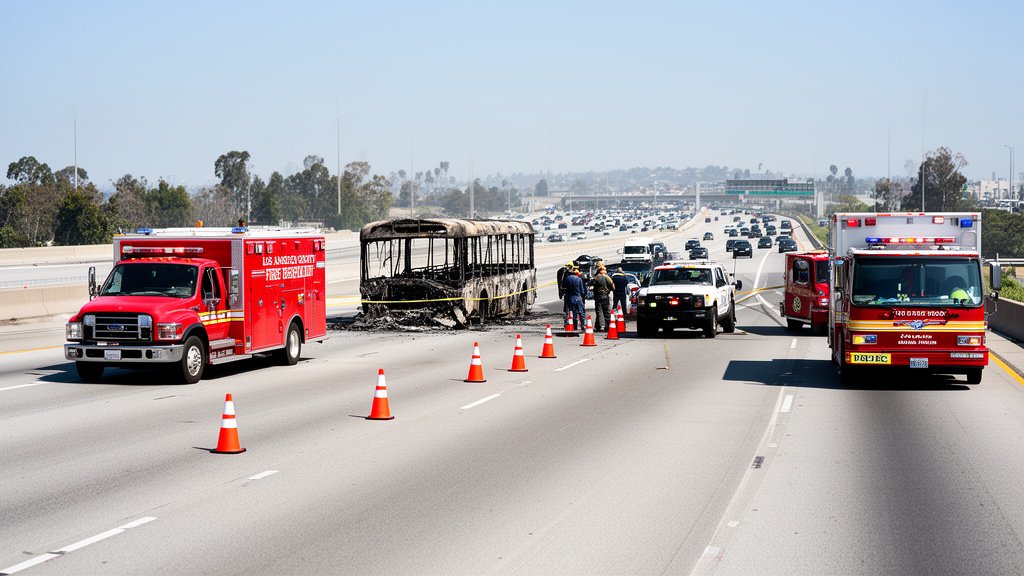
A tragic incident unfolded on the eastbound 60 Freeway in the City of Industry early this morning, as a bus fire led to a confirmed fatality and forced the closure of multiple lanes, throwing morning commute traffic into disarray. The event, which occurred near the crucial junction of Azusa Avenue, has triggered an extensive response from local authorities, including the California Highway Patrol (CHP) and the Los Angeles County Fire Department, as investigators work to determine the circumstances surrounding the blaze.
Key Highlights
- Incident Location: The eastbound 60 Freeway, in the vicinity of Azusa Avenue, City of Industry.
- Status: One fatality confirmed at the scene; multiple lanes remain closed for investigation and cleanup.
- Response: Emergency crews from the Los Angeles County Fire Department responded to reports of a vehicle fire involving a bus.
- Impact: Significant traffic delays expected for eastbound commuters; authorities advise seeking alternate routes.
The Crisis on the 60: Incident Analysis and Emergency Response
The eastbound 60 Freeway, often referred to as the Pomona Freeway, serves as a critical artery for the San Gabriel Valley, facilitating the movement of thousands of commuters and commercial vehicles daily. When a high-capacity vehicle such as a bus is involved in a fire, the logistical and safety implications are magnified, requiring a coordinated, high-intensity response from multiple agencies.
Anatomy of the Emergency
Upon receiving the emergency dispatch, the Los Angeles County Fire Department units were rapidly deployed to the scene. Vehicle fires, particularly those involving large passenger carriers, present unique challenges. Unlike passenger sedans, buses often utilize different fuel systems and carry larger volumes of flammable materials, including upholstery and mechanical fluids, which can accelerate combustion. The primary objective for the responding fire crews was not only to extinguish the blaze but also to secure the safety of the perimeter, as the 60 Freeway represents a high-traffic corridor where secondary accidents are a constant threat.
The California Highway Patrol (CHP) took immediate command of traffic management, implementing strategic lane closures. These closures were deemed necessary to allow for the safe operation of emergency equipment and to preserve the scene for forensic investigation. The proximity to Azusa Avenue, a major cross-street, complicated traffic flow, as commuters attempting to navigate around the blockage were forced onto local surface streets, creating a ripple effect of congestion throughout the City of Industry.
The Investigation Process
With a fatality confirmed, the incident has transitioned from a standard emergency response to an active death investigation. Authorities are currently looking into several potential factors, including mechanical failure, electrical malfunction, or other external causes. Investigators from the CHP’s Multidisciplinary Accident Investigation Team (MAIT) are often deployed in cases involving significant commercial vehicle incidents to reconstruct the timeline of the fire. Their focus will include examining the bus’s maintenance records, the origin point of the fire, and whether all safety systems—such as fire suppression and emergency exits—were functioning as intended at the time of the incident.
Regional Impact and Commuter Dynamics
For the millions of residents in Los Angeles County, the 60 Freeway is more than just a road; it is the backbone of the region’s economy. The sudden closure of lanes in the City of Industry serves as a stark reminder of the vulnerability of Southern California’s transportation network. Traffic on this corridor is rarely light, and an incident of this magnitude can effectively paralyze east-west transit, impacting logistics, freight delivery, and individual commuters alike.
As the investigation continues, Caltrans crews are tasked with assessing the roadway for heat damage. High-intensity fires can compromise the structural integrity of the asphalt, and should the damage be significant, lane closures may persist longer than the initial emergency phase to allow for rapid pavement repair. Motorists are urged to remain patient and prioritize the safety of the crews working on-site.
FAQ: People Also Ask
Why are lanes closed even after the fire is extinguished?
Lanes remain closed to allow investigators to collect evidence, document the scene, and ensure the road surface is safe for transit. In cases involving fire, the asphalt can be severely damaged, necessitating an inspection by Caltrans before the lanes can be safely reopened.
What should commuters do if they are stuck in the resulting traffic?
Drivers are advised to monitor real-time traffic apps, listen to local traffic reports, and, if possible, detour using parallel surface streets or alternate freeways like the 10 or the 210, though these are often similarly congested.
Who is responsible for investigating a bus fire on a state freeway?
The California Highway Patrol (CHP) holds jurisdiction over state freeways. They coordinate the investigation, often working alongside the Los Angeles County Fire Department’s arson investigators or mechanical experts if the cause of the fire is initially unclear.
Will this incident impact public transportation schedules?
Yes. Any disruption on the 60 Freeway inevitably impacts bus routes that utilize the corridor. Passengers should check with their transit providers for potential delays or route changes.