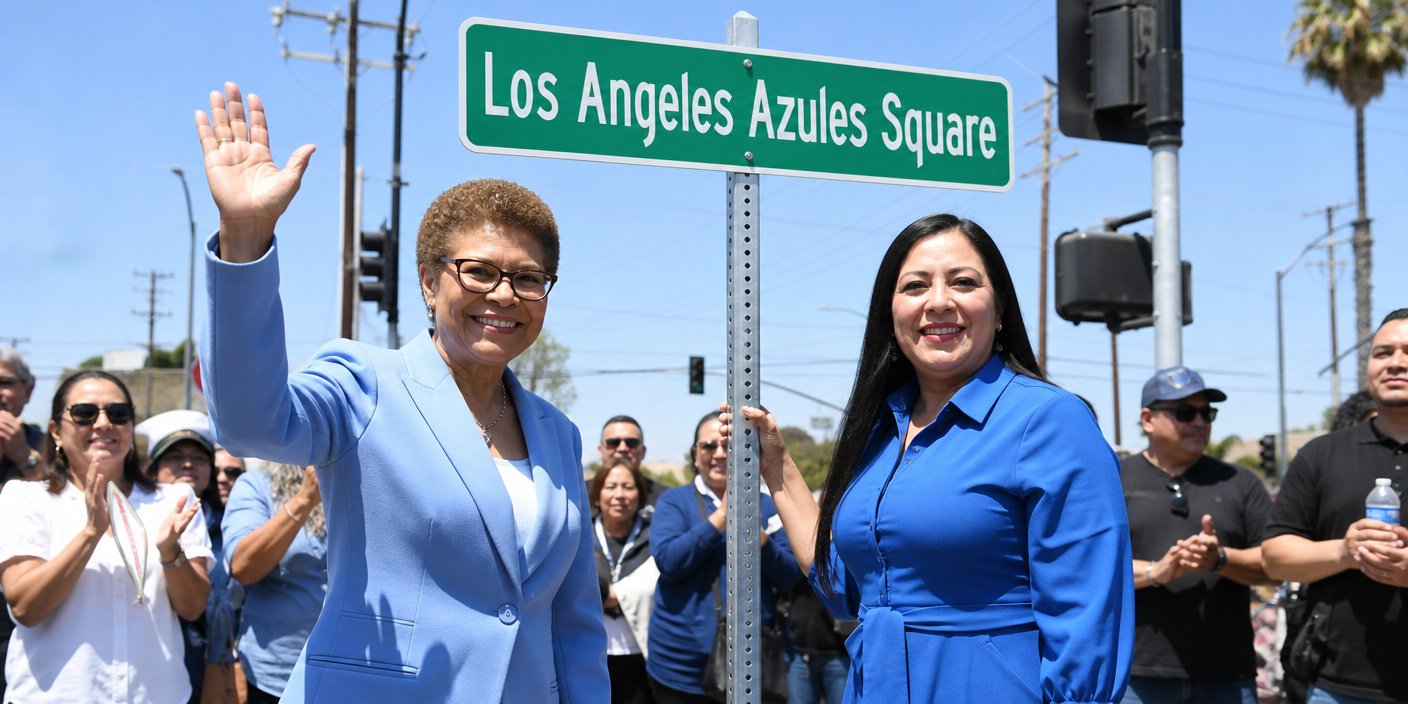
In a vivid demonstration of the indelible link between the San Fernando Valley’s community and its deep-rooted cultural heritage, the City of Los Angeles has officially unveiled “Los Angeles Azules Square.” This dedicated intersection in Panorama City serves as more than just a geographic marker; it stands as a permanent tribute to Los Angeles Azules, the pioneering group that has defined the sound of cumbia sonidera for over forty years.
A Monumental Civic Celebration
The dedication ceremony was a vibrant affair, drawing community members, fans, and local leadership to the heart of the Valley. Mayor Karen Bass, joined by Councilmember Imelda Padilla, presided over the unveiling. The renaming ceremony was not merely a bureaucratic formality but a heartfelt acknowledgment of the band’s influence on the cultural fabric of Los Angeles—a city that has served as a second home to the Mexican icons.
For residents of Panorama City, the intersection now serves as a landmark of pride, connecting the local neighborhood identity with the international stardom of the Mejía Avante siblings who formed the group in the Iztapalapa borough of Mexico City in the early 1980s. The presence of both Mayor Bass and Councilmember Padilla underscored the city’s commitment to recognizing the contributions of artists who have bridged the gap between Latin American roots and Southern California life.
Four Decades of Cumbia Sonidera
To understand the magnitude of this naming, one must look at the trajectory of Los Angeles Azules. The group did not merely play music; they cultivated a genre. Their signature sound, known as “cumbia sonidera,” is characterized by the use of synthesizers, accordion accents, and a distinctive, hypnotic rhythm that has transcended generations.
Starting in 1980, the Mejía Avante family began their journey, facing the typical hurdles of underground musical acts. By the 1990s, they had achieved widespread recognition in Mexico, but their expansion into the United States—and specifically Los Angeles—truly cemented their legendary status. Hits such as “Cómo te voy a olvidar” and “El listón de tu pelo” have become unofficial anthems for the Mexican-American diaspora.
Their sustained popularity is an outlier in the fast-moving music industry. While many groups fade after a decade, Los Angeles Azules has managed to maintain relevance through high-profile collaborations with pop, rock, and urban artists, including Natalia Lafourcade, Saúl Hernández, and Nicki Nicole. This adaptability has allowed them to capture new, younger audiences without alienating the core fanbase that grew up dancing to their records in the 80s and 90s.
The Cultural Landscape of the Valley
Panorama City has long been a hub for the Latino community in Los Angeles. The decision to place “Los Angeles Azules Square” in this specific locale is deliberate. The area represents a dense intersection of residential and commercial life where the music of the band can be heard emanating from backyard parties, local radio stations, and cultural festivals year-round.
Councilmember Imelda Padilla’s office played a crucial role in navigating the complex logistical process of street naming. In Los Angeles, such honors are reserved for individuals or entities that have provided extraordinary service or cultural enrichment to the city. By dedicating public space to a musical act, the city council is making a statement about how it views the cultural identity of its districts. It recognizes that the sounds of the neighborhood are as much a part of the local infrastructure as the roads themselves.
Beyond the Signage: Economic and Social Impact
Critics of city beautification projects often point to the potential for gentrification, but supporters of this initiative argue that honoring cultural icons is a way of anchoring the community. “Los Angeles Azules Square” acts as a cultural anchor point. It serves as a point of interest for tourists and fans of Latin music, potentially driving foot traffic to local businesses located at the intersection.
Furthermore, the recognition validates the lived experience of the local population. When a city government places a permanent sign in the ground honoring a band that sings about the struggles and joys of working-class life, it signals to that demographic that their history is, in fact, part of the official history of the city. It transforms the urban landscape from a utilitarian grid into a living museum of cultural memory.
The Future of the Square
As the physical signage is installed, the conversation shifts to how this space will be utilized in the future. There is already talk of local celebrations and annual commemorative events taking place at the square. For a city as sprawling as Los Angeles, these localized “micro-centers” of culture are essential for maintaining a sense of community identity.
Los Angeles Azules have reached the heights of Coachella and sold out auditoriums globally, yet this small corner of Panorama City might just be their most intimate accolade. It is a reminder that even for global superstars, the most important audience is the one found in the neighborhoods that nurtured them along the way.
FAQ: People Also Ask
Where exactly is the Los Angeles Azules Square located?
The square is located at a prominent intersection in Panorama City, a district in the San Fernando Valley region of Los Angeles. The specific intersection serves as a focal point for the community and was chosen to maximize visibility and accessibility for fans.
Why was this specific band honored in Los Angeles?
Los Angeles Azules have maintained a massive, multi-generational following in Southern California for decades. Their influence on Latin music and their role in preserving cumbia sonidera culture within the Mexican-American community made them candidates for this high-level civic honor.
Did the band members attend the ceremony?
The ceremony was a high-profile civic event attended by key government figures, including Mayor Karen Bass and Councilmember Imelda Padilla. Such events often involve the honorees, reflecting the strong relationship the band maintains with the city’s leadership and the local community.
What does the designation of ‘Square’ imply in this context?
In Los Angeles, naming a square or intersection after an individual or group is a ceremonial honor that acknowledges their significant contribution to the city’s culture. It allows for the installation of official signage that denotes the area as a place of historical or cultural significance.