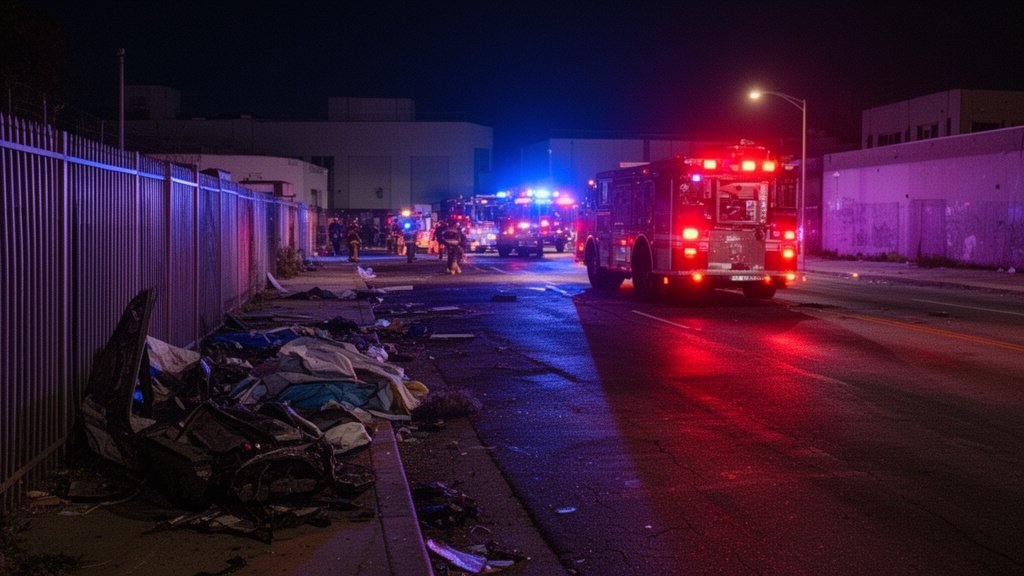
Late Tuesday night, the tranquility of a downtown Los Angeles street was shattered when a red sedan careened into a homeless encampment situated along Hooper Avenue. The incident, which occurred during the late hours, resulted in multiple injuries, drawing a significant emergency response from local authorities and medical teams. The crash has since placed a spotlight on the precarious conditions faced by the unhoused population in industrial zones, where the lack of protective barriers and high-speed traffic creates a persistent, life-threatening environment.
Key Highlights
- Incident Timing: The collision occurred late Tuesday night on Hooper Avenue in downtown Los Angeles.
- Vehicle Involved: A red sedan was identified as the vehicle that struck the encampment.
- Outcome: Emergency crews responded to reports of multiple individuals suffering injuries at the scene.
- Investigation: Local authorities have launched an inquiry to determine the cause of the accident, including potential contributing factors like speed or visibility.
The Intersection of Vulnerability and Urban Infrastructure
The crash on Hooper Avenue serves as a stark, harrowing reminder of the friction between Los Angeles’ urban infrastructure and its growing unhoused population. Hooper Avenue, known for its industrial zoning and frequent heavy-vehicle traffic, has increasingly become a site where homeless encampments are established due to a lack of available shelter space in the immediate downtown vicinity. When vehicles, particularly passenger cars, leave the roadway, these populations have zero physical protection, resulting in incidents that are almost always catastrophic.
Analyzing the Hooper Avenue Corridor
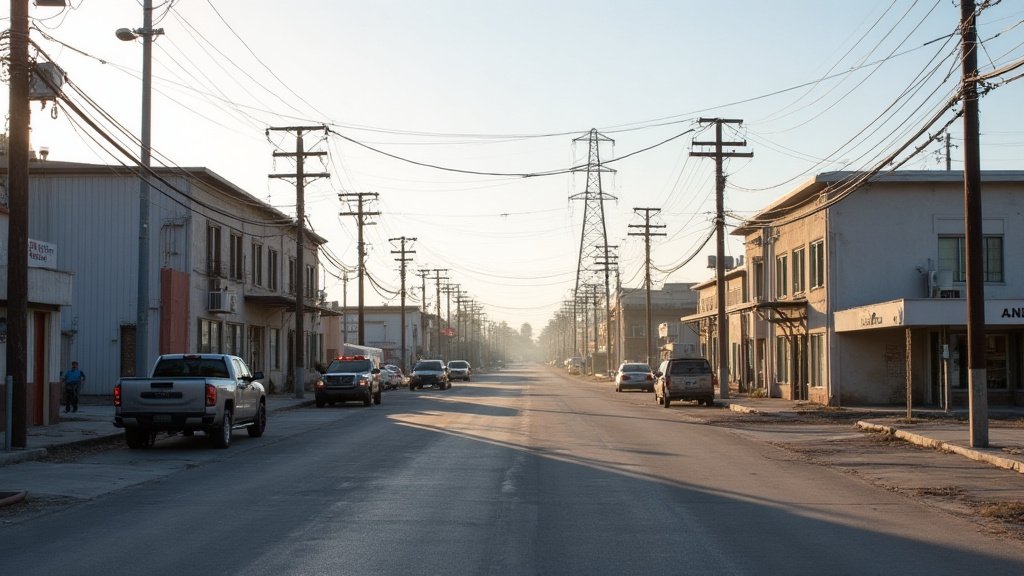
Hooper Avenue cuts through a dense section of industrial Los Angeles. Unlike residential boulevards that might feature curbside landscaping or protective bollards, the infrastructure here is designed for throughput. This creates a specific ‘velocity danger zone’ where the speed of traffic does not account for the presence of pedestrians or stationary human settlements on the shoulder. Traffic safety experts argue that the lack of adequate lighting and the existence of blind spots along this stretch significantly increase the probability of accidents during late-night hours. The red sedan involved in Tuesday’s incident appears to have lost control, but the broader question remains: why are encampments permitted to form in areas where traffic speed and road geometry make them sitting ducks for vehicular accidents?
Emergency Response and Victim Care
The response to the Hooper Avenue crash was swift, with the Los Angeles Fire Department (LAFD) mobilizing rescue units to triage the injured. In accidents of this nature, victim management is highly complex; responders must navigate not only the medical trauma—ranging from blunt force impact to crush injuries—but also the logistical difficulty of locating victims amidst the debris of a collapsed encampment. The LAPD has established a traffic investigation unit to analyze the skid marks and debris field, which will be central to determining whether the driver was experiencing a medical emergency, driving under the influence, or simply navigating the road inattentively.
The Policy Crisis: Safety vs. Displacement
This incident has reinvigorated the debate regarding the City Council’s strategy toward homeless encampment placement. Critics of the current policy argue that simply allowing encampments to exist in high-traffic, industrial zones without basic safety measures is an act of negligence. Conversely, advocates for the unhoused note that these encampments often appear where other options have been exhausted. The challenge, according to urban planners, is that the city lacks the infrastructure to provide ‘hardened’ zones—areas separated from high-speed arterial roads by concrete barriers or metal guardrails. Without these, the city is effectively leaving its most vulnerable citizens in harm’s way.
Long-Term Urban Implications
Looking ahead, the city faces pressure to reassess the zoning laws around encampments. Can Los Angeles integrate protective measures, such as temporary barrier placement, in high-risk zones without exacerbating the stigma against the unhoused? This incident is likely to push the City Council to review traffic safety data specifically in relation to unhoused populations. As Los Angeles continues to struggle with the dual crises of housing and transportation safety, events like the Hooper Avenue crash underscore that the issue is not just one of poverty, but one of fundamental, life-saving urban design.
FAQ: People Also Ask
Q: What is the current status of the victims involved in the Hooper Avenue crash?
A: While officials have confirmed multiple injuries, specific details regarding the condition of the victims remain under the purview of medical professionals. Typically, crash victims are transported to the nearest level-one trauma center for triage and stabilization.
Q: Is there an investigation underway regarding the driver of the red sedan?
A: Yes, the Los Angeles Police Department (LAPD) is conducting a standard traffic collision investigation. This includes analyzing the vehicle’s telemetry, witness statements, and any available street surveillance footage to determine if criminal charges are warranted.
Q: What measures can be taken to prevent future accidents involving encampments?
A: Urban safety advocates recommend the installation of concrete K-rail barriers in high-traffic areas, improved street lighting, and proactive relocation programs that steer encampments away from high-speed roadways to safer, managed environments.
Q: Why are encampments so close to traffic on streets like Hooper Avenue?
A: These areas often lack residential street parking or high pedestrian density, making them less prone to immediate complaint-driven enforcement compared to residential neighborhoods, which inadvertently encourages settlement in these dangerous industrial zones.