Anthropic has officially entered the agentic AI race with the launch of ‘Claude Duet,’ a sophisticated new AI agent powered by the highly anticipated Opus 5.5 model. Currently rolling out to US Pro and Max subscribers via an exclusive waitlist, Claude Duet marks a paradigm shift for the company, moving beyond the traditional chat-based interface to a proactive, task-oriented architecture capable of executing work autonomously in the background.
Key Highlights
- Next-Gen Power: Claude Duet is built on the foundation of Opus 5.5, Anthropic’s most advanced model to date, featuring enhanced reasoning and latency performance.
- Agentic Workflow: The tool is designed to manage autonomous background tasks, allowing users to offload complex, multi-step operations to the AI.
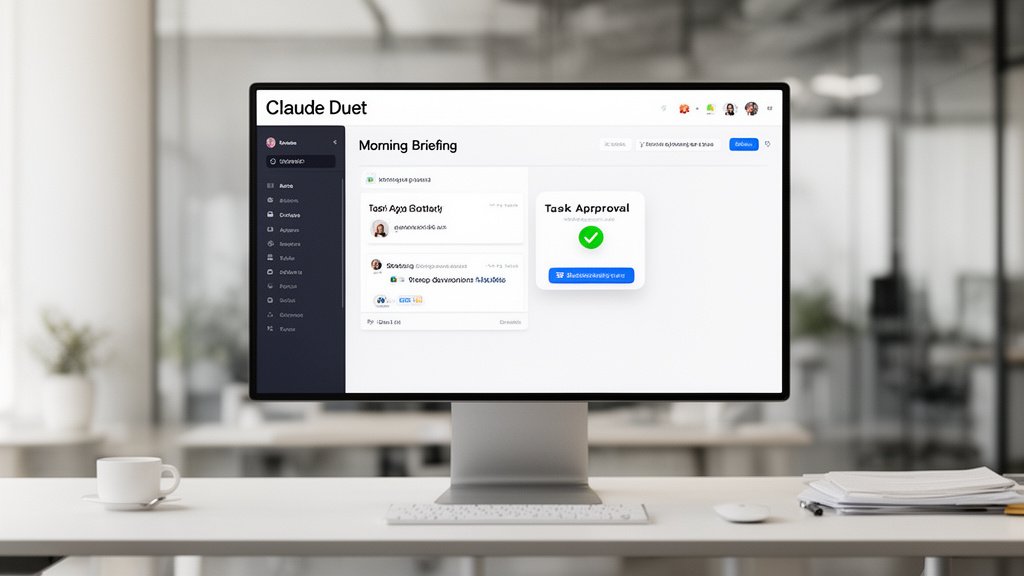
- Proactive Intelligence: Duet provides automated morning briefings, synthesizing data, emails, and project statuses before the user even starts their day.
- Human-in-the-Loop: Safety remains paramount; the agent pings users for approval only when critical decisions or actions are required, ensuring total user control.
- Exclusive Access: Currently available only to US Pro and Max subscribers, access is being managed through a phased waitlist system to ensure stability and service quality.
The Agentic Evolution: Inside Claude Duet
The transition from large language models (LLMs) that respond to prompts to “agentic” AI that anticipates needs represents the current frontier of artificial intelligence. Anthropic’s introduction of Claude Duet signifies their aggressive pivot into this functional domain. Unlike standard chatbots that act as reactive encyclopedias, Duet is designed to be an operational partner.
The Architectural Leap: Opus 5.5
At the heart of this deployment is Opus 5.5. While the specific parameter count remains proprietary, industry benchmarks indicate that the 5.5 iteration focuses heavily on “reasoning reliability”—the ability for the model to self-correct during complex multi-step reasoning tasks without human intervention. This reliability is the prerequisite for agentic behavior. If an AI is to operate in the background, it must demonstrate a level of logical consistency that Opus 5.5 claims to provide. This model architecture appears optimized for high-token-throughput tasks, meaning it can process vast swaths of documentation or codebases significantly faster than its predecessors, allowing it to “read” and “prepare” while the user is offline.
Operationalizing the Agent: Background Tasking
The standout feature of Claude Duet is its ability to handle background tasks. For the professional user, this addresses a major friction point: the latency between initiating a request and receiving a result. Duet operates as an asynchronous worker. Users can assign it to synthesize a document, cross-reference research, or draft a series of communications. It then works in the background, independent of the active session. This capability transforms the AI from a tool one “uses” into a resource that “works” for you.
Safety by Design: The Approval Protocol
Anthropic has long championed “Constitutional AI,” and this philosophy is deeply embedded in the Duet interface. The system utilizes a “human-in-the-loop” design, specifically engineered to prevent unauthorized or unintended actions. The AI does not execute high-stakes tasks autonomously; instead, it performs the heavy lifting of research and drafting, then “pings” the user for a final approval or verification. This mechanism provides a safety buffer, ensuring that the AI’s autonomous behavior is always constrained by human judgment. By requiring confirmation for pivotal actions, Anthropic is positioning Duet as a trustworthy enterprise-grade solution rather than a “black box” experiment.
Competitive Landscape: The Race to Autonomy
Anthropic is entering a crowded field. OpenAI has been iterating on its own agentic capabilities, and Google’s Gemini ecosystem is integrating deeply into productivity suites. However, Anthropic’s approach with Duet focuses on the “morning briefing” value proposition—a specific use case that offers high utility for corporate executives and creative professionals. By bundling this within the US Pro and Max tiers, Anthropic is essentially democratizing access to agentic workflows, moving them from enterprise-only custom integrations to accessible subscriber-level tools.
Future Outlook: What This Means for Professional Workflows
The implications of Duet go beyond mere convenience. We are witnessing the beginning of a shift where “work” is no longer defined by the amount of time an individual spends typing or organizing data, but by the quality of the oversight they provide to their AI agents. As Duet scales and moves beyond the US waitlist, the competitive advantage will likely shift to professionals who master the art of “agent management”—the ability to effectively delegate tasks, set parameters, and supervise automated agents like Duet. If Opus 5.5 proves as stable as early reports suggest, we may be looking at the standard for 2025-era productivity.
FAQ: People Also Ask
1. How can I join the Claude Duet waitlist?
The waitlist is currently accessible through the Anthropic website for existing US Pro and Max subscribers. Users should navigate to their account settings or the dashboard where a “Claude Duet” invitation banner will be visible if they are eligible.
2. Is Claude Duet available outside of the US?
Currently, no. Anthropic has restricted the initial rollout to US-based Pro and Max subscribers. The company has stated this is to ensure quality and regulatory compliance, with international expansions expected in future quarters.
3. Does Claude Duet have access to my private emails?
Duet interacts with the data you explicitly provide or connect to its interface. It follows strict privacy protocols; it does not scrape data without consent. Users must define the scope of the “briefings” and tasks within the settings panel, ensuring you maintain granular control over what the AI accesses.
4. How does Opus 5.5 differ from previous models?
Opus 5.5 is optimized specifically for reasoning reliability and agentic task execution. It minimizes “hallucination” rates and improves the model’s ability to hold context over long-running background tasks, which are essential for the “agent” behavior described in the Claude Duet release.
5. What happens if I don’t approve a task?
If a user does not approve a task or misses a ping, the AI halts the process. Claude Duet is built to be helpful, not intrusive; it will pause the workflow and save its progress, waiting for the user to return and provide the necessary sign-off.