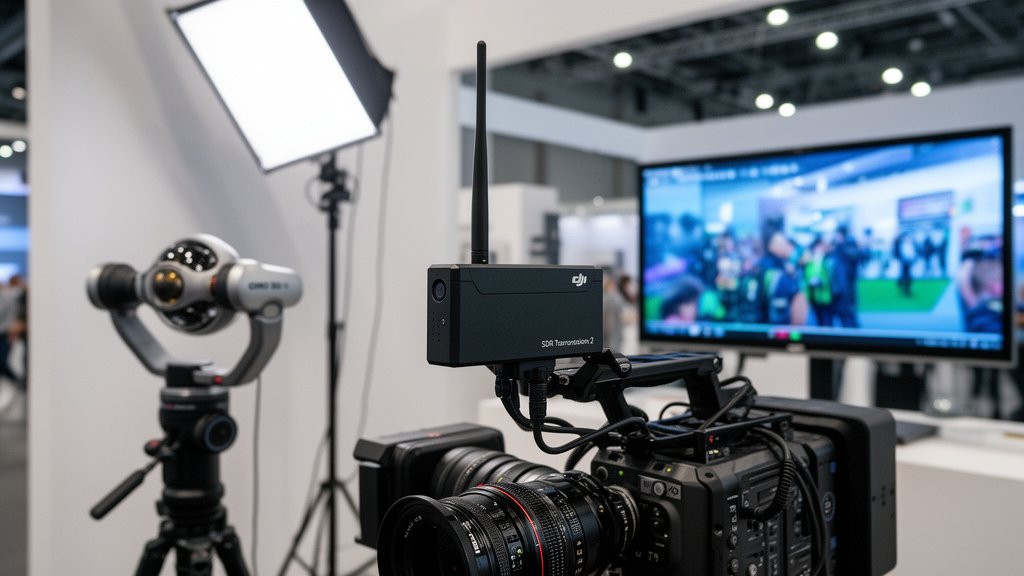
At the 2026 International Broadcasting Convention (IBC 2026) in Amsterdam, DJI has fundamentally shifted the professional broadcasting landscape by unveiling two powerhouse tools: the SDR Transmission 2 and the Osmo 360 II. These releases represent a significant evolution in DJI’s ecosystem, moving beyond consumer-grade aerial technology into the rigorous demands of live production, cinematography, and real-time data management. With a focus on ultra-low latency, robust connectivity, and computational imaging, DJI is clearly targeting the enterprise sector and high-end independent studios, offering solutions that challenge traditional, expensive cabling and cumbersome lighting setups.
Key Highlights
- DJI SDR Transmission 2: Features a next-generation transmission algorithm for high-stability wireless video monitoring, designed specifically to operate in congested RF environments typical of massive live broadcast events.
- Osmo 360 II Innovation: Introduces a revolutionary high-efficiency square HDR sensor, allowing for greater dynamic range and creative flexibility in framing.
- AI Integration: The Osmo 360 II leverages advanced AI-powered low-light processing, enabling clean, usable footage in near-dark conditions that previously required extensive artificial lighting rigs.
- Workflow Efficiency: Both tools aim to reduce ‘time-to-broadcast’ by merging monitoring and high-fidelity imaging into a single, cohesive workflow for professional crews.
Elevating the Standard for Wireless Broadcast
The introduction of the SDR Transmission 2 is not merely an incremental upgrade; it is a direct response to the increasing complexity of modern broadcast environments. In the crowded electromagnetic spectrum of major event venues, maintaining a stable, low-latency video feed is the primary challenge for any production team. The SDR Transmission 2 utilizes a proprietary transmission protocol that prioritizes bitstream integrity, effectively solving the signal dropouts that have historically plagued wireless video monitoring.
Technically, the SDR Transmission 2 bridges the gap between traditional professional broadcast monitors and the high-speed data requirements of modern digital cinema cameras. By offering seamless integration with varied camera platforms, DJI is positioning this transmitter as the industry-standard ‘bridge’ for wireless setups. The capability to monitor multiple high-definition feeds simultaneously with negligible latency allows directors and focus pullers to make instantaneous decisions on set, significantly cutting down on production delays caused by cable mismanagement or signal interference. This evolution aligns with the industry-wide move toward ‘remote production’ (REMI), where the quality of the wireless link determines the feasibility of decentralized production teams.
Computational Imaging and the Osmo 360 II
While the SDR Transmission 2 addresses connectivity, the Osmo 360 II addresses the physical limitations of light and composition. The headline feature, the high-efficiency square HDR sensor, marks a departure from traditional 16:9 rectangular sensors. By utilizing a square format, the Osmo 360 II allows cinematographers to extract various aspect ratios (16:9, 9:16, or 4:3) from a single capture without sacrificing resolution. This is a critical feature for content creators who must deliver to multiple platforms simultaneously—spanning streaming services, broadcast television, and vertical social media.
More impressive, however, is the implementation of AI-powered low-light capabilities. The Osmo 360 II utilizes on-board computational photography algorithms to de-noise footage in real-time. Unlike traditional sensors that require high-wattage lighting to achieve a clean image, the Osmo 360 II processes raw sensor data at the chip level to separate noise from signal. This shift allows for smaller, more discreet production setups, enabling teams to capture high-quality footage in ambient light settings where traditional camera crews would have been forced to set up bulky lights and electrical infrastructure.
Economic and Operational Impacts: The Future of Production
The broader economic implication of these two devices is a lowering of the barrier to entry for high-production-value broadcasting. Historically, the hardware required for stable wireless transmission and low-light imaging was prohibitively expensive, accessible only to large-scale network productions. With the SDR Transmission 2 and Osmo 360 II, DJI is providing mid-tier production houses with tools that can compete directly with legacy broadcast hardware.
This democratizing effect, however, is balanced by the need for technical mastery. As these tools become more reliant on AI and proprietary protocols, the modern broadcast technician must evolve. The role is shifting from simple ‘cable and camera management’ to ‘system orchestration’—managing software-defined networks and computational imaging workflows. For independent producers, this creates an opportunity to increase output quality and reduce rental overheads significantly. By replacing high-rental-cost lighting kits with AI-augmented low-light cameras and replacing copper cabling with stable wireless transmission, the cost-per-minute of high-end production is plummeting.
Historical Context: DJI’s Strategic Evolution
Looking at the trajectory of DJI, the move into these specific IBC 2026 tools is the culmination of a decade-long strategy. Starting as a consumer drone manufacturer, the company gradually moved into stabilizing gimbals, then dedicated cinema cameras (the Zenmuse and Ronin lines), and now, full-stack broadcast infrastructure. Each step has focused on removing friction: removing the need for camera operators (drones), removing the need for steady-cam operators (gimbals), and now, removing the need for cabling teams (SDR Transmission) and lighting technicians (AI-sensor imaging). The company is essentially building a self-contained ecosystem that serves every step of the visual capture pipeline.
FAQ: People Also Ask
Q: How does the SDR Transmission 2 handle interference compared to previous models?
A: The SDR Transmission 2 utilizes a new, proprietary frequency-hopping algorithm that scans the 2.4GHz and 5.8GHz bands in real-time, proactively switching to cleaner channels before interference impacts the feed, ensuring stability even in signal-saturated environments.
Q: What is the benefit of the ‘square’ sensor on the Osmo 360 II?
A: The square sensor maximizes the sensor area usage, allowing for extreme cropping versatility. It enables the capture of both high-quality horizontal footage for cinema and vertical footage for mobile platforms from a single sensor recording, without the quality loss associated with standard digital cropping.
Q: Can the AI low-light processing be turned off on the Osmo 360 II?
A: Yes, professional users can toggle the AI processing off to work with ‘flat’ or ‘raw’ sensor data, providing full control for professional-grade color grading and noise reduction workflows in post-production.
Q: Is the SDR Transmission 2 compatible with third-party camera systems?
A: Yes, DJI has confirmed that the SDR Transmission 2 is designed with universal compatibility in mind, supporting standard SDI and HDMI protocols to ensure it integrates seamlessly with industry-standard cameras from RED, ARRI, and Sony.