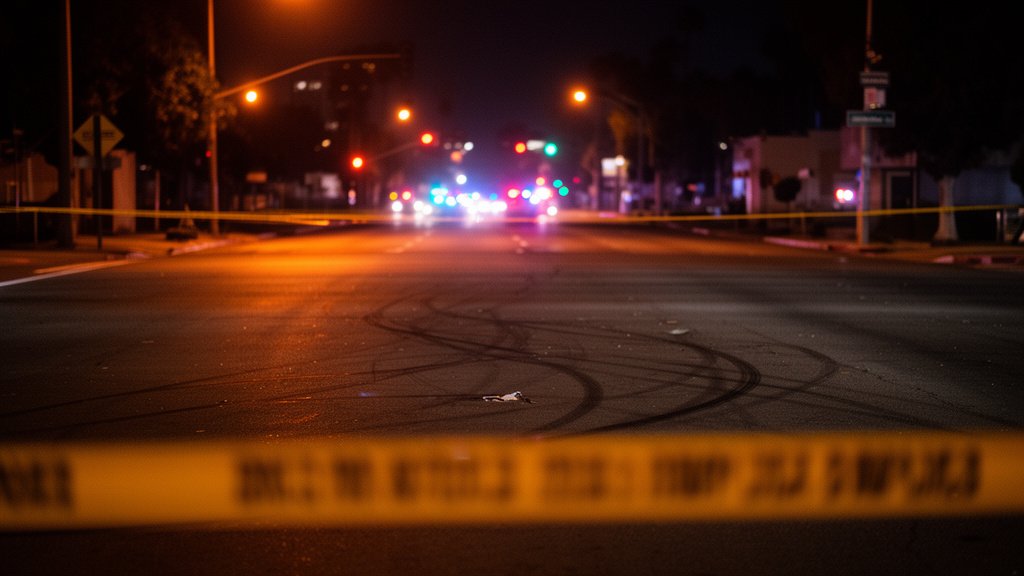
Late Sunday night, the quiet of the Watts neighborhood was shattered by a tragic, multi-vehicle collision that left one pedestrian dead and sparked an active manhunt for two motorists who fled the scene. The incident, which unfolded at the busy intersection of Imperial Highway and Central Avenue, is currently under intense investigation by the Los Angeles Police Department. Authorities have confirmed that a pedestrian was struck by three separate vehicles; while the driver of one vehicle remained at the scene to cooperate with law enforcement, the operators of the other two vehicles left the location immediately following the impact, effectively becoming subjects of a critical hit-and-run investigation.
The Sequence of the Collision
The catastrophic events began late Sunday, though the exact timeline and mechanical sequence are still being pieced together by investigators from the LAPD’s South Traffic Division. According to preliminary reports, the pedestrian was in the intersection when they were first struck. In high-traffic zones like the intersection of Imperial Highway and Central Avenue, visibility at night can be complicated by the specific lighting conditions and the volume of transit vehicles moving through the corridor. The impact was described by witnesses as severe.
What followed was a chaotic chain reaction. The initial strike, which incapacitated the victim, was compounded as subsequent vehicles were unable to avoid the downed individual. While the first motorist involved—the individual who ultimately remained—initiated contact with emergency services, the two subsequent drivers failed to stop, violating California state law regarding vehicular accidents. By the time emergency medical services (EMS) and LAPD units arrived on the scene, the pedestrian had succumbed to their injuries. The identity of the deceased is being withheld pending notification of next of kin, a standard procedure that underscores the human cost of this tragedy.
The LAPD Investigation and Surveillance Challenges
The Los Angeles Police Department is treating this incident with the highest degree of urgency. Investigating a three-vehicle collision where multiple drivers have fled requires a complex gathering of forensic and electronic evidence. Detectives are currently canvassing the area for residential security cameras, business surveillance footage, and municipal traffic sensors that might have captured the make, model, or license plate numbers of the two suspect vehicles.
Identifying the specific vehicles involved in a hit-and-run is notoriously difficult when the suspects flee in different directions or merge back into the flow of nighttime traffic. However, the LAPD utilizes a specialized traffic investigation unit trained to process such scenes. This involves analyzing debris left at the intersection—such as fragments of headlights, bumper molding, or side-mirror casing—which can often pinpoint the specific year and model of the fleeing vehicles. The department is urging anyone who was in the vicinity of Imperial Highway and Central Avenue between the late Sunday hour and the arrival of police to come forward, as even a minor observation could prove pivotal in tracking down the responsible parties.
Infrastructure and Safety in South Los Angeles
The intersection of Imperial Highway and Central Avenue has long been a focal point for traffic safety discussions in South Los Angeles. This area connects major arteries of the city, facilitating high-speed transit that often conflicts with pedestrian activity. Urban planners and local advocacy groups frequently highlight these corridors as ‘high-injury networks’—a classification used by the city to identify streets where the probability of severe traffic incidents is statistically higher.
The tragic event serves as a grim reminder of the vulnerability of pedestrians in urban environments. Infrastructure improvements, such as enhanced street lighting, pedestrian islands, and speed-reduction measures, are often debated in the wake of such fatalities. However, the immediate challenge remains the lack of accountability among drivers who choose to leave the scene of an accident. The culture of ‘hit-and-run’ in Los Angeles has reached alarming levels, with the LAPD dealing with thousands of such reports annually. This incident, involving three separate vehicles, highlights a disturbing trend where the assumption of safety in public intersections is increasingly precarious.
The Legal and Societal Implications
Under California Vehicle Code, fleeing the scene of an accident involving injury or death is a felony offense. The consequences for the drivers involved, once apprehended, will be severe, likely including lengthy prison sentences, heavy fines, and the permanent loss of driving privileges. Beyond the legal ramifications, this incident has caused a ripple of trauma through the Watts community. Neighbors and frequent commuters have expressed shock at the callousness of the drivers who chose to abandon the scene rather than render aid.
From a sociological perspective, the decision to flee often stems from panic, fear of insurance repercussions, or, in more sinister cases, prior involvement in illegal activities (such as driving under the influence or driving without a license). Yet, as community leaders often point out, leaving the scene prevents the possibility of providing life-saving medical aid, potentially turning a survivable accident into a fatality. The search for these two drivers is not merely a procedural exercise; it is an effort to provide closure to the victim’s family and to reinforce the rule of law in a city grappling with a crisis of road safety.