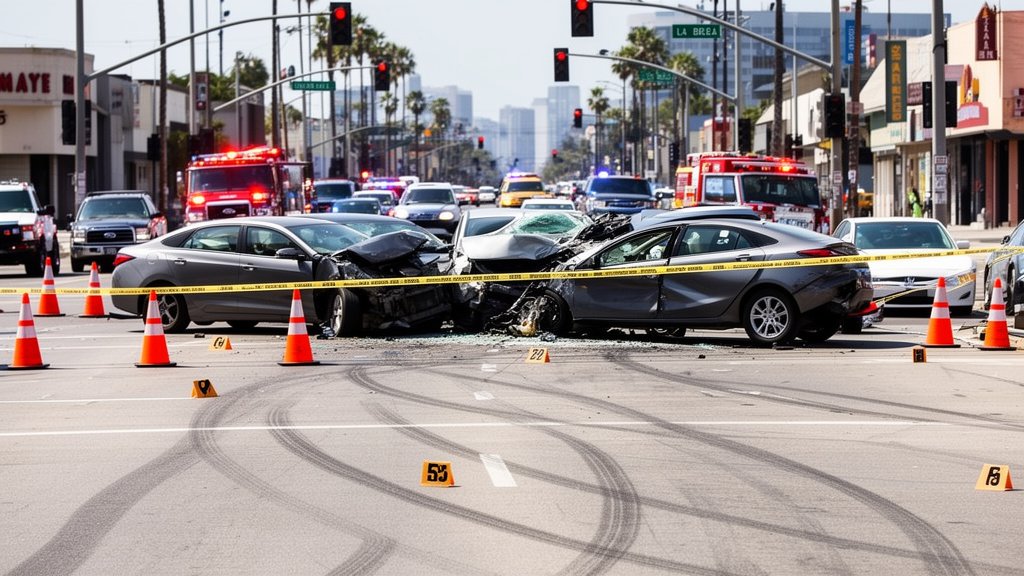
A catastrophic five-car collision occurred at the busy intersection of La Brea and Beach avenues in Inglewood, resulting in a scene of absolute devastation that claimed two lives and left two others hospitalized with varying degrees of injury. Local emergency services were dispatched to the site during a peak traffic window, leading to a significant multi-agency response that locked down one of the city’s critical transit arteries for several hours as investigators began the complex process of reconstructing the events that led to the multi-vehicle pileup.
Key Highlights
- Fatalities Confirmed: Two individuals were pronounced dead at the scene, with two others transported to nearby trauma centers.
- Incident Scope: A complex five-car pileup involving multiple vehicles, necessitating a major emergency response from the Inglewood Police Department and Los Angeles County Fire Department.
- Location Impact: The intersection of La Brea and Beach avenues was cordoned off for an extensive period, causing significant localized traffic disruption.
- Ongoing Investigation: Authorities have launched an inquiry into the causal factors, focusing on speed, vehicle trajectory, and potential mechanical or human error.
The Anatomy of the Inglewood Collision: Investigation and Response
The intersection of La Brea and Beach avenues, usually a standard thoroughfare in Inglewood, became the site of a high-impact collision that has sent shockwaves through the community. According to preliminary reports from the Inglewood Police Department, the incident involved a chain-reaction event. The exact sequence of the crash remains under active investigation, as experts look to determine whether the collision was sparked by a singular high-speed incident or a progressive sequence of errors involving multiple drivers.
Emergency Response and Scene Management
When the first distress calls reached dispatch, the response from the Los Angeles County Fire Department was immediate and multi-faceted. Rescuers were forced to contend with a chaotic scene, where five vehicles were strewn across the intersection, some with significant structural damage that required the “jaws of life” to extract trapped occupants.
“The primary goal in the first hour of a mass-casualty traffic event is stabilization and triage,” noted a local public safety official. The complexity of a five-car crash lies in the geometric analysis required—first responders must manage hazardous fluid leaks, potential electrical fires from compromised vehicle batteries, and the delicate task of moving injured victims while preserving evidence for the inevitable collision reconstruction team. The intersection remained a “frozen crime scene” for hours, a necessary measure to ensure that tire marks, debris fields, and vehicle positions were documented with millimeter-level precision before the wreckage could be cleared.
Intersection Dynamics and Urban Safety
This specific intersection, connecting key local routes, serves as a focal point for the broader debate regarding traffic infrastructure in Southern California. While investigators are currently looking at immediate causes—such as red-light running, excessive speed, or distracted driving—urban planners often examine these sites for “blind spots” or timing issues in traffic signals.
Major intersections in denser metropolitan areas like Inglewood naturally attract a higher frequency of near-misses. When five vehicles are involved, it suggests that the energy involved was significant enough to create a domino effect. The forces generated in such a collision can be exponential, often resulting in fatalities even when safety features like airbags and crumple zones are fully deployed. The ongoing investigation will likely utilize dashcam footage from surrounding vehicles and nearby security cameras to establish whether the intersection’s design or signal timing played a contributory role.
The Mechanics of Crash Reconstruction
For the detectives from the Inglewood Police Department, the next several days will be defined by the rigorous science of crash reconstruction. This process is far more nuanced than simple witness accounts. Investigators will create a 3D scan of the intersection, correlating the physical resting point of each vehicle with the known mass and speed capabilities of the makes and models involved.
They look for “yaw marks”—the tell-tale curved skid marks left by tires sliding sideways—which provide a mathematical roadmap of the collision’s velocity and direction. By calculating the energy dissipation, police can estimate the speed of the primary impact vehicle. If evidence of reckless driving, such as excessive speed or impaired operation, is found, the legal ramifications for surviving drivers could be severe, transitioning the case from a tragic accident to a criminal inquiry involving vehicular manslaughter charges.
Long-Term Trauma and Community Impact
Beyond the physical evidence, the impact of such a high-profile crash on the community is profound. Two families have lost loved ones, and two others are currently fighting for recovery in local hospitals. The psychological toll on the witnesses—those who were present at the intersection during the event—is a secondary but critical aspect of this tragedy. Local trauma services often prioritize mental health resources in the wake of such incidents, recognizing that the shock of a sudden, violent death can have long-lasting effects on the neighborhood psyche.
As the investigation continues, the authorities are urging any witnesses who have not yet come forward to contact the department. The data collected in these early stages will be vital for determining accountability and potentially influencing future safety protocols at the La Brea and Beach intersection. This is not merely a record of an accident; it is a developing story of a community grappling with the harsh realities of urban transit safety, underscoring the critical need for vigilance on the road.
FAQ: People Also Ask
1. What is the status of the investigation into the Inglewood crash?
The investigation is currently ongoing. The Inglewood Police Department is actively collecting evidence, including witness statements, potential security camera footage, and conducting physical reconstruction of the accident site to determine the primary cause.
2. How long will the intersection of La Brea and Beach be affected?
While the primary wreckage has been cleared and the roads reopened to the public, the investigation is continuing. Minor traffic delays may persist in the vicinity as law enforcement occasionally returns for follow-up evidence collection or traffic control measurements.
3. How do authorities handle a five-car pileup investigation?
Police use crash reconstruction technology, including 3D mapping and debris analysis. They focus on determining the initial point of impact and the sequence of events that involved the subsequent vehicles, looking for factors like speed, impairment, and traffic violations.
4. What safety measures exist for high-traffic intersections like this one?
Traffic safety at major intersections usually involves signal synchronization, clear lane markings, speed enforcement cameras, and, in some cases, protective left-turn arrows. Urban planners review these sites after major collisions to determine if infrastructure modifications are necessary to prevent future incidents.