Federal authorities executed a critical arrest on the perimeter of the Trump National Golf Club in Rancho Palos Verdes, taking an individual into custody after he was observed closely monitoring security-planning activities. The intervention, which occurred just hours before a scheduled visit by former President Donald Trump for a Republican National Committee (RNC) fundraiser, underscores the heightened vigilance currently maintained by the U.S. Secret Service and local law enforcement in the wake of recent threats against high-profile political figures.
Key Highlights
- Swift Intervention: The individual was identified and apprehended by federal authorities while allegedly recording or surveilling specific security protocols and tactical preparations near the golf club premises.
- High-Stakes Timing: The arrest took place in the critical window immediately preceding a fundraiser event hosted by Donald Trump, necessitating a rapid threat assessment by the Secret Service.
- Strategic Collaboration: The operation involved seamless coordination between federal agents and the Los Angeles County Sheriff’s Department (LASD) to secure the Rancho Palos Verdes location.
- Protective Protocols: This incident highlights the ongoing complexity of securing open-access or large-venue events, particularly those located in rugged, coastal topography like the Rancho Palos Verdes peninsula.
The Anatomy of a Presidential Security Breach
The apprehension of an individual near the Trump National Golf Club represents a microcosm of the intense logistical challenges inherent in protecting presidential candidates during a contentious election cycle. The Rancho Palos Verdes location, known for its expansive coastline and specific elevated terrain, offers unique visibility advantages—and vulnerabilities—that require aggressive tactical management by protective details.
According to preliminary reports, the suspect was not merely present in the vicinity but was actively engaged in documenting or monitoring the logistical movements of security personnel. In the world of threat assessment, the difference between a bystander and a person of interest is often defined by intent and pattern of behavior. The Secret Service maintains a zero-tolerance policy regarding the observation of tactical, low-profile, or overt security perimeters. When federal authorities observe an individual attempting to map out the ‘static’—the layout of agents, the ingress and egress routes, and the placement of screening equipment—the threat level is escalated immediately.
The Shift in Threat Awareness
The political climate in 2024 has necessitated a radical shift in how the U.S. Secret Service interacts with the public sphere. Traditionally, presidential campaigns rely on the optics of accessibility, with candidates moving through crowds and hosting events at diverse venues. However, the recurring nature of potential threats against political figures has forced a ‘fortress’ mentality. This incident at the Trump National Golf Club serves as a stark reminder that the security apparatus is operating on an accelerated cycle of suspicion. Security teams are no longer just looking for weapons; they are looking for reconnaissance. The ability of the authorities to intercept this individual before any escalation occurred points to the effectiveness of the ‘pre-event’ sweep protocols that are standard for RNC-sponsored fundraisers.
Challenges of the Rancho Palos Verdes Terrain
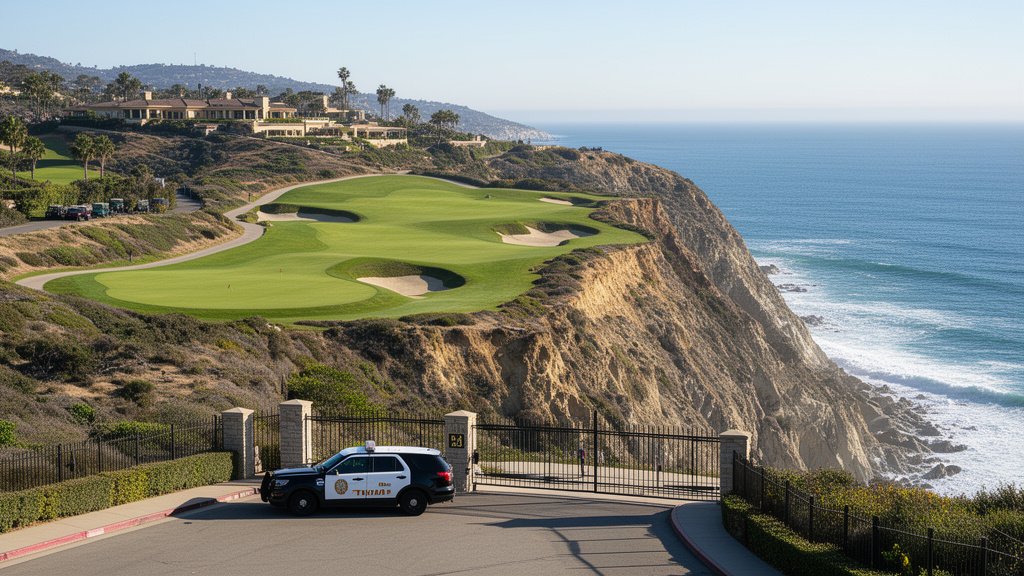
Geographically, the Trump National Golf Club provides a complex security puzzle. Situated on a cliffside, the venue is bordered by the Pacific Ocean to the south and steep, rolling coastal bluffs. Unlike an indoor convention center where access points can be hardened and narrowed down to a few checkpoints, a golf course provides multiple sightlines and potential approaches. Maintaining a sterile zone around such a location requires an integrated approach involving aerial surveillance, perimeter patrols, and the kind of intelligence-sharing that led to this specific arrest. The arrest demonstrates that the federal protective shield extends far beyond the immediate presence of the candidate; it encompasses a wide radius of monitoring intended to neutralize threats before they can materialize into direct actions.
The Role of Inter-Agency Cooperation
While the Secret Service holds the ultimate mandate for protecting the former President, the success of such operations relies heavily on the ‘force multiplier’ effect provided by local agencies like the Los Angeles County Sheriff’s Department. Local law enforcement brings institutional knowledge of the geography and potential traffic bottlenecks, while federal agencies provide the specialized training in counter-surveillance and threat intelligence. The arrest in Rancho Palos Verdes serves as an operational success story for this partnership. By sharing data on suspicious activity in real-time, the agencies created a proactive, rather than reactive, defense posture. For the general public, this interaction is rarely visible, but it is the heartbeat of modern political campaign security.
FAQ: People Also Ask
Q: Why was the arrest at the Trump National Golf Club significant?
A: The arrest was significant because the individual was allegedly monitoring security preparations, a behavior classified as pre-attack surveillance. Catching such behavior before a high-profile visit is a primary objective of the U.S. Secret Service to prevent potential disruptions or threats.
Q: Does this change access for residents of Rancho Palos Verdes during political events?
A: Yes, presidential visits, regardless of the candidate, trigger significant security ‘hardened zones.’ This often involves restricted airspace, road closures, and increased scrutiny of individuals in the surrounding areas, often altering the daily routines of nearby residents.
Q: What is the standard protocol for handling a suspicious person near a protected official?
A: The Secret Service and local law enforcement prioritize an ‘interdict and interrogate’ strategy. If someone is observed acting suspiciously, they are detained and questioned to determine if they pose a credible threat, possess unauthorized technology, or have ulterior motives before being either released or placed under formal arrest.
Q: How does the Secret Service determine if a person is a ‘threat’ versus a ‘bystander’?
A: Security professionals use behavioral analysis. They look for indicators such as documenting security layouts, pacing, concealment of identity, possession of surveillance equipment, and non-compliance with perimeter boundaries. This behavioral ‘baseline’ analysis is what prompts the intervention.