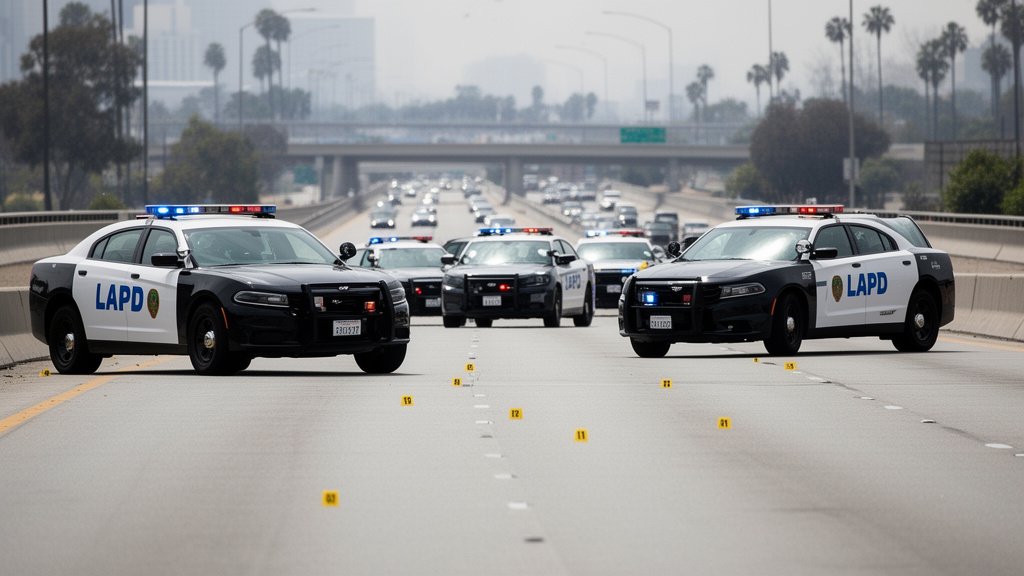
LAPD officers fatally shot an unidentified male suspect who was reportedly swinging a baseball bat at passing vehicles near a freeway onramp, prompting a critical incident investigation by the department’s Force Investigation Division (FID). The encounter, which occurred amid high-traffic conditions, has drawn immediate scrutiny regarding police response protocols to public safety threats involving non-firearm weapons.
Key Highlights
- Incident Context: Officers responded to reports of a suspect blocking traffic and damaging vehicles with a baseball bat at a freeway onramp.
- Use of Force: The engagement resulted in a fatal Officer-Involved Shooting (OIS); no officers or bystanders were reported injured.
- Official Investigation: The LAPD’s Force Investigation Division (FID) has taken control of the scene to conduct a comprehensive analysis of the shooting, in compliance with department policy.
- Public Safety: The onramp and surrounding freeway lanes experienced significant delays as investigators processed forensic evidence and interviewed witnesses.
Anatomy of a Critical Incident and Police Oversight
The shooting incident, which has left the local community grappling with questions regarding crisis intervention and escalation, highlights the complex operational environment faced by Los Angeles Police Department patrol officers. When responding to reports of a suspect actively threatening motorists with a deadly weapon—in this instance, a baseball bat—officers must navigate a split-second decision-making process where the potential for collateral damage to commuters is extremely high.
The Nature of the Threat
In situations involving individuals brandishing blunt force objects, the threat profile is distinct from encounters involving firearms. A baseball bat, while not a ranged weapon, poses an immediate and lethal threat in close quarters, particularly to civilians trapped inside vehicles at a standstill or moving slowly in traffic. The decision to utilize lethal force in such scenarios is strictly governed by the LAPD’s Use of Force Policy, which mandates that force must be objectively reasonable and proportional to the threat presented. Investigators will now be tasked with reconstructing the encounter, utilizing body-worn camera footage, witness statements, and physical evidence to determine if the suspect’s actions left officers with no alternative to neutralize the threat.
Force Investigation Division (FID) Protocols
Following any officer-involved shooting, the LAPD activates the Force Investigation Division. This specialized unit acts independently of the local patrol division to ensure objectivity. Their role is to gather all available evidence, including digital media, 911 call logs, and forensic data, to present a comprehensive report to the Board of Police Commissioners and the District Attorney’s Office. This process is intentionally exhaustive, often taking months to complete, to ensure the integrity of the investigative findings. The goal is not only to determine the legality of the shooting but also to identify any potential tactical failures that could be addressed through additional training or policy adjustments.
The Complexity of Mental Health Crises in Traffic
One of the most difficult variables for law enforcement in such incidents is the prevalence of undiagnosed or untreated mental health crises. When a suspect displays erratic behavior in a high-traffic area, officers are often the first, and sometimes only, resource available. This incident raises questions regarding the capacity for non-lethal de-escalation when a suspect is actively endangering public safety. While the LAPD has integrated Mental Evaluation Units (MEU) and specialized training to better handle such encounters, the reality of a fast-moving, high-threat situation at a freeway onramp often precludes the time required for specialized teams to arrive on the scene.
Broader Implications for Public Safety
This event also underscores the risks inherent in our transit infrastructure. Freeway onramps are highly vulnerable points where traffic congestion creates “trapped” environments for motorists. When individuals choose these locations to engage in erratic or violent behavior, the response time is critical. Future policy discussions within the city council may focus on improved coordination between Caltrans and local law enforcement to better secure these access points during known high-risk scenarios.
FAQ: People Also Ask
Q: What is the current status of the investigation into the shooting?
A: The investigation is being conducted by the LAPD’s Force Investigation Division. They are currently collecting evidence, reviewing body-worn camera footage, and interviewing witnesses to determine the facts of the encounter.
Q: Are there any witnesses to the incident?
A: Officials have indicated that witnesses, including affected drivers, are being interviewed to build a timeline of the events leading up to the officer-involved shooting.
Q: Does the LAPD have a policy for dealing with suspects with blunt weapons?
A: Yes, the LAPD utilizes a graduated Use of Force Policy. However, each incident is evaluated based on the specific threat level, immediacy of danger to the public, and the officer’s reasonable perception of that danger at the moment of the encounter.