Taylor Swift has launched a significant legal offensive to secure her digital identity, filing three new trademark applications with the U.S. Patent and Trademark Office on April 24, 2026. Through her holding company, TAS Rights Management, LLC, the pop icon is seeking to register two specific audio phrases—“Hey, it’s Taylor Swift” and “Hey, it’s Taylor”—alongside a descriptive visual trademark covering a specific, recognizable stage image from her Eras Tour. This maneuver represents a pivotal moment in the entertainment industry’s ongoing struggle to define ownership of personal identity in an era defined by rapid advances in generative artificial intelligence (AI). By moving beyond traditional copyright protections and into the nuanced realm of trademark law, Swift’s legal team is attempting to build a defensive perimeter against the proliferation of deepfakes, voice cloning, and synthetic misinformation.
Key Highlights
- Strategic Trademark Filings: TAS Rights Management submitted three applications: two for audio identifiers (“Hey, it’s Taylor Swift” and “Hey, it’s Taylor”) and one for a visual representation of the artist on stage.
- Combatting AI Misuse: The filings act as a direct response to the increase in unauthorized AI-generated content, including deceptive deepfakes and false political endorsements that have targeted the singer.
- Legal Innovation: Intellectual property experts, including Josh Gerben, suggest this is an unprecedented expansion of trademark utility, using it as a shield to prevent “confusingly similar” imitations of a celebrity’s persona.
- Setting a Trend: Swift follows the lead of actor Matthew McConaughey, who secured similar protections earlier in 2026, signaling a potential industry-wide shift in how celebrities manage and defend their intellectual property.
Protecting Identity in the AI Age
The landscape of celebrity protection has fundamentally shifted. Historically, the legal framework relied on copyright—protecting the fixed expression of a work—and “Right of Publicity” laws, which govern the commercial use of a person’s name, image, and likeness. However, generative AI has effectively broken this model. Sophisticated machine learning models can now synthesize a person’s voice and image to create entirely new, non-existent content that nonetheless feels authentic to fans and the public. Unlike a copy of a song, which is easily identifiable as a copyright violation, AI-generated content that mimics an artist’s cadence or visual aesthetic often occupies a legal gray area.
Swift’s recent filings are a calculated attempt to pull this gray area into the black-and-white domain of trademark law. Trademarks are designed to protect brand identifiers—slogans, logos, and, in rare cases, sounds—that signal the source of goods or services to consumers. By trademarking specific phrases and a distinct visual “look,” Swift creates a legal basis to claim that any unauthorized AI content mimicking these elements could cause consumer confusion or dilution of her personal brand. This creates a powerful, albeit untested, tool for her legal team to issue cease-and-desist orders and pursue litigation against platforms or individuals propagating synthetic content that appropriates her persona.
Understanding Sound Marks and Visual Trademarks
Sound marks are a specialized and underutilized form of intellectual property. Common examples include the NBC chimes or the Netflix “tu-dum” intro. However, registering a human voice—specifically a celebrity’s spoken conversational voice—is a radical departure from standard practice. The filings by TAS Rights Management don’t just protect the recording of the voice (which is a copyright matter); they protect the identity associated with the voice.
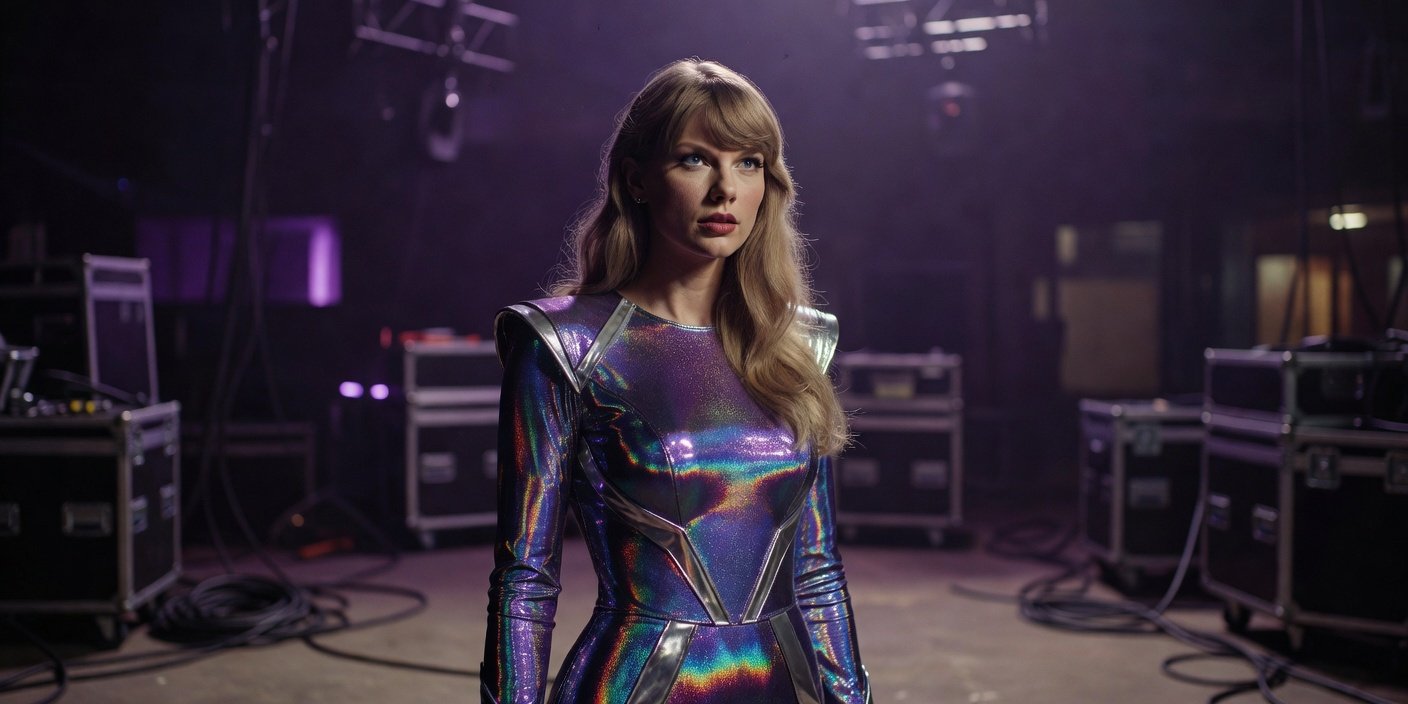
Similarly, the visual trademark application is highly specific. It describes a photograph of Swift holding a pink guitar, outfitted in a multi-colored iridescent bodysuit and silver boots, illuminated by purple stage lighting. This is not just any photo; it is an archetypal image that captures the “essence” of her Eras Tour. By codifying this specific visual composition as a trademark, Swift’s legal team aims to create a shield against “deepfake” imagery that attempts to replicate this specific aesthetic. If a bad actor uses AI to generate an image that mimics this signature look, they aren’t just infringing on a copyright; they are potentially violating a protected trademark, which carries different, and often stricter, penalties.
The Precedent: Why Celebrities are Moving Now
Taylor Swift is not working in a vacuum. The entertainment industry has been reeling from a series of high-profile incidents involving synthetic media. From the circulation of explicit AI-generated deepfakes in early 2024 to the political weaponization of her likeness during the U.S. presidential election cycle—where false AI images suggested her endorsement of candidates—the threat to her personal brand is existential and immediate.
Matthew McConaughey’s decision earlier this year to trademark his iconic phrases and likeness provided a proof-of-concept for this strategy. McConaughey’s legal team argued that for celebrities, the brand is the person. In a world where AI can manipulate that brand to say or do things the person never intended, the old protections are insufficient. Swift’s move suggests that this “McConaughey Doctrine”—treating personal identity elements like corporate assets—is quickly becoming the new industry standard for A-list talent. The goal is to establish a “clear perimeter of ownership,” as McConaughey’s camp put it, where consent is the absolute prerequisite for any reproduction of the artist.
Limitations and Future Challenges
While this strategy is bold, it faces significant hurdles. Intellectual property attorney Josh Gerben has noted that using trademark law to protect a celebrity’s voice has not been robustly tested in court. Critics argue that trademark law was designed for commerce, not for the protection of personality. There is a risk that courts could find these registrations overbroad or attempt to limit their scope to specific commercial goods, rather than applying them as a blanket prohibition against AI imitation. Furthermore, the speed at which AI technology evolves constantly threatens to outpace the slow, deliberate machinery of the patent and trademark office.
Despite these challenges, the filing serves a crucial secondary purpose: deterrence. By establishing a public record of these trademarks, Swift signals to AI developers, tech platforms, and bad actors that her team is prepared to litigate. In the legal world, often the most effective protection is the clear, unambiguous assertion of rights, backed by the financial resources to enforce them. As we move further into 2026, the question is not just whether these trademarks will hold up in court, but whether they will set a precedent that compels legislative bodies to finally enact comprehensive federal protections against unauthorized AI replication of human likeness.
FAQ: People Also Ask
1. Why is Taylor Swift using trademark law instead of copyright law?
Copyright protects specific creative works (like a song or a photograph). Trademarks protect source identifiers (brands). Because AI can create new content that mimics an artist without technically “copying” their old songs, copyright is often insufficient. Trademarks allow Swift to protect the brand of her voice and image, potentially blocking others from using them to confuse consumers.
2. What are “sound marks” and how do they work?
Sound marks are trademarks that identify the source of a product or service through sound rather than a logo. Famous examples include the MGM lion roar or the Intel chime. Swift is attempting to use this category to secure rights over her specific spoken vocal identity.
3. Will these trademarks stop all AI deepfakes of Taylor Swift?
It is unlikely to stop them completely, as enforcement is difficult and legal interpretation remains untested. However, it provides a much stronger legal “club” for her lawyers to swing when demanding that social media platforms or AI model developers remove content that uses her voice or image.
4. Has anyone else successfully done this?
Yes. Actor Matthew McConaughey filed and successfully registered trademarks for his voice and likeness in early 2026 as a direct counter-measure to AI misuse. Swift’s strategy is modeled after this emerging trend among A-list celebrities.