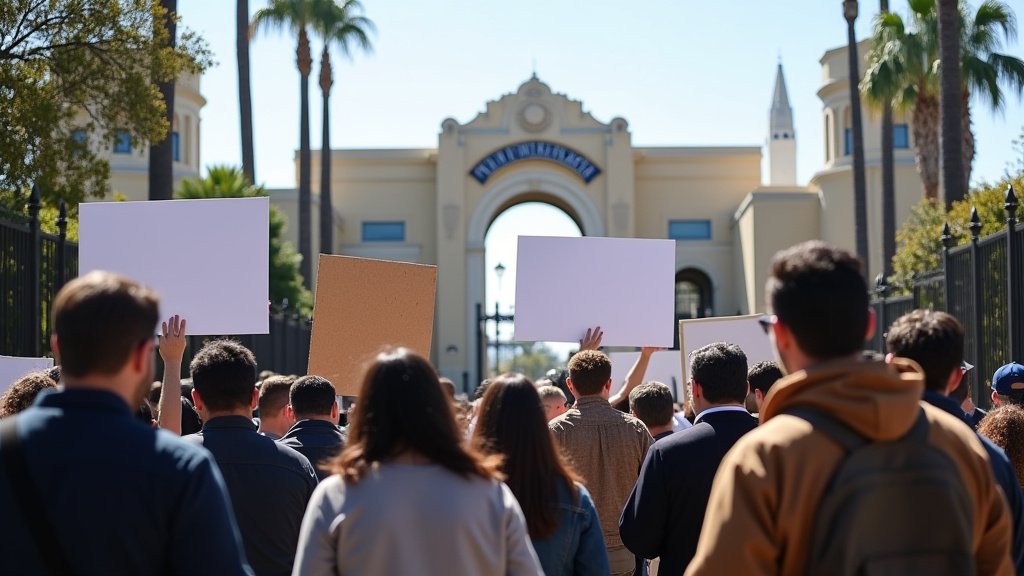
The atmosphere outside the gates of Paramount Studios in Los Angeles turned tense this past Tuesday as the ‘Block the Merger Coalition’ mobilized a vocal protest. The demonstration was organized to voice immediate, deep-seated opposition to the proposed acquisition of Warner Bros. by Paramount, with the primary catalyst being the widespread anxiety surrounding impending mass layoffs.
The Tuesday Confrontation
On Tuesday, members of the ‘Block the Merger Coalition’ gathered in a display of solidarity and concern. The group, representing a diverse cross-section of industry workers—from production crew members to administrative staff—erected signage and led chants aimed directly at the executive leadership suites of Paramount Studios. The core of their message was singular and urgent: the pursuit of a merged Paramount-Warner Bros. entity threatens the livelihoods of thousands of entertainment professionals.
“We are here because these boardroom decisions are not just numbers on a spreadsheet,” a spokesperson for the coalition stated during the event. “They are careers, pensions, and family livelihoods that are being discarded in the pursuit of corporate synergy.” The coalition’s presence served as a physical embodiment of the unease currently permeating Hollywood, as the specter of ‘redundancy’ continues to loom over every major studio consolidation announcement.
Consolidation Conflicts: The Human Cost of Studio Megamergers
The Anatomy of ‘Synergy’
The central economic driver cited by investors and analysts regarding the potential Paramount-Warner Bros. merger is the promise of ‘synergy’—a financial euphemism that almost invariably translates to cost-cutting. In the current economic climate of the entertainment industry, these cost-cutting measures are primarily executed through head-count reductions.
When two media giants merge, overlapping departments such as marketing, legal, human resources, and distribution logistics become targets for consolidation. The coalition argues that this process is inherently destructive. By eliminating duplicate roles, the merged entity aims to streamline operations to improve quarterly earnings, but the workers left in the wake of this consolidation often struggle to find immediate re-employment in a shrinking job market. Analysts observing the protest noted that the fear of layoffs is well-founded, as previous industry mergers have consistently resulted in double-digit percentage workforce reductions within the first eighteen months of a new entity’s formation.
The Streaming Pivot and Economic Realities
Beyond the immediate threat of layoffs, the protest highlights a broader, industry-wide issue: the pivot toward streaming profitability. Both Paramount and Warner Bros. have spent the last half-decade aggressively competing in the streaming ‘wars.’ However, as investor sentiment has shifted from valuing subscriber growth to demanding free cash flow and profitability, the need for deep cost reductions has become paramount.
This merger, according to the coalition, is a symptom of a systemic failure to stabilize the streaming model without sacrificing the labor force. The industry is currently trapped in a cycle where market saturation forces mergers, and mergers force layoffs, creating a volatile environment for the creative class. The ‘Block the Merger Coalition’ suggests that this cycle is unsustainable and that regulators should be paying closer attention to the impact on the labor market, rather than focusing solely on competition metrics like market share or content library size.
The Role of Labor and Future Outlooks
This protest also serves as a bellwether for the evolving relationship between corporate studio leadership and the labor guilds. Following high-profile labor disputes over the last few years, including those involving the WGA and SAG-AFTRA, the workforce is more organized and more willing to engage in public demonstrations. The coalition is not merely asking for job security; they are demanding a seat at the table when the future of the company is being negotiated.
As the proposed merger continues to move through regulatory scrutiny, the voices of these protesters provide a crucial counter-narrative to the optimism presented by Wall Street analysts. If the merger proceeds, it will likely be one of the most scrutinized corporate combinations in entertainment history, with every job cut potentially drawing further negative media attention and political pressure.
FAQ: People Also Ask
Q: Why is the ‘Block the Merger Coalition’ specifically targeting Paramount Studios?
A: The coalition chose Paramount Studios because it serves as the physical headquarters for the negotiations. Protesting at the studio gates provides a direct line of sight to the decision-makers and ensures that the narrative of worker displacement remains visible to the executives involved in the merger discussions.
Q: What are the main economic arguments for the Paramount-Warner Bros. merger?
A: Proponents argue that the combined entity would possess a massive intellectual property library, a stronger consolidated streaming platform, and the ability to significantly reduce operational overhead, thereby creating a more competitive global media conglomerate.
Q: How do mass layoffs in Hollywood affect the broader economy?
A: Layoffs in the film and television industry have a ‘ripple effect.’ Beyond the loss of individual jobs, they impact ancillary service industries, including post-production facilities, catering, equipment rental companies, and local small businesses in Los Angeles that rely heavily on a thriving, stable entertainment workforce.