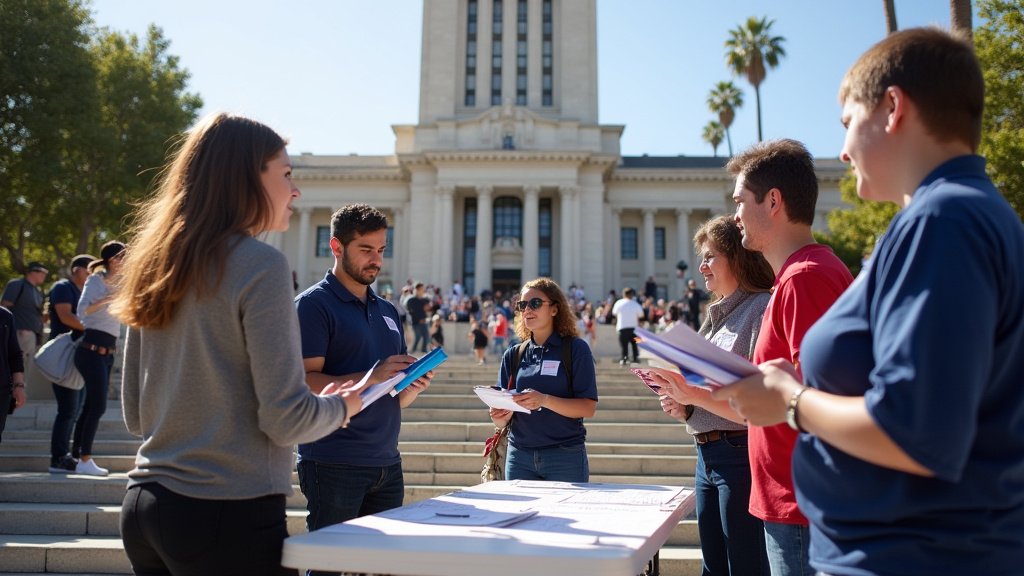
Hundreds of protesters converged on the steps of Los Angeles City Hall this Saturday, united under the banner of the ‘No Kings’ movement. While the rally drew visual inspiration from concerns over the current political trajectory and recent executive power debates, the core mandate of the afternoon was pragmatic: voter mobilization. Organizers utilized the gathering to register dozens of new voters on-site, framing the event as a direct response to the perceived erosion of checks and balances in the United States government.
The Catalyst: Turning Protest into Policy
The ‘No Kings’ movement has gained traction in urban centers across the country, serving as a visceral reaction to the United States Supreme Court’s recent immunity rulings. Demonstrators at the Los Angeles event carried placards featuring historical references to 1776, arguing that the American presidency was never intended to function as an absolute monarchy. However, unlike many protest movements that focus strictly on public dissent, the organizers in Los Angeles explicitly pivoted the rally toward electoral participation.
“The goal isn’t just to be heard; it’s to be counted,” one organizer noted, addressing the crowd. The strategy reflects a growing trend among civic engagement groups: recognizing that the only effective antidote to executive overreach is the mobilization of the electorate. By setting up booths and engaging with passersby, the rally moved beyond the optics of protest to the mechanics of democracy.
Bridging the Divide: Protest and Participation
The intersection of protest and electoral participation is a complex ecosystem. Critics of protest movements often argue that such demonstrations merely ‘preach to the choir’ without effecting systemic change. The Los Angeles rally attempted to dismantle this criticism by creating a physical bridge between the two actions. By providing immediate resources for voter registration, the organizers acknowledged that while protests can set the agenda, the ballot box dictates the outcome. This approach is increasingly common among younger, digitally native activist groups who have integrated traditional ‘boots-on-the-ground’ organizing with modern civic education.
The Historical Context of Executive Power
To understand the intensity of the ‘No Kings’ message, one must analyze the historical context of Article II of the U.S. Constitution. The Founders were deeply skeptical of monarchical power, having fought a war to escape the reach of a king. Consequently, they designed a system of separation of powers specifically to prevent any single branch from accumulating unchecked authority. Recent judicial interpretations, however, have sparked a vigorous national debate about the limits of presidential immunity. The demonstrators in Los Angeles are effectively asserting that the contemporary interpretation of these limits is inconsistent with the original structural intent of the Constitution.
Secondary Angles: Why This Matters
1. The Shift to ‘Active’ Civic Duty: We are witnessing a transition from passive political consumption (social media outrage) to active political production (voter registration drives). This indicates a maturing of the electorate in response to high-stakes legal outcomes.
2. The Role of Urban Centers: Downtown Los Angeles continues to serve as the beating heart of Southern California’s political activism. The choice of location—City Hall—is symbolic, reminding local officials that they are accountable to a constituency that is currently hyper-aware of legal and structural precedents.
3. Future Predictions for November: If these small-scale, issue-specific rallies continue to focus on voter registration, we may see a significant increase in turnout among demographics that typically abstain from mid-term or non-presidential elections, specifically focusing on down-ballot races where executive power oversight is determined.
The Challenges Ahead
While the enthusiasm at the rally was palpable, the movement faces significant hurdles. Maintaining momentum beyond the day of the protest requires sustained logistical efforts, funding, and the ability to pivot from a singular issue (the ‘No Kings’ slogan) to the broader, often less ‘viral’ topics of policy and governance. Additionally, the challenge of converting transient protesters into consistent voters remains the ‘holy grail’ of political science. If this coalition can successfully transition from the streets to the voting booth, they may influence local election outcomes far beyond the downtown district.
In conclusion, the ‘No Kings’ rally in Los Angeles is more than just a gathering of voices; it is an experiment in civic transformation. By linking a profound philosophical debate about the nature of the presidency to the immediate, practical act of casting a ballot, these organizers are testing a hypothesis: that deep-seated fear about the direction of the country can, if properly channeled, lead to a measurable spike in democratic participation. Whether this trend scales remains to be seen, but the intent is clear—the street is no longer the final destination for political energy; it is merely the starting line for the ballot box.
FAQ: People Also Ask
Q: What is the ‘No Kings’ movement protesting?
A: The ‘No Kings’ movement primarily objects to perceived expansions of executive power and legal immunities, arguing that these trends violate the constitutional principle that no person in the United States is above the law.
Q: Is the rally specifically partisan?
A: While the event reflects criticisms often associated with specific political debates regarding the Supreme Court, organizers emphasized that the core mission of the rally was non-partisan voter registration and civic participation rather than direct endorsement of a single candidate.
Q: Why was the rally held in downtown Los Angeles?
A: Downtown Los Angeles, specifically near City Hall, is a central hub for Southern California civic action. Its visibility ensures that political messages reach a wide audience and allows organizers to easily interface with high foot-traffic areas to maximize voter registration efforts.
Q: How does this rally differ from typical protests?
A: This event distinguishes itself by prioritizing direct, immediate action—specifically on-site voter registration—over simple public demonstration, aiming to translate political grievances into tangible electoral engagement.