
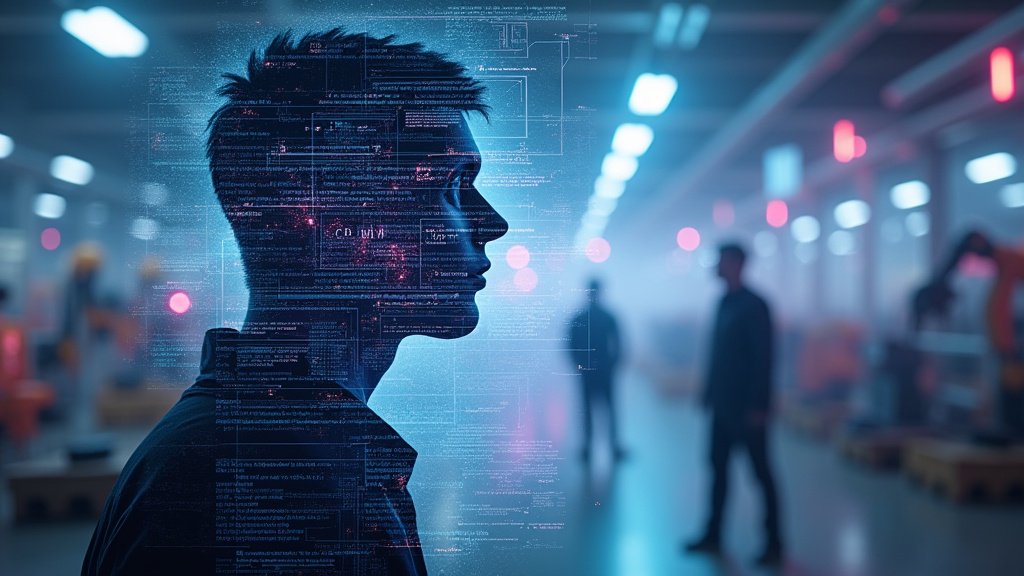
Artificial intelligence is rapidly advancing, raising significant concerns about its potential impact on the job market. Automation powered by AI could displace millions of workers across various sectors, from manufacturing and transportation to customer service and even creative fields. While proponents highlight AI’s potential to boost productivity and create new job categories, the immediate threat of job displacement looms large for many.
Key Highlights:
- AI-driven automation poses a significant risk to current employment.
- Sectors like manufacturing, transportation, and customer service are particularly vulnerable.
- The speed of AI development outpaces traditional job market adjustments.
- New job creation may not fully offset job losses.
- Ethical considerations and societal adaptation are crucial.
The Automation Avalanche
The pervasive integration of artificial intelligence into nearly every facet of modern life has sparked a global debate about its ultimate impact on employment. From sophisticated algorithms managing supply chains to generative AI creating art and text, the capabilities of AI are expanding at an unprecedented rate. This rapid evolution inevitably leads to questions about job security, as tasks once performed by humans are increasingly being automated. The concern is not just about efficiency gains; it’s about the fundamental restructuring of the workforce and the potential for widespread unemployment if society cannot adapt quickly enough.
Manufacturing and Logistics: The First Wave
Historically, automation has first impacted manual labor. AI is now supercharging this trend. Robots equipped with advanced AI can perform complex assembly tasks with greater precision and speed than humans. Autonomous vehicles, powered by AI, are poised to revolutionize the trucking and delivery industries, potentially displacing millions of drivers. Warehouse management systems are also becoming increasingly automated, with AI optimizing inventory, picking, and packing processes. The efficiency gains are undeniable, but the human cost in terms of job losses is a growing worry.
Service Industries: A Digital Overhaul
The impact of AI extends far beyond the factory floor. Customer service is undergoing a dramatic transformation, with AI-powered chatbots and virtual assistants handling an increasing volume of inquiries. These systems can operate 24/7, provide instant responses, and are often more cost-effective than human agents. Similarly, AI is making inroads into administrative roles, automating tasks such as scheduling, data entry, and document processing. Even fields like law and finance are seeing AI assist with research, analysis, and fraud detection, potentially reducing the need for junior-level professionals.
Creative Fields: The Unforeseen Frontier
Perhaps the most surprising area where AI is making inroads is in creative industries. Generative AI models can now produce realistic images, compose music, write articles, and even develop code. While many see this as a powerful new tool for artists and creators, others fear it could devalue human creativity and lead to job losses for graphic designers, writers, musicians, and software developers. The ability of AI to generate content at scale raises questions about intellectual property, originality, and the future of artistic professions.
Economic and Societal Implications
The potential for mass job displacement due to AI presents significant economic and societal challenges. If large segments of the population become unemployed, there could be a drastic increase in income inequality and a strain on social welfare systems. Governments and policymakers are grappling with how to respond, with discussions ranging from universal basic income (UBI) to massive retraining programs. The transition will require careful planning and investment to ensure that the benefits of AI are shared broadly and that society can adapt to a future where the nature of work may be fundamentally different.
FAQ: People Also Ask
Will AI take all the jobs?
While AI will undoubtedly automate many tasks and displace some jobs, it is unlikely to take all jobs. Many roles require uniquely human skills such as critical thinking, emotional intelligence, complex problem-solving, and creativity that AI currently cannot replicate. Furthermore, AI itself creates new jobs in areas like AI development, maintenance, ethics, and data science.
Which jobs are most at risk from AI?
Jobs involving repetitive tasks, data processing, and routine decision-making are most at risk. This includes roles in manufacturing, transportation (e.g., truck drivers), customer service, data entry, and some administrative positions. Emerging generative AI also poses potential risks to roles in graphic design, content creation, and basic programming.
What are the benefits of AI in the workplace?
AI can significantly increase productivity by automating tedious tasks, improving efficiency, and enabling faster decision-making. It can also enhance worker safety in hazardous environments, provide advanced analytical insights, and open up new avenues for innovation and economic growth.
How can workers prepare for an AI-driven future?
Workers can prepare by focusing on developing skills that are complementary to AI, such as critical thinking, creativity, emotional intelligence, and complex problem-solving. Continuous learning, upskilling, and reskilling through training programs and education will be essential to adapt to evolving job market demands.
What is the government’s role in managing AI’s impact on jobs?
Governments play a crucial role in managing AI’s impact by investing in education and retraining programs, developing ethical guidelines for AI deployment, fostering innovation, and potentially exploring new social safety nets like universal basic income to support displaced workers and ensure a just transition.