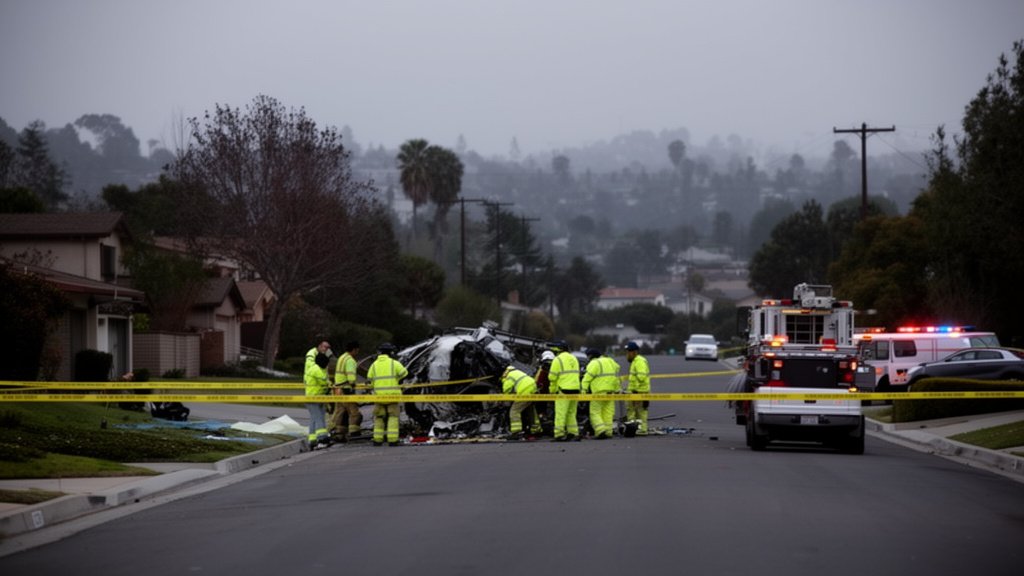
A somber calm has descended upon the Chatsworth community following a catastrophic aviation accident. An NBC Los Angeles news helicopter, deployed to document the aftermath of a fatal bus accident in the same neighborhood, crashed during its flight operations, resulting in the loss of all three individuals on board. The dual nature of this tragedy—a fatal ground accident met with a catastrophic aerial failure—has sent shockwaves through the local news industry and the broader Los Angeles community.
The Sequence of Events
The incident unfolded rapidly under what appeared to be routine operational conditions for the news crew. The helicopter was tasked with providing aerial coverage of a fatal bus accident occurring in the Chatsworth area, a standard procedure for local news stations managing high-interest traffic stories in the sprawling Los Angeles metropolitan area. However, the mission took a devastating turn when the aircraft went down. First responders, already active in the area due to the initial bus accident, were forced to pivot their resources immediately to the site of the crash. The convergence of these two distinct, tragic events in a single neighborhood has complicated the logistical response and intensified the emotional weight of the day’s reporting.
The Paradox of News Gathering: Risk vs. Responsibility
This incident highlights the inherent risks involved in Electronic News Gathering (ENG). Los Angeles is arguably the helicopter capital of the world for broadcast media. For decades, news stations have relied on aerial vantage points to provide context to traffic, chases, and breaking news. The visibility of these aircraft is a defining feature of the Southern California skyline. Yet, every flight carries an inherent risk factor. News helicopters must often navigate congested airspace, volatile weather conditions, and low altitudes to capture the required footage. The loss of a crew while performing their journalistic duty prompts an uncomfortable but necessary examination of the balance between the public’s right to know and the safety protocols governing those who bring the news to the screen.
Anatomy of the Investigation: Sorting Through the Wreckage
Following the crash, the site was cordoned off as investigators from the National Transportation Safety Board (NTSB) and the Federal Aviation Administration (FAA) initiated a formal inquiry. The investigation will be meticulous and multi-faceted. Authorities will examine the wreckage for mechanical anomalies, review maintenance logs, and analyze flight data recorders if available. Furthermore, the NTSB will scrutinize the flight path taken by the pilot, analyzing communication logs between the helicopter and the news station’s assignment desk. This process is exhaustive, often taking months or years, as investigators work to determine whether the crash was caused by a mechanical failure, pilot error, environmental factors, or a combination of complex variables.
The High-Risk Skies: Operational Challenges in the Los Angeles Basin
The Los Angeles Basin presents unique challenges for aviation. High-density urban development, combined with complex wind patterns and temperature inversions, creates a demanding environment for any pilot, let alone those tasked with multitasking—piloting a helicopter while ensuring camera operators and reporters are in the optimal position for a broadcast. This event underscores the immense pressure faced by these crews. Unlike commercial flights, which adhere to rigid, pre-planned routes, news helicopters are dynamic by nature. They go where the story is, often at a moment’s notice, flying into environments that are inherently fluid and unpredictable.
The Broader Implications for Newsroom Safety Protocols
For media organizations, this incident serves as a grim inflection point. Newsrooms across the country are expected to review their aerial operations safety manuals in the wake of such a disaster. Questions are being raised regarding the necessity of human-crewed helicopters in an era of advanced drone technology. While drones offer a safer alternative for low-altitude photography, they currently lack the flight endurance and legal flexibility to replace the capabilities of a full-sized news helicopter. Nevertheless, the industry will likely see a push for enhanced safety equipment, updated crew training requirements, and stricter guidelines regarding when it is appropriate to launch an aerial asset into potentially hazardous situations.
Exploring Secondary Angles: The Future of Aerial Journalism
1. Technological Transitions: As this investigation proceeds, there will undoubtedly be renewed discussions about the efficacy of replacing piloted helicopters with sophisticated, long-range heavy-lift drones. While the technology is advancing, the legal and regulatory framework—specifically FAA Part 107 rules and beyond—is still catching up, creating a gap between safety aspirations and operational reality.
2. The Psychological Toll: There is a significant, often overlooked psychological component to this tragedy: the impact on the newsroom staff who lost colleagues. The investigative nature of the news business often masks the camaraderie formed in high-stress environments. Support systems for newsroom staff are critical, as is the necessity of recognizing the specific trauma of covering a story that hits so close to home.
3. FAA Regulatory Scrutiny: This event will likely trigger a review of FAA oversight for media-operated aircraft. If investigators find that any part of the flight path was compromised by the density of the urban environment, regulators may move to impose stricter buffer zones or altitude restrictions for news helicopters operating in populated sectors, potentially changing the face of local news coverage for years to come.
FAQ: People Also Ask
Q: What is the NTSB’s role in this crash?
A: The National Transportation Safety Board (NTSB) is the primary federal agency responsible for investigating civil aviation accidents in the United States. They will lead the investigation to determine the ‘probable cause’ of the crash.
Q: Are news helicopters statistically more dangerous than other aircraft?
A: News helicopters face higher risks due to the nature of their missions, which require frequent low-altitude flying, maneuvering in congested urban airspace, and operating in potentially unstable weather conditions to capture live footage.
Q: Why was the helicopter in the same area as the bus accident?
A: The crew was assigned to provide aerial coverage of the fatal bus accident. News stations routinely deploy helicopters to traffic-heavy or breaking news stories to provide visual context for their audiences.
Q: How does this affect the future of local news aerial coverage?
A: Such tragedies frequently lead to industry-wide safety reviews, including the potential implementation of new flight technology, stricter operational protocols, and increased pressure from regulators to ensure safety in dense metropolitan environments.