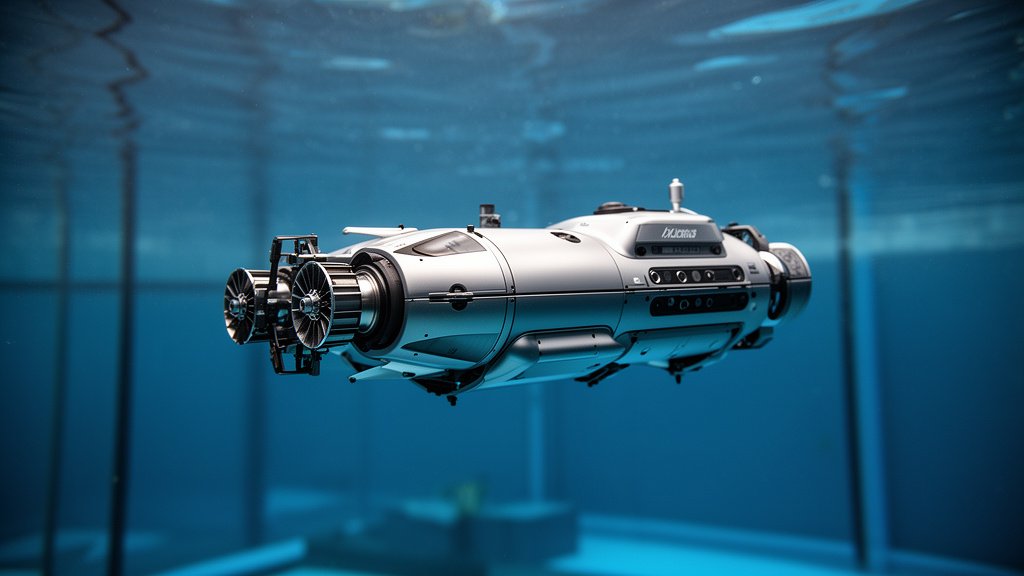
Purdue University engineers have unveiled a compact underwater robot capable of switching between three distinct locomotion modes—drifting, gliding, and thruster-driven—to maximize efficiency and mission success in complex underwater environments. This breakthrough addresses one of the most persistent challenges in marine robotics: the trade-off between energy consumption, speed, and endurance.
Key Highlights
- Triple-Mode Efficiency: The robot autonomously toggles between passive drifting, energy-saving gliding, and high-precision thruster-driven navigation.
- Extended Mission Duration: By utilizing ocean currents and buoyancy-driven gliding, the vehicle significantly reduces power drain compared to traditional propeller-only systems.
- Enhanced Reliability: The adaptable nature of the craft allows it to survive in challenging environments where single-mode robots might fail due to battery depletion or mechanical stress.
Advancing the Frontier of Autonomous Marine Exploration
For decades, Autonomous Underwater Vehicles (AUVs) have been the backbone of deep-sea research, defense monitoring, and climate study. However, the traditional AUV design has long been trapped by a rigid mechanical limitation: the reliance on continuous active propulsion. A propeller-driven robot is agile, but it is also a massive energy consumer. Conversely, passive gliders are energy-efficient but lack the precision required for navigating tight coastal corridors or reacting to sudden obstacles. The latest innovation from Purdue University’s School of Mechanical Engineering breaks this dichotomy, introducing a hybrid platform that functions effectively in three distinct physical states.
The Engineering Behind the Triple-Threat System
The secret to this robot’s versatility lies in its sophisticated buoyancy and thrust control system. The Purdue team, leveraging advanced fluid dynamics and control theory, designed the craft to utilize the ocean’s natural environment rather than constantly fighting against it.
In ‘drifting’ mode, the robot mimics floating debris, allowing it to move passively with the current. This mode consumes virtually zero power, preserving the onboard battery for critical operations. When it needs to cover ground across a wider basin, the robot shifts into ‘gliding’ mode. By adjusting its internal buoyancy, the craft uses a sawtooth flight pattern through the water column, utilizing minimal energy to traverse large distances. Finally, when the mission requires precise maneuvers—such as inspecting underwater infrastructure, identifying biological signatures, or navigating through complex reef systems—the robot engages its ‘thruster-driven’ mode. This transition is seamless, governed by an onboard algorithm that monitors battery levels, mission urgency, and the immediate hydrographic environment.
Addressing the Energy-Endurance Paradox
In the realm of oceanography, the ‘endurance gap’—the inability to stay at sea for weeks or months while maintaining active sensing capabilities—is a billion-dollar problem. Marine research organizations and military bodies often spend substantial budgets on deployment and recovery logistics. Every time a ship must launch to retrieve a robot for recharging, costs skyrocket.
The Purdue innovation offers a solution to the energy-endurance paradox. By utilizing a hybrid approach, the robot can remain in the water for significantly longer durations than its predecessors. This extension of ‘time-on-station’ is a massive leap forward for climate researchers monitoring changing ocean temperatures or oceanic acidification. The ability to drift or glide during long-range transit means that when the robot arrives at a target, it still possesses the energy reserves to conduct high-fidelity, high-power sensor analysis.
Implications for Global Marine Science and Defense
Beyond simple data collection, this technology holds significant weight for national security and international maritime law. Reliable underwater monitoring is essential for tracking unauthorized vessel movement, securing subsea communication cables, and ensuring environmental compliance in restricted waters. Traditional systems often lack the ‘stealth’ or the stamina required for these tasks.
Furthermore, this development signals a shift toward ‘Swarm Robotics.’ If one hybrid robot can achieve this level of efficiency, the deployment of a fleet—or a swarm—of these units becomes a viable strategic asset. A network of low-cost, high-endurance Purdue-designed robots could potentially blanket large swathes of the ocean, creating a persistent, dynamic surveillance and data-gathering grid that was previously only achievable with significantly larger, more expensive assets.
Historical Context: The Evolution of AUVs
To appreciate the scale of this breakthrough, one must look at the history of marine robotics. Early AUVs were essentially torpedo-shaped thruster systems: heavy, loud, and battery-hungry. While effective for short-duration surveys, they were incapable of long-term presence. The introduction of buoyancy gliders in the early 2000s changed the game by offering months of operation, but they were notoriously ‘dumb’—drifting with the currents with limited ability to maneuver against them or respond to localized events.
The Purdue robot represents the third generation of AUV architecture: the ‘Multi-Modal Intelligent Vehicle.’ By marrying the navigational authority of a thruster with the persistence of a glider, Purdue engineers are effectively merging two separate branches of the marine robotics evolutionary tree. This isn’t just an incremental update to a propeller; it is a fundamental rethinking of how a robot should interact with the ocean.
FAQ: People Also Ask
Q: How does the robot switch between its three modes?
A: The robot uses an intelligent onboard controller that manages internal buoyancy bladders for gliding/drifting and electronic speed controllers for the thrusters. The software automatically switches modes based on pre-programmed mission goals and real-time power consumption metrics.
Q: What is the primary benefit of this system over traditional AUVs?
A: The primary benefit is energy efficiency. By switching to passive modes (drifting and gliding) during transit, the robot saves its battery capacity for high-effort tasks, allowing it to stay in the field for much longer periods than standard thruster-only vehicles.
Q: Can this robot operate in extreme weather conditions?
A: While no autonomous vehicle is immune to extreme deep-sea conditions, the ability to switch to a ‘drifting’ mode allows the robot to act as a resilient, low-profile object in rough seas, potentially surviving conditions that would cause mechanical failure or power loss in a robot fighting to stay on a fixed, rigid path.
Q: When will this technology be available for commercial use?
A: Purdue University typically advances these technologies through research phases, often collaborating with industry partners for field testing. While specifics on a commercial launch date are not yet public, this technology marks a significant step toward scalable, modular underwater platforms for commercial and research sectors.