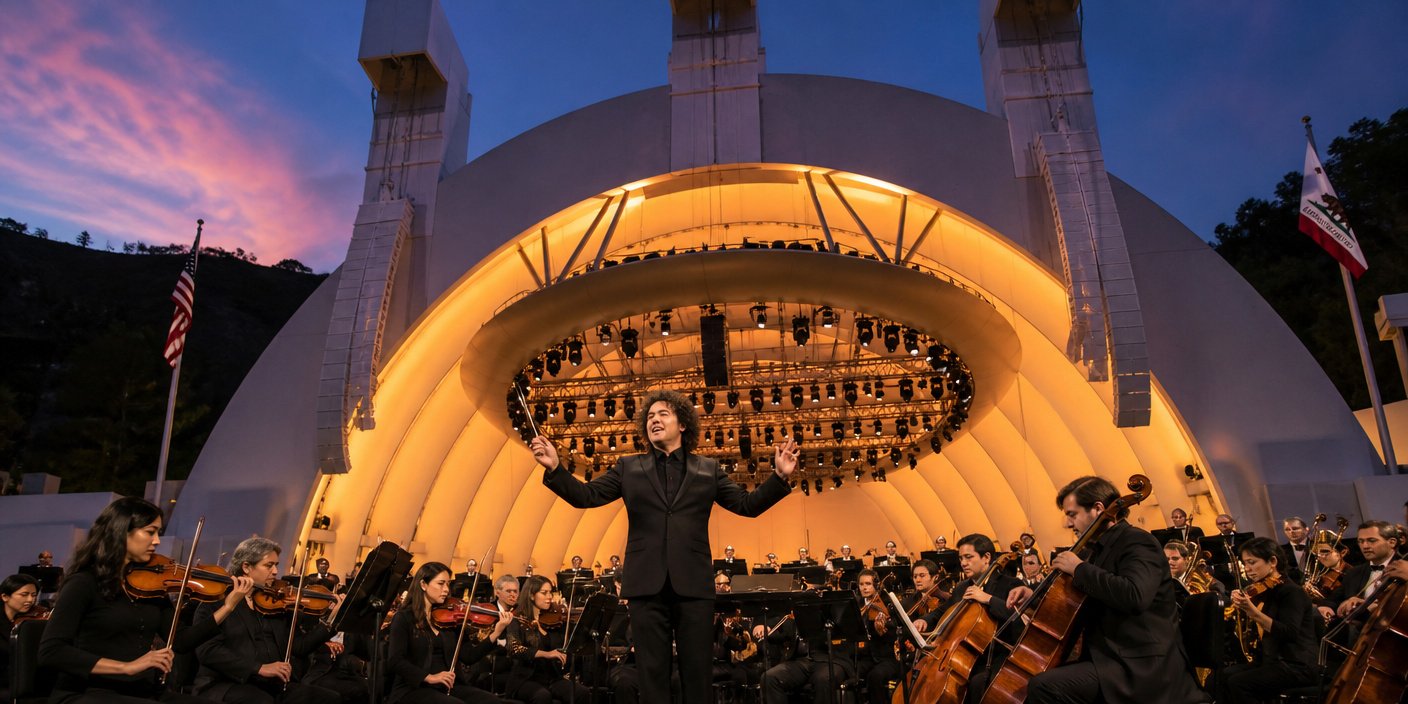
Gustavo Dudamel has officially concluded his monumental 17-season tenure as the Music Director of the Los Angeles Philharmonic, marking the end of an era that redefined the landscape of American orchestral music. The conductor, known for his infectious energy and revolutionary approach to community engagement, orchestrated a four-night concert series at the legendary Hollywood Bowl to bid a final, public farewell to the city that became his second home.
Key Highlights
- 17-Year Tenure: Dudamel concludes his historic run as Music Director, having transformed the LA Phil into one of the world’s most progressive and accessible orchestras.
- Four-Night Extravaganza: The farewell series featured a curated program designed to showcase the breadth of the orchestra’s versatility, culminating in a sold-out finale.
- The Beethoven Finale: The residency ended with an emotionally charged performance of Beethoven’s Ninth Symphony, a work deeply symbolic of humanity and joy.
- Orchestral Legacy: Dudamel leaves behind a legacy of expanded digital initiatives, deep community integration through Youth Orchestra Los Angeles (YOLA), and increased international acclaim.
A Legacy Defined by Joy and Connection
The four-night residency at the Hollywood Bowl was not merely a series of concerts; it was a curated retrospective of a tenure that fundamentally shifted how Los Angeles interacts with classical music. When Dudamel arrived in 2009, there was a palpable sense of anticipation for a new kind of leadership. Over the course of nearly two decades, he delivered on that promise, dismantling the ivory tower of orchestral tradition and replacing it with a model of radical inclusion.
The Mechanics of the Residency
The programming choice for these final nights was deliberate. Dudamel selected pieces that reflected his own eclectic taste and his commitment to highlighting both the canon of Western classical music and contemporary voices. The logistics of moving thousands of patrons through the Hollywood Bowl for four consecutive nights is an operational feat, but the atmosphere remained intimate. Audience members reported a unique sensation: despite the massive size of the venue, the rapport between Dudamel and the ensemble created a sense of proximity that is rare in such a setting.
Each night served as a different chapter in his narrative. While the earlier nights explored symphonic depth and rhythmic precision, the final evening served as the climax. By selecting Beethoven’s Ninth Symphony—often referred to as the “Choral” symphony—Dudamel underscored his core philosophy: music as a universal language of brotherhood and collective human experience. The inclusion of the full choir and soloists in the open-air acoustic of the Bowl provided a visceral sonic experience that resonated across the hills.
The Evolution of the Los Angeles Philharmonic
To understand the significance of this farewell, one must look back at the institution Dudamel inherited. In 2009, the LA Phil was already a highly respected organization, but under his baton, it evolved into a cultural engine. He brought the “Sistema” method of music education to Los Angeles, creating the Youth Orchestra Los Angeles (YOLA), which has since provided free instruments and rigorous training to thousands of students from underserved communities.
Digital Transformation and Global Reach
Another critical pillar of his tenure was the embrace of digital technology. Long before the industry was forced to pivot during the pandemic, Dudamel was already experimenting with digital broadcasts and innovative ways to capture the visual spectacle of an orchestra in motion. His tenure saw the creation of the Sound/Stage digital platform, ensuring that the excellence of the LA Phil was not confined to the walls of the Walt Disney Concert Hall but was accessible globally. This approach set a benchmark for other cultural institutions, proving that digital accessibility does not dilute artistic quality.
Secondary Angles: The Path Ahead
1. The Post-Dudamel Transition
With the baton now passed, the organization faces the challenge of succession. The LA Phil is an institution that prioritizes identity and innovation, and the search for the next Music Director is undoubtedly being conducted with an eye toward maintaining the momentum Dudamel generated. The question remains: can the next leader maintain the same balance of high-art excellence and community grassroots connection?
2. Economic and Cultural Impact on Los Angeles
Dudamel’s departure is also an economic shift for the city. As a high-profile cultural ambassador, his presence elevated Los Angeles as a destination for international tourism centered around the arts. The Hollywood Bowl residencies alone generated significant revenue for the surrounding community, and his departure marks a shift in how the city markets its cultural offerings on the world stage.
3. The Shift in Classical Programming
Finally, the departure signifies a turning point in programming trends. Dudamel was a champion of Latin American composers and contemporary works. His legacy is one that successfully integrated “pop” sensibilities with traditional forms. Future directors will now have to decide whether to double down on this contemporary, genre-blending approach or return to a more traditionalist curation.
FAQ: People Also Ask
Q: What is next for Gustavo Dudamel after his LA Phil tenure?
A: Gustavo Dudamel has announced his transition to the New York Philharmonic, where he is slated to take on the role of Music and Artistic Director. This move is widely considered one of the most significant leadership changes in the history of American orchestral music.
Q: Why was the performance of Beethoven’s Ninth significant?
A: Beethoven’s Ninth is considered the pinnacle of the symphonic repertoire. Its message of universal brotherhood and hope served as the perfect thematic closing statement for Dudamel, whose entire tenure focused on connecting people through music.
Q: Did this concert mark his final performance ever in Los Angeles?
A: While this marked the end of his tenure as Music Director, the relationship between Dudamel and Los Angeles remains strong. It is widely anticipated that he will return as a guest conductor in future seasons, though he will no longer hold the permanent administrative and artistic responsibilities associated with the Music Director title.
Q: What impact did Dudamel have on YOLA (Youth Orchestra Los Angeles)?
A: YOLA became a flagship program under Dudamel’s leadership. He championed it as a vehicle for social change, proving that an orchestra’s duty extends beyond the concert hall to the active cultivation of the next generation of musicians and citizens.