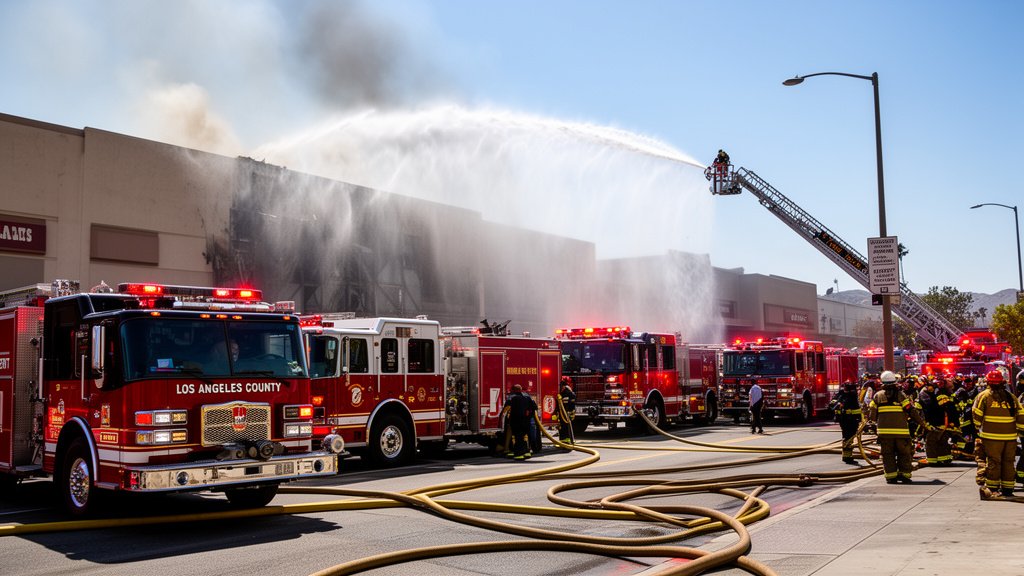
In a display of rapid tactical deployment, over 100 firefighters from the Los Angeles County Fire Department (LACoFD) are currently engaged in a intense third-alarm structural fire within the historic Newhall district of Santa Clarita. The blaze, which broke out earlier today, has successfully been prevented from further rapid expansion despite the significant challenge posed by the density of the impacted commercial corridor. Residents and commuters are advised to avoid the area, as significant road closures have been implemented to allow heavy emergency apparatus to maneuver effectively and safely.
Key Highlights
- Massive Response: More than 100 specialized personnel, including engine and truck companies, are actively operating at the scene.
- Third-Alarm Status: The incident was escalated to a third-alarm status, a designation typically reserved for large-scale structure fires requiring significant resource allocation and regional support.
- Strategic Containment: Emergency crews are employing defensive tactics to isolate the fire to the primary affected structures and prevent further spread to adjacent business blocks in the Newhall area.
- Ongoing Impact: Major transit arteries and streets surrounding the site remain closed to the public to facilitate emergency operations.
Anatomy of a Structural Crisis: The Newhall Operation
The declaration of a third-alarm fire in the Newhall area triggered a massive pre-planned response from the Los Angeles County Fire Department. This specific classification—the ‘third alarm’—is not merely an indicator of fire size, but a strategic categorization that mandates the automatic dispatch of additional battalion chiefs, specialized truck companies, and urban search and rescue units to the scene. As the fire progressed through the initial stages, incident commanders shifted from aggressive interior offensive operations to a defensive exterior posture to ensure the structural integrity of neighboring facilities and the safety of the firefighters themselves.
Tactical Firefighting in Dense Commercial Corridors
Firefighting in a built-up commercial zone like Newhall presents a unique set of hazards. Unlike suburban residential fires, commercial fires often involve varying ceiling heights, complex electrical and HVAC systems, and hazardous materials associated with the businesses housed within. The primary tactical goal currently is ‘exposure protection’—a technique where water streams are directed not just at the primary fire, but at the roofs and walls of nearby structures that are at immediate risk of radiant heat ignition. Fire command is utilizing aerial ladder pipes to create a water curtain, effectively shielding the remaining businesses from the intense thermal output of the main structure.
The Economic Ripple Effect on Santa Clarita
The Newhall business corridor is a vital economic hub for the Santa Clarita Valley. The impact of this fire extends far beyond the immediate physical damage. For local small business owners, the current uncertainty presents a significant hurdle. Interrupted utility services and structural damage assessments will likely keep this section of the district closed for an extended period, creating an immediate economic bottleneck for the area. The Santa Clarita Valley Sheriff’s Station is coordinating closely with LACoFD to secure the perimeter, ensuring that non-essential traffic remains clear while business owners wait for updates on insurance and remediation logistics.
Secondary Angles: Resilience and Future Risk Mitigation
This incident serves as a critical case study for urban fire resilience in Santa Clarita.
1. Urban-Wildland Interface (WUI) Dynamics: While this incident is structural, Santa Clarita is uniquely positioned in a high-risk WUI area. The professional response today highlights the necessity of maintaining high-readiness teams that are equally adept at fighting structural conflagrations and preventing sparks from transitioning into wildland fires during high-heat periods.
2. Aging Infrastructure and Fire Codes: Many of the older commercial buildings in the Newhall area face challenges regarding modern fire suppression technologies. This event will likely lead to renewed municipal conversations regarding retrofitting older structures with upgraded sprinkler systems and fire-rated barriers, potentially shifting local building inspection policies.
3. Post-Fire Remediation and Community Recovery: The long-term recovery of a business block is often complex. Experts in structural engineering and environmental remediation will be required to assess the integrity of the affected buildings before any business can return to operation. The speed of this recovery will be a litmus test for the city’s economic development resilience.
FAQ: People Also Ask
Q: What is a third-alarm fire and what does it mean for the community?
A: A ‘third alarm’ is a designation used by fire departments to indicate the scale of resources dispatched to an incident. It essentially signifies that the initial responders require significant additional backup, often including specialized equipment and personnel from multiple stations, to gain control of the fire.
Q: Are there any reported injuries from the Santa Clarita fire?
A: As of the latest reports, the focus remains on containment and protecting exposures. Updates regarding personnel and civilian safety will be provided by official LACoFD press briefings as the situation stabilizes.
Q: When will the road closures in Newhall be lifted?
A: Road closures remain in effect to allow emergency vehicles to access the scene without obstruction. Authorities have not yet set a timeline for reopening these roads, as that decision depends entirely on the progress of fire suppression and the subsequent safety assessment of the area.