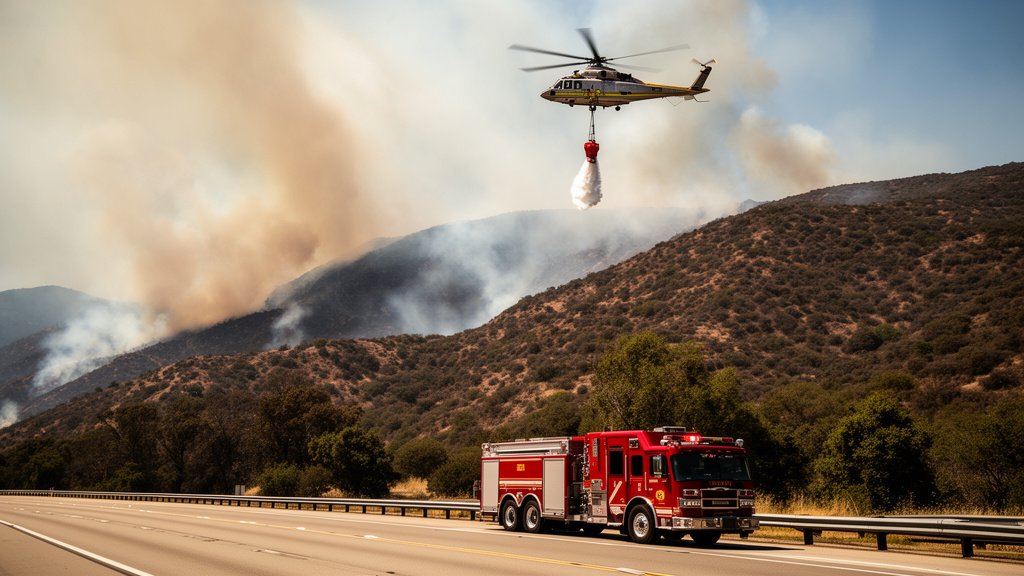
Emergency crews are battling a brush fire that erupted near the Newhall Pass in Santa Clarita on Friday afternoon. Officials have issued evacuation orders for the surrounding area as the fire spreads near the North Sierra Highway, forcing local authorities to mobilize rapid response teams to protect homes and essential infrastructure. The situation remains fluid as winds drive the blaze toward residential zones, creating a critical scenario for public safety officials.
Key Highlights
- Immediate Threat: A rapidly growing brush fire has triggered mandatory evacuation orders for residents living near the Newhall Pass and North Sierra Highway corridor.
- Emergency Response: Multiple agencies, including CAL FIRE and the Los Angeles County Fire Department, are coordinating aerial and ground-based suppression efforts.
- Critical Infrastructure: The fire is threatening a key regional transit artery, raising concerns about traffic flow and emergency access in the Santa Clarita Valley.
- Public Safety: Local authorities have established safe zones and are urging residents to follow all directives from law enforcement immediately.
Crisis in the Canyon: The Escalation at Newhall Pass
The ignition of the fire on Friday afternoon has tested the emergency readiness of the Santa Clarita region. As plumes of smoke rise over the Newhall Pass, the intersection of natural vegetation and urban development presents a complex challenge for containment. The fire, which reportedly started in close proximity to the North Sierra Highway, has moved aggressively due to dry conditions, requiring an all-hands-on-deck approach from regional firefighting units.
The Anatomy of the Response
When a brush fire breaks out in this specific corridor, the primary objective is containment before the blaze hits the major interchange. CAL FIRE, in collaboration with local Los Angeles County units, has deployed “initial attack” resources. These resources typically include specialized wildland engines, water tenders, and tactical aircraft. Aerial support, such as helicopters equipped with water-dropping buckets or “helitack” teams, is essential in the initial stages to box in the fire and prevent it from jumping containment lines or reaching residential pockets located in the rugged terrain of the Santa Clarita Valley.
Infrastructure and the Newhall Pass Corridor
The Newhall Pass is more than just a geographic landmark; it is a critical artery connecting the Santa Clarita Valley to the Greater Los Angeles basin. For commuters and logistics fleets, this pass is the lifeline of daily commerce. A fire of this nature creates two distinct problems: the immediate risk to property and the secondary, severe disruption of transportation. When major highways near the pass are compromised, it disrupts the movement of essential services, including ambulances and police, and traps civilians in congestion, making evacuation maneuvers significantly more dangerous. Urban planners and fire safety experts have long identified this specific area as a high-risk zone for rapid fire spread, necessitating the aggressive tactical response observed today.
The Science of Suppression in Santa Clarita
Fighting fires in the Santa Clarita landscape requires a specific tactical methodology. The topography—characterized by steep canyons and dry, chaparral-covered hills—acts as a chimney for flames. As heat rises, it pulls oxygen into the fire, accelerating the rate of spread. Firefighters are employing “direct attack” methods, working at the fire’s edge, while simultaneously scouting for “indirect attack” opportunities, such as using existing roadways like the North Sierra Highway as natural firebreaks. The success of these efforts hinges on wind conditions; as of this report, changing wind speeds are the primary variable determining whether containment can be achieved before nightfall.
Climate and Vegetation Context
The Santa Clarita region, like much of Southern California, is susceptible to these events due to the unique convergence of seasonal winds and native fuel loads. The chaparral vegetation is highly flammable, especially during dry spells. This incident serves as a stark reminder of the “wildland-urban interface” problem. As residential developments push further into wildland areas, the cost of protection, the complexity of evacuations, and the ecological impact of fire mitigation efforts have all risen. It is a balancing act between environmental stewardship, urban growth, and public safety.
Future Resilience and Mitigation
What happens after the smoke clears is just as important as the suppression itself. The recovery phase involves assessing damage, rehabilitating the scorched earth to prevent mudslides, and revising evacuation plans for the future. Following the events of this Friday, authorities are expected to conduct a full after-action review. This will likely include analyzing the “ignition timing” and whether fuel management programs (such as controlled burns or vegetation thinning) in the Santa Clarita hills were sufficient to prevent this event from escalating further. The resilience of the community depends on robust infrastructure, early detection systems, and a public that is educated on the risks of living in high-fire-severity zones.
FAQ: People Also Ask
Why are evacuations ordered so quickly in Santa Clarita?
Evacuations are ordered preemptively to ensure that traffic congestion does not trap residents. Given the geography of the Newhall Pass, exit routes are limited; moving residents out early ensures that emergency vehicles can access the fire lines without being blocked by fleeing traffic.
How does the Newhall Pass location affect firefighting strategy?
Because the pass is a major transit node, firefighting efforts must be twofold: suppressing the blaze while also coordinating with law enforcement to manage highway traffic and prevent gridlock that could endanger civilians.
What should residents do if they see smoke near the North Sierra Highway?
Residents should immediately monitor local news and the Los Angeles County Fire Department’s official social media channels. If an evacuation warning is issued, begin gathering essential documents, medications, and pets, and prepare to leave. Do not wait for an order to become mandatory if you feel unsafe.
Are there specific agencies leading the containment effort?
Yes, the effort is primarily led by the Los Angeles County Fire Department and CAL FIRE. These agencies coordinate closely with local law enforcement, such as the Santa Clarita Sheriff’s Station, to manage the perimeter and ensure public safety.