A devastating accident on the Angeles Crest Highway (Hwy 2) has claimed one life and resulted in serious injuries to three survivors, further compounding the tragedy as a Pasadena firefighter sustained injuries while performing a technical rescue on the perilous mountain terrain. The incident, which unfolded over the last 24 hours, serves as a grim reminder of the extreme risks associated with navigating Southern California’s rugged high-altitude roadways and the inherent dangers emergency responders face during complex mountain recovery operations.
Key Highlights
- Fatal Plunge: One fatality confirmed after a vehicle departed the roadway and plummeted over the side of the Angeles Crest Highway.
- Survivor Status: Three additional occupants sustained injuries and were transported for medical treatment.
- Rescuer Injured: A Pasadena Fire Department firefighter was injured during the technical rescue mission, highlighting the hazardous conditions of the terrain.
- Complex Rescue: The operation required high-angle rescue protocols, involving coordinated mutual aid between local fire agencies and specialized SAR teams.
Anatomy of a Mountain Tragedy on Highway 2
The Angeles Crest Highway is renowned globally for its winding turns, steep drop-offs, and spectacular vistas, but it remains one of the most unforgiving stretches of road in Southern California. The recent incident has once again brought the logistical challenges of this specific geography to the forefront. When a vehicle leaves the roadway in this region, the response is rarely a standard roadside assistance call; it is a full-scale, high-angle rescue operation that tests the limits of equipment and personnel.
The Logistics of High-Angle Recovery
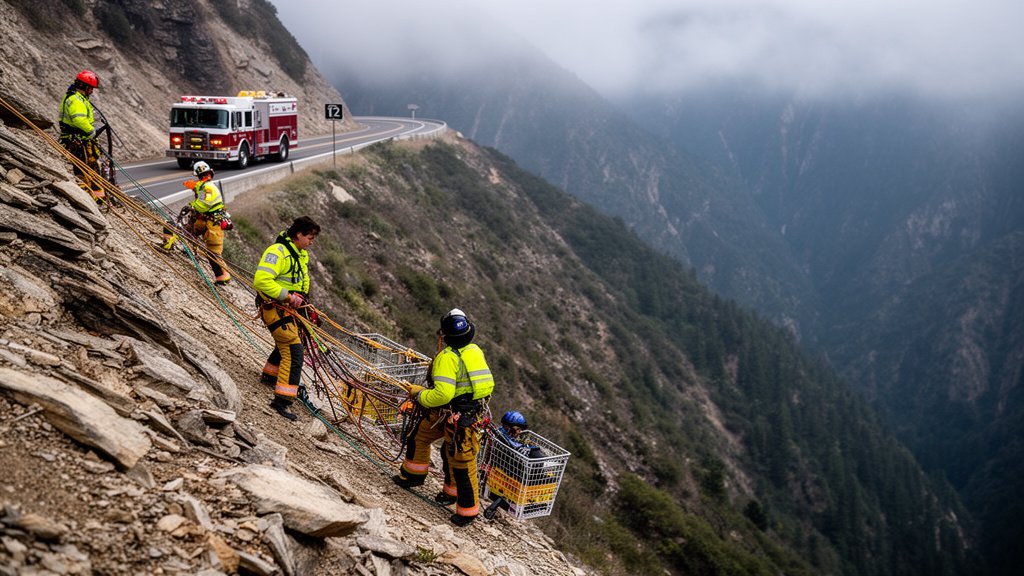
In mountainous terrain, such as the areas surrounding mile markers on Hwy 2, the recovery of victims requires the deployment of specialized gear, including rope systems, basket stretchers, and, occasionally, helicopter long-line extractions. When the Pasadena Fire Department and collaborating agencies arrived at the scene, they were met with a severe slope and limited visibility. These rescues are time-sensitive, as the difference between life and death often hinges on the speed at which a victim can be extricated and transported to a trauma center. However, the terrain that endangers civilians also poses a direct threat to the rescuers themselves. Loose gravel, sheer drops, and the physical exhaustion of carrying equipment over uneven, unstable ground create a precarious environment where even the most experienced professionals are vulnerable to injury. The injury sustained by the Pasadena firefighter during this operation underscores that these first responders are entering an inherently hostile environment to save others.
Mutual Aid and Emergency Coordination
This incident relied heavily on the concept of ‘mutual aid’—the formal agreement where different agencies (such as Pasadena Fire, Los Angeles County Fire Department, and the California Highway Patrol) support one another during large-scale incidents. Because the Angeles Crest Highway spans vast areas of the Angeles National Forest, it often falls within the jurisdiction of multiple agencies. The seamless integration of these teams is essential for managing scenes that are too complex for a single department to handle. Following the injury of the firefighter, protocols dictated a rapid pivot: while continuing the extrication of the crash victims, the teams also had to manage the immediate medical stabilization and evacuation of their own comrade, a scenario that exponentially increases the stress and complexity of the mission.
Infrastructure and Human Factors
The Angeles Crest Highway is not only a tourist destination but a critical artery for local transit, and it has historically been the site of numerous accidents due to speed, intoxication, or the simple difficulty of the road’s design. From a structural standpoint, the road lacks modern protective barriers in many stretches due to the sheer cost and engineering difficulty of anchoring steel or concrete into the mountainside. Secondary angles of this story involve the ongoing debate regarding road safety improvements. Should the state invest more heavily in guardrails and improved signage, or does the nature of the terrain essentially dictate a level of risk that drivers must inherently accept? Furthermore, the psychological toll on first responders who repeatedly engage in these high-stakes rescue efforts cannot be understated. Following the treatment of the injured firefighter, the focus shifts to internal support structures within the fire department to address both the physical recovery and the mental resilience required to return to duty.
The Ongoing Investigation
While the rescue mission has concluded, the investigation into the cause of the plunge remains active. California Highway Patrol (CHP) investigators are meticulously examining the crash site for skid marks, debris patterns, and mechanical evidence to determine if excessive speed, environmental conditions, or a mechanical failure triggered the vehicle’s departure from the road. The final report will likely be cross-referenced with toxicology reports and vehicle maintenance records to provide a complete picture for the victims’ families.
FAQ: People Also Ask
Q: Why is the Angeles Crest Highway considered so dangerous for drivers?
A: The highway features extremely narrow lanes, hundreds of sharp hairpin turns, significant elevation changes, and minimal to zero shoulder space in many areas. These factors, combined with the lack of modern safety barriers and unpredictable weather, make it one of the most challenging drives in the state.
Q: How do technical rope rescues work in these scenarios?
A: When a vehicle falls over an embankment, rescuers must anchor ropes to stable points (like fire trucks or trees) and rappel down the slope. They then secure the victims into litters or stokes baskets to be hoisted up the embankment using mechanical advantage systems, a process that is physically grueling and highly technical.
Q: What is a mutual aid agreement in this context?
A: It is a contractual agreement where the Pasadena Fire Department, Los Angeles County Fire, and other local agencies agree to assist each other during emergencies. This ensures that the best-equipped personnel—such as those trained in high-angle search and rescue—are available regardless of which specific jurisdiction the accident occurred in.
Q: Are there plans to make the Angeles Crest Highway safer?
A: Caltrans conducts ongoing assessments of the roadway. However, upgrading safety infrastructure like guardrails on such steep terrain is financially and engineeringly prohibitive in many sections, leaving driver caution as the primary safety mechanism.