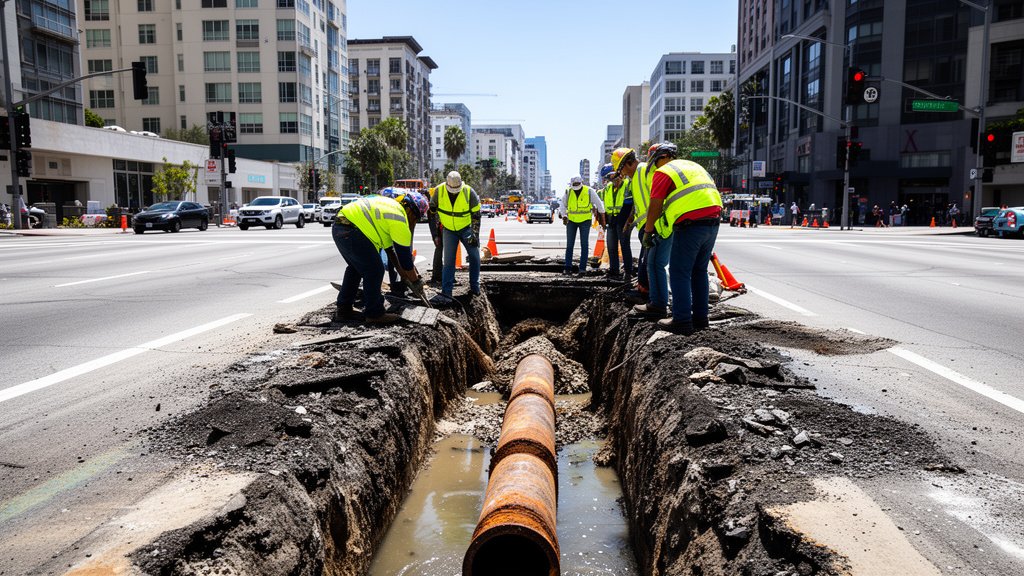
Los Angeles’ underground infrastructure is reaching a breaking point, with aging, century-old pipes failing at an alarming frequency across the city. Following a massive disruption on July 17, a secondary critical leak on July 23 at Santa Monica Boulevard and Laurel Avenue highlights the precarious nature of the city’s essential utility backbone. For the Los Angeles Department of Water and Power (LADWP) and the millions of residents relying on this grid, the reality is that the ‘public servants’ keeping the city hydrated—the vast network of subterranean pipes—are 80, 90, and in many cases, over 100 years old, creating a growing public safety and economic crisis.
Key Highlights
- Immediate Infrastructure Strain: Major water main breaches occurred on July 17 and July 23, 2024, causing localized flooding and significant traffic disruptions.
- The Centennial Problem: Much of the L.A. pipe network was laid in the early 20th century; these iron conduits have exceeded their expected lifespan by decades.
- Reactive vs. Proactive: The city is currently caught in a cycle of emergency repairs rather than systemic replacement, leading to inflated operational costs.
- The Geographic Challenge: The combination of aging subterranean cast iron and the city’s seismic activity creates a ‘perfect storm’ for water infrastructure failure.
The Centennial Crisis Beneath the Asphalt
When citizens of Los Angeles turn on their faucets, they rarely consider the ancient metal arteries running beneath their feet. Yet, the events of July 2024 have forced this hidden reality into the public consciousness. On July 17, a massive water main break sent water cascading through streets, followed just six days later by another significant failure at the intersection of Santa Monica Boulevard and Laurel Avenue. These incidents are not anomalies; they are the symptom of an urban system pushed far beyond its intended engineering limits.
Anatomy of an Ancient System
Much of Los Angeles’ water infrastructure dates back to a period of rapid expansion in the 1920s and 1930s. Engineers of that era utilized cast iron piping, which was the gold standard of the day. However, metal pipe technology has evolved significantly since then. Modern ductile iron and high-density polyethylene (HDPE) pipes offer superior flexibility and corrosion resistance, properties the original century-old pipes lack.
As these older pipes sit in the soil, they are subjected to fluctuating soil moisture, the immense pressure of the city’s weight, and the subtle, constant grinding of seismic activity common to the Los Angeles basin. Over time, the structural integrity of this cast iron degrades. The pipe walls thin, and the joints—the weakest points in any distribution network—become susceptible to separation. When a pipe that has been in the ground for 100 years finally fails, it doesn’t just leak; it often ruptures catastrophically, as seen in the recent July incidents.
The Economic Toll of Reactive Maintenance
There is a profound economic difference between proactive infrastructure management and the reactive ‘break-fix’ cycle currently plaguing the LADWP. When a pipe bursts, the costs are exponential. They include emergency overtime for utility crews, the cost of asphalt and road reconstruction, potential damage to private property, and the lost value of the wasted water.
Furthermore, the logistical nightmare of shutting down major arteries like Santa Monica Boulevard during a pipe repair creates a ripple effect of economic loss. Traffic delays, lost productivity, and the frustration of local business owners add ‘hidden’ costs to every burst pipe. Urban planners argue that the city is currently ‘paying the interest’ on deferred maintenance. Replacing a section of pipe as part of a planned capital improvement project is significantly cheaper than the emergency response necessitated by a sudden rupture.
Engineering the Future: Beyond Ductile Iron
Moving forward, the challenge for Los Angeles is two-fold: replacing existing infrastructure and building new lines that can withstand the unique challenges of the 21st century. Innovations in trenchless technology now allow utility crews to reline existing pipes or install new ones with minimal surface disruption. This is critical in a high-density, high-traffic environment where digging up an entire block is often impossible.
Additionally, the integration of smart sensors and acoustic monitoring is becoming vital. These technologies can ‘listen’ for the vibrations of a developing leak before it becomes a massive blowout, allowing the city to transition from a reactive posture to a predictive one. However, the sheer scale of the network—stretching thousands of miles—means this technological rollout will take decades to complete. Until then, the citizens of L.A. remain reliant on the aging, subterranean workforce that has served the city for a century, but is now showing its age.
FAQ: People Also Ask
Q: Why do these pipes break in the summer months like July?
A: While pipe failures occur year-round, increased water demand during summer months places higher pressure on the system. Additionally, soil expansion and contraction due to heat can shift the ground, putting extra stress on brittle, 100-year-old iron pipes.
Q: Are these water main breaks dangerous for drinking water quality?
A: When a water main breaks, the drop in pressure can theoretically allow contaminants from the surrounding soil to enter the water supply. The LADWP typically issues ‘boil water’ advisories if they detect any drop in pressure that could compromise safety, ensuring the public is protected until testing confirms the water is clean.
Q: Is the city doing anything to replace these pipes?
A: Yes, the LADWP has ongoing capital improvement projects to replace aging cast iron pipes with modern alternatives. However, the scale of the city’s network and the difficulty of working under active, congested streets mean this is a long-term, multi-generational process.
Q: Who pays for the repair of these water mains?
A: Repairs are funded through the LADWP, which is a public utility. Operating costs, including infrastructure maintenance, are primarily covered by customer water rates, making infrastructure resilience a direct matter of public utility pricing.